Tag Archives land rights

A revolution for land and life in Colombia – and the world

By Posted on 1878 views

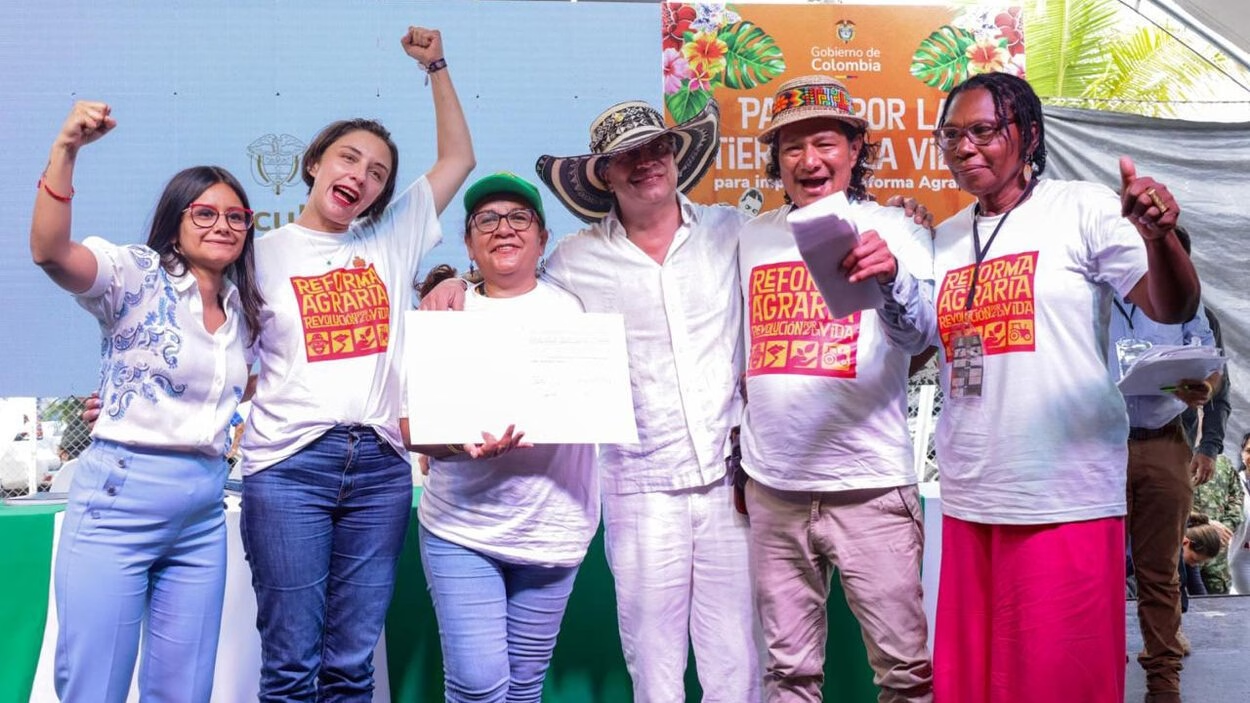
Colombian President Gustavo Petro signs a Pact for Land and Life; Revolution for Life, committing to carry out land redistribution, restitution, and recognition to enable rural working people to pursue economically and ecologically regenerative livelihoods. In this blog, Prof. Jun Borras and Itayosara Herrera discuss the implications of this pact.

Photo Credit: Ministry of Agriculture, Colombia

In February 2025, in Chicoral, Tolima, Colombia, 5,000 campesinos, Afrodescendants, Indigenous and government officials gathered for two days, and made a pact: Pacto fpr la Tierra y la Vida – Pact for Land and Life; Revolution for Life. The 12-point agreement signed by President Gustavo Petro and representatives of grassroots social movements revolved around the commitment to carry out land redistribution, restitution, and recognition to enable rural working people to pursue economically and ecologically regenerative livelihoods, with meaningful representation. The Chicoral event tries to undo a past in Colombia, and confronts a difficult challenge in the present world.

Undoing the past

In 1972 in Chicoral, landed elites and traditional political parties conspired to dismantle the 1960s redistributive land reform. They pushed to relax the criteria for defining unproductive land and inadequate land use to effectively avoid expropriation. This agreement became known infamously as the Pacto de Chicoral. It marked the definitive burial of Colombia’s redistributive land reform. It was, in essence, a pact of death—the death of land reform in Colombia—whose consequences continue to shape society today. Instead of redistribution, Colombia experienced more than half a century of counter-land reform, which led to increased violence in rural areas and the unprecedented expansion of the agricultural frontier with internal colonization in lieu of redistribution. This would also contribute to the rise of coca cultivation under the control of narco syndicates. Ultimately, it fed into the divide-and-rule strategy of the elites toward campesinos, Indigenous, and Afrodescendants.

Chicoral2025 is historic as it flips Chicoral1972: from the death of land reform to a commitment to redistributive land policies. It is ground-breaking as it is a pledge for a common front of struggles for land among campesinos, Afrodescendants and the Indigenous, aspiring to put an end to the divide-and-rule tactic employed by counter-reformists.

Confronting current challenges

The contemporary climate of land politics is extremely hostile to redistributive land policies, reflected in the continuing global land grabs. The condition is marked a global consensus among reactionary forces celebrating land grabbing, while maligning redistributive land reforms, as exemplified in Trump’s plan for the Gaza land grab while rejecting a modest liberal land reform in South Africa that land reform advocates in that country are not even happy about.

This current condition did not emerge from nowhere. It is a direct offshoot of decades of neoliberalization of land policies. The neoliberal consensus has deployed coordinated tactics.

  1. First, rolling back gains in redistributive land policies, largely through market-based economic policies hostile to small-scale farmers.
  2. Second, containing the extent of implementation of existing redistributive land policies where these exist.
  3. Third, blocking any initiative to pass new redistributive land policies in societies where these are needed.
  4. Fourth, reinterpreting existing laws and narratives away from their social justice moorings and towards free market dogmas; thus, land tenure security means security for the owners of big estates and capital.
  5. Finally, all four are being done in order to promote market-based, neoliberal land policies: justification and promotion of market-based land policies, formalization of land claims without prior or accompanying redistribution which simply ratifies what exists.
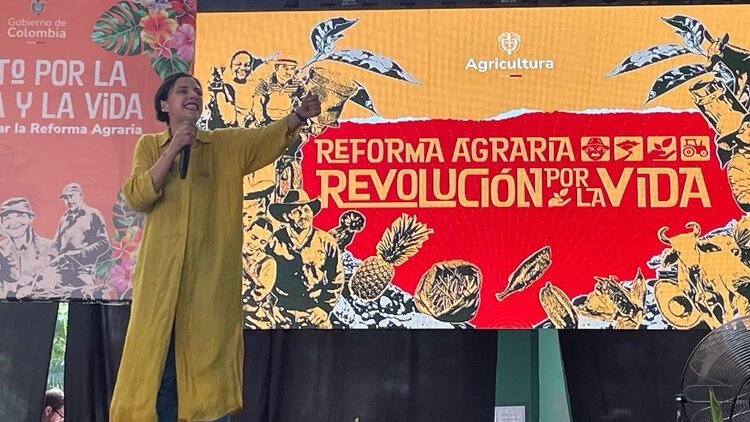
Minister of Agriculture Martha Carvajalino, Chicoral, February 2025 Photo Credit: Jun Borras

When neoliberalism gained ground in the 1980s, among the first casualties was redistributive land policies. The heart and soul of classical land reform were:

  • (a) land size ceiling, a cap to how much land one can accumulate and
  • (b) the right to a minimum access to an economically viable land size, or land for those who work it.

Today, land size ceiling is a taboo. Thus, programmes for providing minimum access to land to build-scale farms have difficulty finding land to redistribute.

During the past four decades, there have been only a handful of countries that managed to pursue redistributive land reforms: Bolivia, Brazil, Colombia, the Philippines, and Zimbabwe. Significant programs have provided collective land titles for the Indigenous such as the one in Colombia, although many of these lands are in isolated, marginal geographic spaces.

The more common accomplishments are a variety of petty reforms. Small reforms are not inherently good or bad, and they are good especially when they provide immediate relief to ordinary working people. They constitute ‘petty reformism’, a negative term, when small reforms were done in lieu of systemic deep reforms. Thus, limited land titling, formalization of land claims, and individualization and privatization of the commons – often labeled under a misleadingly vague banner: land tenure security, which is often about the security of the owners of big estates and capital.

Globalizing Chirocal2025

The need for land redistribution, restitution and recognition remains urgent and necessary, for Colombia and the world. This is even more so in the current era when dominant classes other than agrarian elites aggressively grab land from peasants and Indigenous: profiteers behind market-based climate change mitigation and adaptation strategies, corporate actors in renewable energy sector, global food system giants and financial capital. The forces against reforms have multiplied. But so as the potential forces in favour of reforms. The main alliance for redistributive land policies today is no longer limited to agrarian classes and state reformists; rather, it has to necessarily include social forces in food, environmental and climate justice, as well as labour justice, movements and struggles.

In 1979, FAO convened in Rome the World Conference on Agrarian Reform and Rural Development (WCARRD) hoping to bring new energy to global land reformism. The following year turned out to be beginning of the end of classic land reforms as neoliberalism kicked in and put an end to state-driven redistributive land policies. In March 2006, FAO convened a follow-up to WCARRD, the International Conference Agrarian Reform and Rural Development (ICARRD) in Porto Alegre, Brazil, with the goal of reviving efforts at democratizing land politics. The following year, the global land rush exploded that led to the dispossession of millions of peasants and Indigenous worldwide. In February 2026, twenty years after Porto Alegre, ICARRD+20 will be convened by the Colombian government. It is a very timely international initiative. Chicoral2025 signals what kind of agenda the Colombian government wants to emerge at ICARRD+20: a deep commitment to democratic land politics for regenerative renewal of life.

Several researchers from the ISS-based ERC Advanced Grant project RRUSHES-5 and the Democratizing Knowledge Politics Initiative under the Erasmus Professors program for positive societal impact of Erasmus University Rotterdam are engaged in the Pact for Land and Life process.

About the Authors:

Saturnino (‘Jun’) M. Borras Jr.

Saturnino (‘Jun’) M. Borras Jr. is a Professor of Agrarian Studies at the International Institute of Social Studies (ISS), The Hague. He served as Editor-in-Chief of the Journal of Peasant Studies for 15 years until 2023 and is part of the Erasmus Professor Program for Societal Impact at Erasmus University Rotterdam. He holds an ERC Advanced Grant for research on global land and commodity rushes and their impact on food, climate, labour, citizenship, and geopolitics. He is also a Distinguished Professor at China Agricultural University and an associate of the Transnational Institute. Previously, he was Canada Research Chair in International Development Studies at Saint Mary’s University (2007–2010).

Itayosara Rojas Herrera

Itayosara Rojas is a PhD Researcher at International Institute of Social Studies (ISS), Erasmus University Rotterdam. She is member of a European Research Council (ERC) Advanced Grant awarded project “Commodity & Land Rushes and Regimes: Reshaping Five Spheres of Global Social Life (RRUSHES-5)” led by Professor Jun Borras. As part of this project, Itayosara examines how the contemporary global commodity/land rushes (re)shape the politics of climate change, labour, and state-citizenship relations in the Colombian Amazon.


Are you looking for more content about Global Development and Social Justice? Subscribe to Bliss, the official blog of the International Institute of Social Studies, and stay updated about interesting topics our researchers are working on.

COVID-19 | Remembering the ongoing assassination of human rights defenders in Colombia

By Posted on 3673 views


When a peace agreement was signed in 2016 in Colombia between the government and armed forces (FARC), citizens and activists seized the opportunity to make longstanding grievances heard and press for change. But between September 2016 and March 2020, 442 social leaders were assassinated. As death becomes part of the daily discourse, especially during the COVID-19 pandemic, we should look beyond these shocking numbers and understand that the massive killing of social leaders is not only a humanitarian crisis, but also a threat to the process of social transformation and local empowerment.

Postales para la memoria

Hope for change

The peace agreement signed in 2016 in Colombia signaled change. Since the political exclusion of government dissidents and others critical of the political regime is considered to have been one of the root causes of the conflict, the agreement sought to create spaces to promote the organization and participation of diverse actors with diverse voices and included a series of provisions to strengthen the presence of the state in marginalized areas to address issues such as poverty, inequality, and unequal distribution of land. In this context, the signature of the peace agreement opened a window of opportunity for activists and citizens to present to the state their long overdue demands for changes related to such issues, which had taken the back seat during the conflict.

The persistence of violent repression

In the period shortly before the peace agreement was signed in 2016, a reduction in homicidal violence and conflict-related deaths following the de-escalation of violence seemed to signify the end of an era characterized by violence. This reduction in violent acts provided space for activists and citizens to present their demands to the state in a way that was not possible in the preceding years, when violence made mobilization riskier. However, sectors within the country not interested in peace talks started to exert violence on citizens, continuing a growing trend since 2016. Consequently, during the post-agreement period, Colombia has experienced a dramatic increase in the cases of murders and threats against social leaders. According to figures from the NGO Somos Defensores, between September 2016 and March 2020, 442 social leaders had been killed. According to a recent report of the U.N., which we analyzed in a previous article, these worrying figures situate Colombia as the country with most killings of human right defenders in Latin America.

Assassinated activists and human rights defenders were individuals linked to organizations attempting to mobilize society for the implementation of the peace accords and strengthening of statehood. Those maimed were peasant leaders, environmentalists, land defenders, women, indigenous leaders, and afro-descendants representing marginalised communities.

COVID-19: obscuring intensified killings

This trend has worsened in Colombia during the COVID-19 pandemic, as illustrated by a sharp increase in assassinations of social leaders by 53% between January and April this year[1]. However, as the attention of political leaders and citizens is focused on the response of the government to address the crisis of the COVID-19 pandemic, civil society groups fear that the assassination of community leaders will go unnoticed and unpunished. As the attention of political leaders and citizens is focused on the response of the government to protect and ensure the health of their citizens from COVID-19, groups often resorting to violence in Colombia (right-wing paramilitary groups, drug traffickers, dissident guerrilla members, and other armed organizations) are taking advantage of the pandemic to divert attention from violence that would otherwise be observed.

As people are getting used to seeing figures of death daily, it is critical to remember that we need to see beyond the numbers and understand that the massive killing of social leaders is a humanitarian crisis with different impacts. At the individual level, the right to life of the leader is violated, and at the social level, the assassinations affect the representation of collective interests, becoming a threat to the process of social change and local empowerment.

Social leaders are the voice of the communities that have been historically forgotten. Hence, when they are threatened, there is a further weakening in the social fabric of these groups. According to the testimonies of several social leaders who were interviewed in a recent study by CNC, CODHES and USAID, after an attack, the members of the community became afraid to participate, to organize, and the formation of new leaders was also obstructed. That is how the killing of social leaders has a long-term effect that impacts the deepening of democracy in Colombia, benefiting the interests of those who want to maintain the status quo and continue to use violence to do so.

The effect of the COVID-19 response on social organization

Whereas civil society has improved its capacity to hold the government accountable with regards to the assassination of social leaders, their capacity to pressure the government has been diminished due to the restrictions on gatherings due to the pandemic, and due to the focus of public opinion on the risk of COVID-19. This makes it more difficult for organizations to centre the defence of the lives of social activists in public discourse and increases the likelihood of the assassination of community leaders being obscured.

In this context, we want to contribute to an ongoing campaign started by civil society groups in Colombia to use opinion articles and other spaces of communication to raise awareness about the severity of this situation and to tell the stories of those who are at risk. As part of this initiative, the newspaper El Espectador on its front page of June 14th 2020 published a list with the names of the 442 people who have been killed with the title “Let’s not forget them” (“No los olvidemos” in Spanish). Let this become the start of a movement to continue highlighting mass killings of social leaders and to problematize them. It is not okay, and we will not accept it. #NoLosOlviDemos.

[1] In comparison with the number of assassinations taking place between January and April 2019.

This article is part of a series about the coronavirus crisis. Read all articles of this series here.

About the authors:

Fabio Andrés Díaz PabónFabio Andres Diaz Pabon is a Colombian political scientist. He is a research associate at the Department of Political and International Studies at Rhodes University in South Africa and a researcher at the ISS. Fabio works at the intersection between theory and practice, and his research interests are related to state strength, civil war, conflict and protests in the midst of globalisation.


Ana María Arbeláez Trujillo

Ana María Arbeláez Trujillo is a lawyer, specialist in Environmental Law and holds an Erasmus Mundus Master in Public Policy. She works as a legal consultant in Climate Focus, where she focuses on climate change policies and forest governance. Her research interests are the political economy of extractivist industries, environmental conflicts, and rural development.

EADI/ISS Series | The Battle is on: Civic Space & Land Rights by Barbara Oosters and Saskia van Veen

By Posted on 1995 views

Defenders of land rights all over the world struggle with shrinking civic space. The more that space for people to peacefully claim their land rights is restricted, the more intense land disputes become. In 2017, Global witness recorded that globally an unprecedented number of 197 land rights defenders were killed. A recent Oxfam Novib learning lab identified strategies for associations working in the area of land rights to deal with an environment of shifting and shrinking civic space.


My (Barbara)’s fascination and interest for the issue of civic space started in Indonesia. Local organisations struggled with the introduction of a vaguely framed law for Non-Governmental Organisations (NGOs), warning them not to work on issues going against ‘’Indonesian’’ values. A few years later I found myself supporting initiatives in more than 15 countries spread across the globe, struggling with shifting and shrinking civic space. Although this is just a fraction of countries facing a reduced space to assemble, associate and speak up freely, it enabled me to learn from a variety of contexts on how people resist, adapt and reclaim civic space. To me the key to win this battle is exactly this: learn from and connect those who face similar challenges fast and on a wide scale. Our opponents are doing exactly the same. We need to become faster and smarter in connecting and learning.

The civic space you have as an individual or organization depends very much on the issue you want to address. Some battle grounds are fiercer than others. Land rights are such a hot potato, touching on the interests of many. Small farmers or indigenous communities who defend their century-old reliance on forests find themselves in front of large agriculture or extractive investment projects. Concerned that land disputes can fuel social disorder, local and national governments limit the space for civil society to assist affected communities. The more that space for people to peacefully claim their land rights is restricted, the more intense land disputes become.  In 2017, Global witness recorded that globally an unprecedented number of 197 land rights defenders were killed.

How to tackle land rights in a complex environment?

In 2019 we at Oxfam Novib scoped the interest of some of our offices and partners working on land rights to document their strategies, successes and brilliant failures to remain influential in a shrinking civic space context. We also looked for Oxfam country offices facing a similar shrinking space while fighting for land rights and looking for inspirational ideas forward. Our vision: bringing them together in a unique participatory learning way in order for all parties to gain from this exchange. As an end-product we envisage a toolbox with actionable tactics that help to resist, adapt and reclaim civic space while working on land rights.

Oxfam country offices, partners and allies from Cambodia, Vietnam and Myanmar took part in this learning lab on land rights and civic space. Cambodian and Vietnamese Civil Society Organizations (CSOs) have had documented some successful outcomes of their land advocacy before, and are having a close look at the adaptive strategies that made these positive gains possible. Over the past number of years, Myanmar has been marked by shifting and shrinking civic space. How to tackle land rights in such a complex/changing environment? Indonesia was added as fourth country because of its exemplary way of bringing a diverse range of civil society together and bridge differences for a common cause.

Avoid naming and shaming

What were some of the successful approaches identified? Monitoring tools for robust land re-allocation and smart collaboration between local and national organisations and their combined strategies enabled change in one country. In another it was more a change of tactics (from confrontational to a more collaborative one) that enabled the participation of hundreds of communities and local CSOs in first ever consultation workshops on a land related law. Naming and shaming tactics were avoided as well as fights in the media. Direct feedback via closed-door meetings proofed more effective.

The need for alliances came out strongly in many aspects. Local organizations fighting for land rights are a fragmented group, with conflicting demands and needs as they all want to defend their rights. Uniting them in solidarity strengthens their common voice for change. It also builds their credibility and highlights their overall size as a force that needs to be acknowledged.  Staying close to one’s constitution is also a key requisite for both success and resilience. Strong solidarity networks to mitigate risks to single organizations proved a successful and necessary tactic throughout.

The Myanmar team, together with partners, is at this moment experimenting with some interesting ways forward, as identified and listed above.  The other participating country representatives are in the process of reflecting on their learnings. On the basis of this experience, we would like to encourage everyone who is struggling with land rights in a shrinking civic space context to join us on this exciting learning road to remain influential on land rights despite all odds. Many have proved that it is possible.


This article is part of a series launched by the EADI (European Association of Development Research and Training Institutes) and the ISS in preparation for the 2020 EADI/ISS General Conference “Solidarity, Peace and Social Justice”. It was also published on the EADI blog.

About the authors:

Barbara Oosters is Policy Advisor civil society space and strengthening at Oxfam Novib – she is supporting the learning lab on land rights and civic space from her expertise on civic space.

Saskia Veen is an Impact Measurement and Knowledge specialist at Oxfam Novib – she is supporting the learning lab in terms of methodology of documentation and learning strategy.


Image Credit: Rainforest Action Network on Flickr

Land and property rights in South Africa: questions of justice by Sanele Sibanda

By Posted on 2183 views

How we approach contestations over land and property rights in South Africa says a lot about what we believe a just post-colonial constitutional order to be. While politicians and political parties have exploited issues around land and property rights to garner votes, particularly in the 2019 election, what has become apparent from ensuing public and scholarly debates is that there is emerging a collective sense of an impending national existential crisis. At the heart of this crisis lies the thorny question: where to from here for South Africa’s constitutional democracy?


How the ground shifted in the 2019 general election

In early May 2019, South Africa held elections that were dubbed by South African Independent Electoral Commission head, Sy Mamabolo, as the “most complex, highly contested and logistically demanding”  since the commencement of the democratic era in 1994. The highly contested election saw the governing party, the African National Congress (ANC) and the official opposition, the Democratic Alliance (DA) retain their overall positions as South Africa’s biggest political parties, while simultaneously losing a substantial portion of the national vote. These losses can be contrasted, first, with the continuing electoral rise of the Economic Freedom Fighters (EFF), whose policy mainstay has been the promotion of a radical programme of economic freedom, focusing particularly on land redistribution. Secondly, there was the unexpected (re)emergence of the Freedom Front Plus, whose policies reflect a retrogressive, right-leaning, white separatist agenda that opposes race-based affirmative action in any form and the redistribution of land.

While the respective decline and rise in popularity of the four parties (who between them garnered over 90% of the national vote) is notable, these shifts in numbers are far from the most interesting aspect of the election. Rather, it was how the issue of land or, more broadly, the question of property rights dominated public discourses as well as the different parties’ electoral campaigns and manifestos. Nearly, all the parties took up clear positions around the question of whether or not section 25 of the Constitution (the property clause) should be amended. Unsurprisingly, this question generated much cause for hope and anxiety, depending on which side of the economic or class divide one falls; it hardly requires mention that in South Africa there is a close correlation between race and class, and indeed class often operates as a proxy for race.

Land and Property Rights Debates

The real significance of the heated debates around land and property rights is that they clearly indicate a collective sense of an impending national existential crisis. At the heart of this crisis lies the thorny question where to from here for South Africa’s constitutional democracy? In other words, whilst much of the contestation was rooted in the EFF’s original proposal – often dismissively dubbed as populist – for “land expropriation without compensation” to be realized by an amendment to the property clause, the questions raised are much more profound. Such as, what remains of the sense of possibility in the post-apartheid constitutional project in the eyes of those who, 25 years into democracy, continue to occupy the margins reserved for those historically disenfranchised and dispossessed? To be precise, at their core these questions reflect an increasing sense of marginality, exclusion and growing hopelessness experienced by multitudes of Black South Africans who continue to be asked to temper their expectations towards attaining the ‘improve[d] quality of life of all citizens’ promised to them by what many commenters regularly remind us is the best constitution in the world.

There have been calls for the land and property debate to be less populist and emotive, but more rational and pragmatic by many commentators, who also often call for a defense of the Constitution. These calls also often oppose the very idea of an amendment to the property clause. It is notable how in making these calls for level heads or pragmatism notions of justice (in light of centuries of colonial-apartheid dispossession) remain largely absent in the arguments and reasoning advanced. Instead, these calls justify persevering with the current governmental land policies (with the caveat that they be subject to faster, better, less corrupt implementation). This silence on the justice question is quite telling, as the question of who retained land and property rights acquired originally through violent racist policies, and who was conferred with a hope to acquire land and property in a post-apartheid future speaks fundamentally to what we understand justice to be, or more precisely, what type of justice has been or can be achieved under the 1996 South African Constitution.

It is easy to dismiss questions of what type of justice or whose justice as being overly philosophical, esoteric or ethereal even. However, what cannot be dismissed with equal ease is that South Africa’s fomenting crisis has profound implications for what the citizenry understand or believe to be the constitution’s vision of justice and its potential to undo unearned material and social privilege and change South Africa’s historically racialised property relations. What I am suggesting here is that those engaging in the debate about land and property rights should stop talking past each other as is the case currently. There should be less of a focus on abstract questions of the constitutionality or necessity of an amendment, instead what is needed is an increased emphasis on setting out, examining and elaborating upon the justice claims of the different positions advanced. Elaborating on the justice claims would entail requiring being transparent in naming or expounding on the ethical, moral, philosophical and/or historical justifications that ground positions advanced, as well declaring whose or which interests their positions advance.

Competing notions of justice

At this juncture, it is fair to ask what it would mean, in practical terms, to center the notion of justice in this debate. At the risk of over-simplification, I suggest that in public and academic discourses there are at least two identifiable streams of this debate. One stream (that I associate myself with) broadly speaking, advances a probing critique of the current constitutional paradigm and calls for a decisive change to the prevailing land and property relations achieved under the current dispensation which has left much of the land, property and wealth in the hands of white South Africans. Another stream defends the constitutional compromise that largely retained the status quo on land and property relations at 1994 whilst committing (at least textually in accordance with the constitutional property clause) to progressive, piecemeal redistribution and restitution of land; this stream tends to be simultaneously critical of government’s perceived failure to fulfill its constitutional mandate. To place justice at the center would be to require that both sides equally foreground their underlying justice claims, although in fairness it must be acknowledged that those calling for paradigmatic change generally do.

Earlier this year Time Magazine dubbed South Africa as “the world’s most unequal country”, this fact of a growing divide between the haves and the have-nots coupled with the increasing angst around land and property rights suggests an impending crisis is on the horizon. Continuation of the debate on current terms signals a failure to address the underlying justice questions of how this inequality was produced and has been sustained post 1994. To avoid the descent into a cataclysm, I suggest here that a first step must be to shift the grounds of debate away from political rhetoric, a focus on legalities and policy (over)analysis as this all too comfortably skirts the questions of justice implicit in really grappling with South Africa’s racially skewed wealth, land and property holdings.


Image Credit: Martin Heigan on Flickr


About the author:

IMG-20191030-WA0027Sanele Sibanda is a faculty member in the School of Law at the University of the Witwatersrand in South Africa. He has been a visiting fellow at ISS, a participant in the joint Erasmus School of Law – ISS Project on Integrating Normative and Functional Approaches to the Rule of Law, and currently serves in the supervisory team of one of the candidates in a joint ISS-Wits PhD programme. Sibanda recently completed his PhD at University of the Witwatersrand entitled “Not Yet Uhuru” – The Usurpation of the Liberation Aspirations of South Africa’s Masses by a Commitment to Liberal Constitutional Democracy.