Tag Archives usa

Trade Wars vs. Planetary Peace: Can International Trade Support Environmental Harmony?

By Posted on 2411 views

In this blog to mark the International Day of Biodiversity, Kim-Tung Dao explores the interplay between international trade and environmental sustainability, which has become increasingly consequential in an era marked by escalating climate crises and geopolitical tensions. The resurgence of protectionist trade policies under President Donald Trump’s second term has intensified global economic disruptions, and trade cannot by itself ensure an equitable green transition in many contexts, but it can be a powerful driver.

AI Photo Generated by Bliss

The Environmental Footprint of Global Commerce

International trade has historically contributed to environmental degradation in multiple ways: maritime shipping alone accounts for approximately 3% of global CO2 emissions, with this figure projected to rise significantly without robust regulatory intervention. The carbon footprint of transportation represents only one dimension of trade’s environmental impact, though.

Additionally, it is common to outsource manufacturing to regions with lenient environmental regulations. This effectively exports emissions alongside production, undermining domestic climate policies through what economists term “carbon leakage”. This process not only shifts the geographic distribution of emissions but often increases their total volume as production moves to less efficient facilities.

Perhaps most concerning is trade’s role in exploiting the natural world. Trade-driven demand for commodities like palm oil, soy, and beef has accelerated deforestation in critical ecosystems such as the Amazon rainforest and Southeast Asian forests, exacerbating biodiversity loss and climate change the conversion of these carbon-rich landscapes (through widescale deforestation) for agricultural production represents a doubly negative climate impact: releasing stored carbon while reducing future sequestration capacity.

Trade Wars: Disruption with Environmental Consequences

The ongoing retaliatory ‘trade war’ led by the US government has introduced significant environmental implications beyond pure economic considerations. The imposition of steep tariffs, some reaching as high as 145% on Chinese goods, has disrupted global supply chains in the clean energy sector, increasing costs for renewable technologies and potentially slowing the transition to a low-carbon economy. These price increases affect everything from solar panels to electric vehicle components, creating artificial barriers to clean technology adoption.

The first Trump administration’s withdrawal from the Paris Agreement via Executive Order 14162 signals a retreat from international climate commitments, potentially encouraging other nations to deprioritize environmental considerations in trade negotiations with the new Trump administration. This regulatory retreat threatens to undermine decades of progress in integrating sustainability principles into international commerce frameworks.

Further complicating matters, tariffs on electronics components, including lithium batteries and LED lights, have sparked concern among industry stakeholders, with the Consumer Technology Association warning of potential harm to clean energy innovation. These sectoral disruptions illustrate how trade policies ostensibly designed for economic protection can have far-reaching environmental consequences.

Trade as a Tool for Environmental Governance and Protection

Despite these challenges, trade agreements can serve as powerful instruments for environmental governance when properly structured. Modern trade deals increasingly incorporate environmental clauses aimed at promoting sustainable development. The United States–Mexico–Canada Agreement (USMCA), for instance, includes commitments to enforce environmental laws and combat illegal wildlife trade, representing an evolution in how environmental concerns are integrated into commercial frameworks.

Trade can accelerate the diffusion of clean technologies and sustainable practices across borders, creating economies of scale that drive down costs for environmental solutions. When markets for green technologies expand through trade, innovation accelerates and prices decline, making sustainability more economically viable globally. This positive feedback loop demonstrates trade’s potential as a catalyst for environmental progress. In addition, similar outcomes can also be achieved through state-led interventions: recent policy shifts, such as those documented by the International Energy Agency, show that governments are actively deploying clean energy policies and industrial strategies to foster innovation, reduce costs, and shape the emerging low-carbon economy.

Through regulatory cooperation mechanisms, trade agreements can promote the alignment of environmental standards, preventing a ‘race to the bottom’ in environmental protection. Harmonization of product standards, chemical regulations, and energy efficiency requirements can elevate environmental performance across entire industries and supply chains.

However, the effectiveness of such provisions depends on robust enforcement mechanisms and genuine political will, both of which may be compromised under trade policies that prioritize economic nationalism over environmental objectives. Environmental chapters in trade agreements often lack the same enforcement mechanisms as commercial provisions, leaving them vulnerable to neglect.

Green Trade: Case Studies and Promising Developments

The global market for environmental goods and services represents a significant growth sector within international trade. According to the OECD, exports of green goods have nearly doubled over the past decade, reflecting growing demand for sustainable solutions across markets. This expansion demonstrates that environmental protection and economic opportunity need not be mutually exclusive.

The European Union’s Carbon Border Adjustment Mechanism (CBAM) aims to align trade practices with climate goals by imposing carbon tariffs on imports based on their ‘embedded emissions’: a potential model for integrating climate considerations into trade policy. This innovative approach addresses competitive concerns while creating incentives for trading partners to strengthen their own climate policies.

Circular economy initiatives supported through trade policies can reduce resource extraction and waste, fostering more sustainable consumption patterns globally. Trade frameworks that facilitate the movement of recycled materials, remanufactured goods, and repair services help extend product lifecycles and reduce environmental footprints across value chains.

Towards an EcoConscious Trade Regime: A Path Forward

Reconciling trade with environmental sustainability requires fundamental changes to global economic architecture. Environmental objectives must be embedded more directly within trade institutions and agreements, with mechanisms to resolve conflicts between trade and environmental rules. This institutional reform would elevate environmental considerations from peripheral concerns to central organizing principles.

Trade policies should explicitly support the United Nations Sustainable Development  Goals and Paris Agreement commitments through incentive structures and compliance mechanisms. Creating positive linkages between trade benefits and environmental performance can harness economic motivation to drive sustainability improvements.

Innovative models like “doughnut economics,” as proposed by Kate Raworth, propose reorienting economic activity within ecological boundaries while meeting social needs, an approach that could inform more sustainable trade policies. This framework recognizes planetary limits as non-negotiable constraints within which economic prosperity must be pursued.

Trade agreements should incorporate support for workers and communities affected by the shift to more sustainable production methods, ensuring that environmental progress doesn’t exacerbate economic inequality. These just transition provisions acknowledge that sustainability transformations create both winners and losers, requiring active management of social impacts.

Trade is only one driver of green transitions

The current trajectory of international trade, characterized by rising protectionism and environmental deregulation, poses significant challenges to global sustainability efforts. However, trade also holds tremendous potential to drive environmental innovation and cooperation. Realizing this potential requires a deliberate and coordinated approach to integrating environmental objectives into trade policy, ensuring that economic growth supports rather than undermines planetary health.

As nations navigate complex trade relationships in an era of climate urgency, the choices made today will significantly shape both economic systems and environmental outcomes for generations to come. The imperative is clear: we must design trade policies that recognize ecological boundaries as fundamental constraints within which prosperity must be pursued.

References

Cristea, M., Hummels, D., Puzzello, L., & Avetisyan, H. (2013). Trade and the Greenhouse Gas Emissions from International Freight Transport. Journal of Environmental Economics and Management, 65(1), 153–173.

Curtis, P. G., Slay, C. M., Harris, N. L., Tyukavina, A., & Hansen, M. C. (2018). Classifying drivers of global forest loss. Science, 361(6407), 1108–1111.

Raworth, K. (2017). Doughnut Economics: Seven Ways to Think Like a 21st-Century Economist.

Chelsea Green Publishing.

Opinions expressed in Bliss posts reflect solely the views of the author of the post in question.

About the author

Kim Tung Dao

Kim Tung Dao is a recent PhD graduate of the International Institute of Social Studies, Erasmus University Rotterdam. Her research interests include globalization, international trade, sustainable development, and the history of economic thought.


Are you looking for more content about Global Development and Social Justice? Subscribe to Bliss, the official blog of the International Institute of Social Studies, and stay updated about interesting topics our researchers are working on.

The rise of Big Tech cements the fall of the US economy

While the US economy is going through its worst crisis in the last eight decades, with small businesses shutting down en masse and millions of Americans losing their jobs, one wouldn’t know anything is wrong solely from looking at the largest US companies. The crisis, triggered―but not caused―by the COVID-19 pandemic measures, has enabled some of the world’s largest corporations to amass record profits. It allows them to capture ever-larger shares of a market that is increasingly monopolised. How could that happen and what will it lead to?

The widening gap between the Big Five and the rest

It is no secret that Amazon has done well throughout the pandemic, with both the company’s profits and Jeff Bezos’ personal wealth shooting up to record highs in the middle of one of the worst recessions the US has ever seen. While brick-and-mortar retailers have suffered tremendous damage as a result of the measures implemented in response to COVID-19, Amazon has thrived off the accelerated shift to online services.

And it is not alone in this: The so-called US tech companies―also referred to as the Big Five―have all managed to keep increasing their profits while the US economy is contracting. Apple, Alphabet (Google’s holding company), Amazon, Facebook, and Microsoft saw their combined pre-tax profits rise by an annualised 5% in the second quarter; starkly contrasting profits of the rest of corporate America, which fell by an annualised 27% (excluding finance).

[/vc_column_text][vc_single_image image=”18703″ img_size=”full” alignment=”center”][vc_column_text]

A company experiencing profits growth during a recession is highly unusual, and the Big Five’s outperformance has led to a dramatic increase of their share in total non-financial profits made by US companies. Having already risen from 4% in 2011 to 11% in 2019, the Big Five have increased their slice of the pie to 16% in the first half of this year.

To put this into perspective: The concentration of US non-financial profits in the top five companies has historically been around 7-9% while the current top five, which includes three of the large tech companies, accounted for an astounding 19.3% in 2019. Since the onset of the pandemic, this figure is estimated to have risen further to 25%. This would mean that five companies now receive one quarter of all non-financial profits made in the US.

[/vc_column_text][vc_single_image image=”18704″ img_size=”full” add_caption=”yes” alignment=”center”][vc_column_text]A long-standing trend of market concentration

There is no question that the pandemic measures have accelerated the ever-widening gap between the Big Five and the rest, but at the same time it cannot be ignored that the US economy has seen a long-standing trend of market and profits concentration. Even before Big Tech came along, many of the major industries, ranging from beer to healthcare, had already seen the emergence of oligopolies (a few dominant firms), duopolies (two dominant firms) and even monopolies (one dominant firm).

A prime example is the case of high-speed internet provision in the US, for which the market is almost completely controlled by the three telecom giants AT&T, Verizon, and Comcast. By carving up the market, they have avoided competing in the same regions, forcing as many as 75% of US households to ‘choose’ from just one provider. Health insurance is another industry for which the market has been sliced up by the companies who dominate it, ensuring that competition is avoided as much as possible. As a consequence, in many states 80-90% of the health insurance market is controlled by just two companies.

Capitalism is a system in which competition drives innovation and growth. The natural strategy for a company to become dominant in an industry is to outcompete its rivals by producing better and cheaper products―i.e., by innovating. The problem in the US today is that more often than not, it has been a lack of competition which has allowed for high levels of market concentration and abnormally high profit margins in the US.

But it wasn’t always like this. The US government used to pay great attention to market concentration and threats to competition, which was why they had created antitrust regulation in the first place around the turn of the 20th century. According to Jonathan Tepper and Denise Hearn, who documented the vast extent of uncompetitive and increasingly concentrated industries in the US in ‘The Myth of Capitalism’, point to the dismantling of antitrust regulation since the 1980s as one of the major causes for the growing degree of what they refer to as ‘industrial concentration’.

An illustration of when antitrust was still applied in full force is the case of IBM in 1969. The US government brought an antitrust lawsuit to PC maker IBM who held 70% of the market at the time. The lawsuit instigated IBM to make its hardware compatible with software other than the programmes it sold itself, allowing for new companies such as Microsoft (founded in 1975) to emerge and produce software for IBM machines and, eventually, for those produced by other companies.

In 1998, when the number of antitrust cases was already much lower than before, the US government brought an antitrust lawsuit against Microsoft because it was starting to monopolise the PC software market. The tech giant was using its popular Windows operating system to favour its own programs such as the Internet Explorer. And with the internet on the rise, the company was also well positioned to block competitors from areas such as search engines. The lawsuit helped curb Microsoft’s growing power and allow other software companies to compete. Perhaps more importantly, it also allowed tech startups―such as a little company called Google―to grow.

The Big Five and the abandonment of antitrust regulation

The irony of Google owing its existence to antitrust is that the tech giant is currently one of the largest violators of antitrust principles, which appear to no longer be enforced by the US government. Apart from being a monopoly in the market for search engines, Google together with Facebook controls the market for online advertising with both companies actively barring new entrants to the industry. When Facebook bought social media rival Instagram in 2012, there was not a single antitrust case brought against them to block the acquisition.

Buying the competition certainly has been a favorite tool for retaining dominance. Since 2005, the Big Five have acquired 549 companies, which in many instances were direct competitors. From 1985 to 2017, the number of mergers and acquisitions completed annually rose from 2,308 to 15,361 nationwide. Unsurprisingly, Tepper and Hearn are able to show that the rise in acquisitions has a clear inverse relationship with the number of antitrust cases.

On top of acquisitions, the Big Five have found other ways to cement their market dominance. As US President Donald Trump correctly pointed out, Amazon is subsidised massively by their exclusive access to state-owned US postal services (USPS) at cheap rates. It is estimated that the USPS undercharges Amazon by $1.47 per package―no wonder Amazon accounts for more than 43% of online retail sales.

Boosting profits without being more competitive

Highly concentrated industries allow for two major distortions that boost corporate profits without the dominant companies having to be more competitive: price gouging and suppressing wages.

For price gouging, the internet provision industry serves as a good example. New York University economist Thomas Philippon found in a 2019 study that prices for a monthly broadband connection were almost twice as high in the US than in Europe or South Korea. Similar price differences were observed for air travel in the US when compared to Europe. Flights in the US are dominated by four major airlines that often enjoy regional monopolies and have solidified their market dominance since the US deregulated the airline industry in 1978. Having been fairly stable until that point, inflation-adjusted flight prices jumped by 50% in the first ten years after deregulation.

Being often one of the few employers (in some cases the only employer) in small-town America, monopolies also hold significant power over labour, which they exert through lobbying for laxer labour laws, inserting non-compete clauses in labour contracts, and consequently depressing wages. Marshall Steinbaum, Ioana Marinescu and Jose Azar found that wages are typically 10-25% lower in a ‘highly concentrated’ industry than in a ‘very competitive one’. Overall, wages adjusted for inflation have been stagnant in the US since the 1970s.

The suppression of wages has no doubt elevated profits margins, as Tepper and Hearn show in an almost perfectly inverse relationship between the two. What they further show is that the income distribution to the lower percentiles has a remarkably close correlation to union membership, the latter of which has been on a steady decline since the 1960s, implying that the large US corporations have successfully worn down the power of labour.

The consequences of not having to compete

Higher prices and lower wages are the reason for the exorbitant profit margins we see in today’s economy. But apart from that, they also lead to a complete loss of the capitalist drive that usually spurs companies to innovate. This decline in innovation is for a large part indicated by the number of US-American start-ups―which usually account for a large portion of total innovation―having fallen by nearly half since the 1970s.

What’s more, the large companies that dominate their industries are themselves not driven to innovate anymore. Instead, they have found a new way to inflate the value of their company: share buybacks. A study conducted by the Harvard Business Review found that between 2009-2018, companies listed on the S&P500 spent $4.3 trillion, or 52% of net income (profits), on share buybacks and $3.3 trillion, or 39% of net income, on dividends. This increases the wealth of both owners and managers, but does not make the company any more productive as little capital remains for research and development (R&D). In 2018, only 43% of all companies listed on the S&P500 index invested in any R&D.

Of the Big Five, the loss of competitiveness is perhaps the clearest in the case of Apple. The American electronics manufacturer that once pioneered and dominated the smartphone market for almost a decade has been knocked to the fourth place in global smartphone sales, losing out to East Asian competitors Samsung, Huawei and Xiaomi. The only market Apple still dominates is the US, although it is worth wondering whether this would be the case if Huawei were allowed to sell its phones in the American market.

It is not to say innovation in the US has completely left the scene (for instance, the US is still a leader in microprocessors), but that the dynamism that once allowed for rapid technological change and global dominance is in decline. Tesla is another good example of a monopoly born in the US and having received billions worth of government support (see Mazzucato’s 2013 book ‘The Entrepreneurial State’) that now has increasing difficulty remaining competitive in an international setting.

The concentration of profits in the largest US companies and their dominance of entire sectors is essentially not a reflection of their superior competitiveness, but the result of a system benefiting them disproportionately while allowing them to accumulate wealth without becoming more competitive.

The lack of innovation is significant because an economy thus hollowed out of its productive capacity is bound to crumble, and, in the case of the US, allow a new power to rise and take its place in the global economy. There is only one reason that the loss of international competitiveness has not yet fully translated itself into a deterioration of living standards for Americans: the Dollar.


Further reading

  1. Jonathan Tepper (2018): Why American Workers Aren’t Getting A Raise: An Economic Detective Story. https://www.mythofcapitalism.com/worker-s-wages
  2. Jay Shambaugh, Ryan Nunn, Audrey Breitwieser, and Patrick Liu (2018): The state of competition and dynamism: Facts about concentration, start-ups, and related policies. https://www.brookings.edu/research/the-state-of-competition-and-dynamism-facts-about-concentration-start-ups-and-related-policies/
  3. Patrick Bet-David and Jonathan Tepper (2019): The Missing Link To Modern Day Capitalism. https://www.youtube.com/watch?v=HTGzUVH9LsA
  4. John Coumarianos (2019): How corporate monopolies fuel wage stagnation, inequality, and populism. https://www.marketwatch.com/story/how-corporate-monopolies-fuel-wage-stagnation-inequality-and-populism-2019-05-06
  5. Walter Frick (2020): Big tech’s 15-year acquisition spree had a hidden cost. https://qz.com/1883377/how-big-techs-acquisition-strategies-suppress-entrepreneurship/

This article was originally published on Kapital Economics, the platform for evidence-based economic analysis.

Josephine Valeske

About the authors:

Josephine Valeske holds a MA degree in Development Studies from the ISS and a BA degree in Philosophy and Economics. Apart from contributing to Kapital Economics, she currently works for the research and advocacy organisation Transnational Institute.


Bram Nicholas holds an MBA from the University of Western Sydney and is in the process of writing a PhD on the subject of exchange rates and forex markets at the University of Colombo. He is the founder and CEO of Kapital Economics and currently lectures at HUTECH, Vietnam.


Are you looking for more content about Global Development and Social Justice? Subscribe to Bliss, the official blog of the International Institute of Social Studies, and stay updated about interesting topics our researchers are working on.


Europe in Times of Deglobalization by Peter A.G. van Bergeijk

By Posted on 3292 views

The current phase of deglobalization is a challenge for social sciences. Peter van Bergeijk discusses what we can learn from previous deglobalizations. What do the periods of the Great Depression and Great Recession currently imply for Europe?


Similarities

Both the “Roaring Twenties” and the “Roaring 2000s” were characterized by ‘globality’, a combination of belief in openness and optimism about our future. With open and global markets, capital freely moved around the globe. The speed and level of global change was unprecedented. New products changed our daily life, new economies emerged, and life expectancy improved, creating hope while strengthening confidence. The pre-crises years were characterized by an increasing share of internationally traded products, as illustrated in Figure 1.

pic 1

Source: van Bergeijk 2019.

However, this changed dramatically with the Great Depression and the Great Recession. First and foremost, there was the impact of the financial crisis that gave rise to the idea of secular stagnation. Openness as we can see in Figure 1 entered a downward phase for more than a decade.  In the international political arena, the erosion of the hegemon’s (in the 1930s the British Empire and nowadays the United States) position associated with the rise of previously peripheral countries in the global trade system was an important element. Countries in the periphery grew faster than the advanced economies and competition from the previous-outs created doubt about the future rules and norms of the world trading and investment system.  Figure 2 illustrates how the position of the hegemon is being handed over roughly at the time when deglobalization made its mark. In the 1930s, we see that an eminent change at the top takes place as the United States undercut economic power of the British Empire. Today we witness how the emergence of China challenges the position of the United States.

pic 2

* UK before 1950 covers the British Empire. Calculations based on Bolt et al. 2018.

Differences

On the other hand, significant differences could be noted between the deglobalization of the 1930s and 2010s. Both in a North–South and South–South context, trade in the Interbellum period relied on specialization based on comparative advantage, and not on intra-industry trade organized in international value chains which is an increasingly important characteristic of today’s trade. Protectionism is often seen as an important reason for trade destruction in the period after the breakout of the world trade collapse during the Great Depression, but much less so for the Great Recession and its immediate aftermath. Trade-wise, the most important difference is perhaps the fact that our deglobalization experience started from a much higher intensity of globalization and that according to current projections, a fall to the level of the 1930s is not likely.

Europe

The very existence of the European Union is a fundamental difference to the 1930s when the European continent was fragmented, confrontational and bellicose. While Europe is missing the military might that is often seen as a necessary condition for world leadership, there could be a possible scenario in which the European Continent has to act as the hegemon of last resort. In this scenario, neither the US nor China may assume the role of the world leader, either by choice or forced by internal and external circumstances. A hot trade war between the United States and China could fit into this scenario, for example, because trade is diverted to Europe. In this scenario, China refocuses its internationalization strategy and reorients from serving export markets to serving domestic markets. The US strengthens its isolationist policies and withdraws from a number of international agreements.

If that happens, European cohesion will increase as the costs of leaving the European Union become very clear to the member states (and their populations) after the dust settles on Brexit. So, while a particular weak spot of Europe currently is the lacklustre support of its basic philosophy amongst the large former communist countries (Poland, Hungary, Romania) and even among increasing parts of the Dutch population, coherence of the European Union may actually increase, especially if the British exit is as disastrous as many predict. With China and the US being unwilling or unable to provide global economic leadership, the world would turn towards Europe.

Indeed, the European Union was built on the idea of the Liberal Peace and can be expected to further democratization and the multilateral trade system. Maintaining good relationships with China, Japan and the United States will be crucial, however, for the extent to which progress can be made with the European external agenda.


References
Bolt, J., R. Inklaar, H. de Jong and J. Luiten van Zanden, 2018, ‘Rebasing ‘Maddison’: new income comparisons and the shape of long-run economic development’, GDC Research Memorandum 174, Groningen University: Groningen.
Peter A.G. van Bergeijk, Deglobalization 2.0, Edward Elgar, 2019.

This article is a shortened version L’Europe à l’ère de la démondialisation that appeared in French on Telos. 

In 2018, Bliss Blog featured a series on deglobalisation. Articles of this series can be read here, here and here.


About the author:

pag van bergeijk

Peter van Bergeijk (www.petervanbergeijk.org) is Professor of International Economics and Macroeconomics at the ISS.

The Orphan Industrial Complex comes home to roost in America by Kristen Cheney and Karen Smith Rotabi

By Posted on 2956 views

The recent removal of migrant children from their parents at the southern US border has caused great public outcry, but Kristen Cheney and Karen Smith Rotabi argue that it could become another incarnation of the Orphan Industrial Complex that glorifies ‘child rescue’ and the charitable commodification of children without parental care—one that actually produces orphans for a hungry adoption market through dubious legal means.


What is happening to migrant children is egregious and yet predictable: children separated from their families and moved hundreds of miles away to foster homes—by an adoption agency with ties to US Secretary of Education Betsy de Vos.

To those who are appalled by this move by the Trump administration, the situation is unconscionable and ‘not who we are’ as Americans (though there are numerous historical cases of intentional family separation by the state).

To those of us in children’s studies, however—and particularly those of us who study orphanhood and adoption—it was only a matter of time before the Trump family separation policy crossed paths with the Orphan Industrial Complex.

The Orphan Industrial Complex

The Orphan Industrial Complex (OIC) is the charitable commodification of children without parental care. It is driven by persistent narratives of “orphan rescue” that not only commodify orphans and orphanhood itself but that frequently spurs the “production” of “orphans”, resulting in child exploitation and trafficking (Cheney and Ucembe forthcoming). The OIC includes such activities as fundraising for orphanages, orphanage volunteering, and international adoption.

The OIC has largely been operating internationally, driven by North American and European desires for children and/or experiences with orphans abroad (Cheney and Rotabi 2017). Now that we are seeing young children at the doorstep of the US, the next chapter in a long story of child abduction into adoption is currently being written—this time domestically.

Adoption scholars and children’s advocates have been speculating on social media that the plan is (and has likely been all along) that they move the young children far from their parents at the border, charge an absurd amount for fostering and/or reunification that the parents can’t pay—either because they just don’t have the money and/or are still in detention—then when they can’t pay, the authorities declare the children abandoned and available for adoption. This has happened before, and make no mistake, it is happening as we type. And it is perfectly “legal”, in that the courts are sanctioning these actions; indeed, they are enabling the stealing of children against the will of their parents.

Bethany Christian Services of Michigan, an adoption agency with ties to billionaire Education Secretary Betsy de Vos and a history of coercive adoptions, has placed approximately 80 children in foster care thousands of miles from the southern US border, where some of the parents are detained while other parents have already been deported to Central America. Bethany and other agencies have government contracts to provide so-called “foster care” while reunification strategies are sorted. We submit, why would a large-scale adoption agency be trusted with such a critical and essential task all those miles removed from the location where the child was separated from their parent(s)?

Tackle the enabling environment first

Because the courts are so often complicit in child stealing, it is difficult to actually talk of “illegal adoptions”. That is why Cheney told the UN HRC Council last year that using the law to battle “illegal adoptions” is not enough; we need to address the enabling environment that is undergirded by “child rescue” and “better life” narratives that justify helping ourselves to the children of the poor and desperate. These discourses are also what undergird the OIC, thus perpetuating such violence against children and families. As we know from previous experience, there are people out there who have no scruples about adopting the children separated from their detained and deported migrant parents—many of whom came to the US with their children to protect them from violence and instability at home—and in fact there are whole social movements dedicated to adoption.

Yet, a number of the families crossing the U.S. border are actually eligible to apply for asylum based on societal violence: asylum seekers from Guatemala, El Salvador and Honduras are over-represented in the recent influx. All three countries suffer notorious gang violence and other problems that rise to the definition of persecution when an individual or family is targeted. Ironically, US government policies have fueled poverty and violence underlying the requests for asylum from the region (Costantino, Rotabi and Rodman 2012). Gang violence is just one symptom that has, in turn, pushed some of the region’s most vulnerable people to immigrate northward for safety (Carlson and Gallagher 2015).

Rather than being welcomed at the border as asylum seekers, they are charged with a misdemeanor for illegal entry to the US. To make matters worse, there are credible stories of immigration agents coercing parents with threats of child adoption if they should file for their rights to seek refuge. As the U.S responds to asylum seekers and others with such a heavy and uncaring hand, Federal Judges are now weighing in: a recent court order requires the children affected and in foster care to be quickly reunited with their families. However, U.S. Attorney General Jeff Sessions fought the court order—and lost. Nonetheless, this mean-spirited delay of the court judgment being realized inevitably will prolong the waiting game which is a potential means of child abduction into adoption through the courts. All too often, when a challenge to separation finally comes to court, judges have ruled that a child has lived with a foster family for long enough that they have emotionally attached to the new family. On the basis of the best interests of the child, legal judgments favoring adoption rather than returning a child to their parents have prevailed. This has already happened in notorious cases of child abduction into US adoption from Guatemala (Rotabi and Bromfield 2017).

In the case of an organization like Bethany, they typically serve the very hungry adoption marketplace rather than facilitate parent-child. While Bethany can and should mobilize to change its case management model from adoption to reunification, the clock ticks on the family lives of vulnerable children.

The dark side of adoption

It may look like some of the children adjust well to their new homes and families, but let us tell you what is going to happen if we do not stop it: the older children will likely not adjust well to being ripped from their parents and told they have new families, so those adoptions are bound to “fail”, with kids running away, ending up cycling through multiple foster homes, or worse. For younger kids, the memories of their families and the harrowing journey they have made with them will likely fade over time as the children get adjusted to their new homes. But imagine how they will feel as they come of age and learn the true circumstances of their adoptions; that they were essentially stolen at the border from a parent(s) who carried them for thousands of treacherous miles seeking safety from the very violence instigated by the US. Older adoptees have been devasted to learn of such questionable reasons for their international adoptions, and it can lead to a dissolution of their relationships with their adoptive parents as well as incredible emotional difficulties that come with such a revelation: adoptees, for example, have high rates of depression and suicide.

Many adoptee advocates note that adult adoptees are often driven to learn more about their origins, as an integral part of their identities. In fact, origin tourism has become another facet of the OIC, marketizing adoptees’ need to search for their birth families (Dorow 2010, 78). Nonetheless, one of the strongest recommendations to come out of the International Forum on Intercountry Adoption and Global Surrogacy held at the ISS in 2014 was for preservation of records in adoption so that when the time comes for individual adoptees to search for their original families, they will have access to the vital information necessary.

If we cannot stop this from happening now, we need to make sure this injustice is well documented so that sooner or later, it can be righted, and these children can finally be reunited with their families.


References:
Carlson, Elizabeth, and Anna Marie Gallagher. 2015. “Humanitarian Protection for Children Fleeing Gang-Based Violence in the Americas.” Journal on Immigration and Human Security 3(2), 129-158.
Cheney, Kristen E., and Karen Smith Rotabi. 2017. “Addicted to Orphans: How the Global Orphan Industrial Complex Jeopardizes Local Child Protection Systems.” In Conflict, Violence and Peace, edited by Christopher Harker and Kathrin Hörschelmann, 89-107. Singapore: Springer Singapore.
Cheney, Kristen, and Stephen Ucembe. forthcoming. “The Orphan Industrial Complex: the charitable commodification of children and its consequences for child protection.” In Disadvantaged Childhoods and Humanitarian Intervention: Processes of Affective Commodification, edited by Kristen Cheney and Aviva Sinervo. London: Palgrave MacMillan.
Costantino, Rosalin, Karen Smith Rotabi and Debra Rodman. 2012. Violence against women and asylum seeking: Global problems and local practices applied to Guatemalan women immigrating for safety. Advances in Social Work 13(2), 431-50. Available at http://journals.iupui.edu/index.php/advancesinsocialwork/article/viewFile/1974/2465.
Dorow, Sara. 2010. “Producing Kinship through the Marketplace of Transnational Adoption.” In Baby Markets: Money and the New Politics of Creating Families, edited by Michele B. Goodwin, 69-83. Cambridge: Cambridge University Press.
Rotabi, Karen Smith, and Nicole F. Bromfield. 2017. From Intercountry Adoption to Global Surrogacy:  A Human Rights History and New Fertility Frontiers. Abingdon: Routledge.

About the authors: 

Headshot 02 17.pngKristen Cheney is Associate Professor of Children and Youth Studies at ISS. She is author of Crying for Our Elders: African Orphanhood in the Age of HIV and AIDS and co-editor of the forthcoming volume, Disadvantaged Childhoods and Humanitarian Intervention: Processes of Affective Commodification.

Headshot_Rotabi_CSUMB_Fall2017.jpgKaren Smith Rotabi is Professor and Chair of the Department of Social Work at California State University Monterey Bay. She is co-author of From Intercountry Adoption to Global Surrogacy: A Human Rights History and New Fertility Frontiers and co-editor of Intercountry Adoption: Policies, Practices and Outcomes.
Cheney and Rotabi co-organized the 2014 International Forum on Intercountry Adoption and Global Surrogacy at ISS.

The imperial intentions of Trump’s trade war babble by Andrew M. Fischer

By Posted on 2817 views

In defence of his trade war with China, Trump claims that ‘when you’re $500bn down you can’t lose.’ The problem with this stance is that persistent US trade deficits with China are arguably a sign of US strength or even imperial privilege, not weakness. However, on this issue, he has much of conventional economics wisdom supporting him in his delusions that the US is being treated unfairly or is ‘behind’ based on these deficits.


Trump’s trade tirades are being vigorously disputed by liberal economists the world over, although the riposte is usually in defence of free trade and existing trade deals. However, many of these same economists have promulgated the underlying idea that US trade deficits are the result of some sort of disadvantage or decline.

For instance, as I discussed in 2009, 2010, 2011 and 2012, many prominent economists such as Paul Krugman argued then (and many still do now) that China’s undervalued currency gave it an unfair advantage, causing deficits and even financial bubbles in the US. Many economists on the left have taken a similar line of argument. For instance, Yanis Varoufakis argues that US trade deficits have planted the seeds for the downfall of the US ‘Minotaur’ because it has made the country increasingly dependent on the willingness of other countries to finance these deficits.

Beyond methodological nationalism

The problem with this reasoning is that international trade, income and financial data mostly represent the trade, income and asset movements made by corporations. Conversely, our system of international accounts is severely out of date given that these data are still reported on the basis of country residence rather than ownership. It also treats these flows as if they were arm’s length trades in final goods, or so-called ‘autonomous’ flows of income or finance, rather than the internalised operations of lead firms and their networks of subsidiaries, affiliates, or subcontractors.

The country-based framing of the international accounts serves to obscure the very resilient and virulent foundations of US power, based in the private corporate sector. Corporate ownership and/or control of trade, income and financial flows have become increasingly internationalised, even while remaining predominantly centred in the North and with a strong allegiance to maintaining US dominance. International efforts to track and govern these aspects of ownership or control from the 1970s onwards have also been systematically undermined, especially by the US. As a result, the antiquated international accounting system is very unfit for the task of tracking these corporate activities. Most of the discussion on global imbalances avoids this reality.

In this sense, as argued by Jan Kregel already a decade ago, the US shift to systemic trade deficits from the late 1970s onwards is best understood as a reflection of this internationalisation of US-centred corporations as well as the increased profitability of these US corporations operating in the international economy.

A simple stylised example is the iPhone. When Apple sends a production order to a subcontractor, this is not recorded as a service export from the US. However, the return export of the iPhone is reported as a goods export from China, even though the export is contracted by Apple, a US company. The iPhone is then sold in the US at many times its exported value, and the vast majority of the value of the final sale is accrued in the US. The US has a merchandise trade deficit in this production and distribution network, even though this deficit is associated with the immense value-added accrued in the US and the profitability of Apple. The same applies when Walmart exports from itself in China to itself in the US.

The idea that China’s surpluses and foreign exchange reserves constitute increasing power is similarly based on this flawed understanding of international accounts. As I have argued in 2010 and 2015, a rarely acknowledged attribute of the explosion of China’s surpluses in the 2000s was their rapid denationalisation. Foreign funded enterprises (FFEs)—most fully foreign funded—quickly came to dominate the exports of China, and then the trade surpluses themselves, to the extent that by 2011, FFEs accounted for over 84% of the merchandise trade surplus.

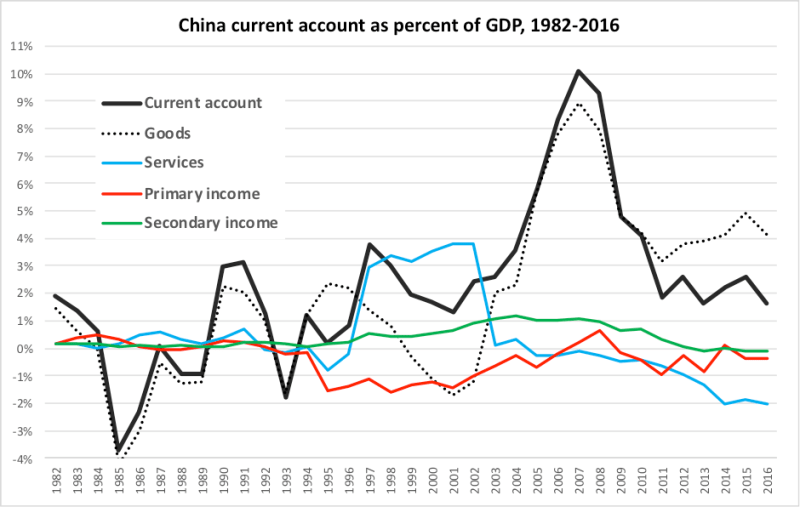
This share subsequently fell sharply due to a surge in exports from non-FFEs, although this was also in a context of falling current account surpluses as a proportion of GDP. As shown in the figure below, this was due to increasing deficits on China’s services account, which reached 2% of China’s GDP in 2014-16, knocking out about half of its goods surplus in 2014 and 2016.

China also returned to running deficits on its income account from 2009 onwards (with the slight exception of 2014), despite being a major international creditor. As explained by Yu Yongding, this is because China’s foreign assets mostly earn very low returns, such as in US treasury bills, whereas foreign investment in China is very profitable, possibly in excess of 20-30% per year, thereby cancelling out any of the balance of payments benefits that would normally accrue to being a major international creditor.

Graph Andrew Fischer article
Source: Author’s calculations from IMF balance of payments and international finance statistics (last accessed 21 March 2018).

Notably, the US is the mirror image of China: it is a major international debtor and yet it earns a surplus on its income account. Both situations were due to profit remittances, e.g. profits leaving China and entering the US. Indeed, Yilmaz Akyüz estimates that the net current account position of FFEs in China has been in deficit in recent years, meaning that their profit remittances were cancelling out their merchandise trade surpluses.

In other words, after the exceptional but historically brief period of running very large ‘twin surpluses’ (on both the current and financial accounts), the current account structure of China has reverted to a pattern that, as I explain in a recent article, is common among peripheral developing countries. The pattern is characterised by goods trade surpluses that counterbalance service account deficits (dominated by payments to foreign corporations) as well as the profit remittances of foreign corporations (and of other foreign investments, whether licit or illicit).

These rapid transformations have been reflective of the increasingly deep integration of China’s foreign trade into international networks dominated by Northern-based transnational corporations. The model has resulted in exceptional export performance, although this has occurred through the injection of considerable but underappreciated sources of vulnerability.

Indeed, as noted by Yu Yongding, from 2015 to 2017 the People’s Bank of China undertook the largest intervention in foreign exchange markets that any central bank has ever taken in order to prevent a run on the renminbi. This depleted its foreign exchange reserves by over 1 trillion US dollars. In another recent article, Yu adds that from 2011 to 2017, around 1.3 trillion US dollars of China’s foreign assets had effectively disappeared, probably reflecting capital flight. Together with the run on the renminbi, these were the principal reasons that the Bank of China put a hold on capital account liberalisation and tightened capital controls to an extent not seen since the East Asian financial crisis of the late 1990s.

Considering that much of such capital flight is destined for the US, either directly or indirectly via multiple offshore financial centres, in addition to the profitability that US corporations derive from China’s trade with the US, it is clear that the US is in the more powerful position in this bilateral relationship.

The imperial utility of trade decline discourses

From this perspective, the deep US trade deficits that have persisted since the early 1980s arguably represent a new form of advanced capitalist imperialism, the emergence of a system of tributes whereby states around the world effectively subsidise the expansion of US-centred capitalism. At the very least, the deficits are signs of a structural shift underlying global power relations, based on an increasingly predatory form of financialised capitalism, with the US still at its helm.

Much like with discourses of Soviet rivalry in the 1960s and 1970s, the current babble of US decline and lagging serve an ideological purpose within these continuing transmutations of US-centered power. It is effectively aimed at subordinating other countries and shifting the burden of adjustment onto them, while distracting attention away from the US-centered, corporate-led restructurings of global production systems that underlie US deficits in the first place.


Main photo: https://pixabay.com/en/donald-trump-politician-america-1547274/

About the author:

Andrew mug shot.JPGAndrew M. Fischer is Associate Professor of Social Policy and Development Studies at the ISS, and laureate of the European Research Council Starting Grant, which he won in the 2014 round. He is also the founding editor of the book series of the UK and Ireland Development Studies Association, published by Oxford University Press, titled Critical Frontiers of International Development Studies. He is also editor of the journal Development and Change. His forthcoming book, Poverty as Ideology, won the 2015 International Studies in Poverty Prize, awarded by the Comparative Research Programme on Poverty (CROP).


Trump’s ‘doublespeak’—why academics should speak out by Jeff Handmaker

By Posted on 2222 views

U.S. President Donald Trump in January 2018 delivered his first State of the Union Address (SOTU). At first glance, he sounded more presidential than ever following his tumultuous first year in office. However, his careful words hid an agenda that is hostile to most of us, and to academics in particular. As scholars, we have a responsibility to take notice, and to speak out. 


The SOTU Address – Trump’s doublespeak

During much of his SOTU address, Trump made an effort to reach Americans, beyond his more familiar, albeit dwindling ‘base’ of support, composed of evangelicals, the elderly and whites without a university degree. His presentation was peppered by American proverbs and even managed to come across as compassionate.

But gaps and contradictions blatantly revealed Trump’s doublespeak. While Trump refrained from referring to countries as “shitholes” as he had done a few weeks earlier, his contempt for foreign nations was evident. He praised the Iranian peoples’ “struggle for freedom”, while failing to mention the travel ban in place against all Iranians.

Trump also praised his decision to recognize Jerusalem as Israel’s capital, a decision condemned by most nations in the United Nations General Assembly. Trump said that “friends” of the US would receive support, while “enemies” would not. While these were not explicitly specified, there was a clear reference to how nations voted at the UN concerning Jerusalem.

Capping off a dizzying array of international law violations, Trump insisted that the notorious detention camp in Guantanamo Bay, associated with torture and indefinite detention without trial, would remain open. He affirmed that the US military would continue its operations in Afghanistan, ominously, under unspecified “new rules of engagement”.

So how is this all relevant for scholars?

The overall response from media commentators to Trump’s SOTU address was disappointing. Most focused on its tone rather than its content. In the Netherlands, some even referred to Trump’s address as “brilliant” and “politically, very clever”. The NRC Handelsblad offered perhaps the best commentary, emphasising its ‘polarising’ content, but this was an exception.

The fact remains that a significant majority of Americans have consistently disapproved of Trump’s job as president. There has been a public outcry in countries around the world, particularly after Trump’s decision to recognize Jerusalem as the capital of Israel. So why have there been so few critical analysts, particularly in the mainstream media?

In my own observations at academic gatherings in the US and abroad, since Trump first came to office in January 2017, it appears that most academics tend to dismiss Trump, rolling their eyes, ignoring his statements, mocking him, or even suggesting that he doesn’t really have all that much power. A handful of academics have even openly supported him.

There are, of course, notable exceptions. Those in the immigration law field have written persistently on the Trump administration’s persecution of immigrants. Apart from the alternative media, such as Mondoweiss, Democracy Now and MSNBC, The Conversation has produced in-depth articles by scholars condemning the Trump administration’s policies. But even critical media outlets, such as De Correspondent in The Netherlands have acknowledged that, while news outlets have tended to reflect daily indignation, they have rarely produced sustained resistance to the policies of the Trump administration.

A position of ambivalence in these circumstances is not tenable. As Professor Harris Beider has poignantly observed: “we live in an age of volatility and scepticism … As academics we find ourselves in the dock of public opinion too … we as universities and academics can also be part of the problem”.

Accordingly, with the rise of ethno-nationalist administrations in the USA and the United Kingdom, Beider has issued an appeal to academics to be less self-absorbed and “to question received wisdom and follow the people rather than expect them to follow us”.

What Trump says publicly should matter a great deal to us, if only in view of the vast military and nuclear arsenal at his disposal and the message to other world leaders that Trump’s behavior should in any way be regarded as acceptable.

Trump’s specific threats to academics

Alongside general concerns around Trump’s policies, there are at least three specific examples that are pertinent to academics worldwide.

First, Trump’s travel ban on nationals from specific countries has made it impossible, and even dangerous for academics from these countries, some of whom are regarded as scholars at risk, to share their knowledge and in extreme cases obtain safe refuge in the United States. Several vice chancellors (rectors magnificus) of Australian universities have protested Trump’s travel ban, joining thousands of other scholars worldwide.

Second, while Congress has so far pushed back on Trump’s proposals to slash health research, Trump’s refusal to accept the scientific consensus concerning a link between carbon emissions and climate change is having a devastating global impact in restricting access to crucial research funding. Research funding cuts in other areas are also likely.

Third, the harassment of scholars by right-wing groups has been steadily rising against scholars, particularly following the election of Donald Trump. Such harassment is even described as “becoming normal” by the American Association of University Professors, which has set up an on-line platform for reporting incidents of harassment.

6219961958_e15d5cdec6_b
Picture Credit: Newtown grafitti

This would not be the first time scholars have stood up in protest against regimes whose policies have threatened society at large, and academics specifically. This includes South Africa’s persecution of non-whites and critical scholars in the 1980s, the persecution of scholars by the government in Turkey and Israel’s persecution of Palestinian scholars.

Whether as scholars of climate change, international law, race relations or many other related areas, we should all be shocked. Alarmed. Indeed, appalled at Trump’s SOTU speech. And we should speak out at every opportunity, particularly outside our close-knit community that largely holds the same views we do.


Also see: Scholars at risk: precarity in the academe by Rod Mena and Kees Biekart


Picture credit: DonkeyHotey


JeffHandmakerISS_smallAbout the author:

Jeff Handmaker teaches law, human rights, development and governance and conducts research on legal mobilisation at the ISS. He is also an associate member of the Faculty of Law at the University of the Witwatersrand in Johannesburg, Editor-in-Chief of the South African Journal on Human Rights and a member of the EUR INFAR Project.