Tag Archives united states

US Congress backs diaspora-driven efforts for Tamil self-determination

By Posted on 1581 views

On 15 May 2024, US Congressman Wiley Nickel introduced House Resolution 1230, which addresses long-standing grievances of the Tamil community. Endorsed by over 50 Tamil diaspora organisations worldwide, the resolution symbolises hope amid frustration over Sri Lanka’s lack of accountability. Although its path to becoming law is uncertain, the resolution reflects shifting geopolitical dynamics and marks a significant moment in US policy regarding the Tamil diaspora’s pursuit of self-determination. With a new president in place, Sri Lanka may also have the opportunity to reshape its approach to the Tamil question. In this blog, Shyamika Jayasundara-Smits delves into the potential impacts and wider implications of this resolution.

Source: East Asia Forum

On 15 May 2024, US Congressman Wiley Nickel introduced House Resolution 1230, marking the latest congressional effort to address the long-standing grievances of the Tamil people. The resolution recognises the hundreds of thousands of lives lost during Sri Lanka’s nearly 30-year long armed conflict. It also seeks to ensure nonrecurrence of past violence, including the Tamil Genocide, by supporting the right to self-determination of Eelam Tamil people and their call for an independence referendum.

The resolution received moderate partisan support and was endorsed by over 50 Tamil diaspora organisations across fifteen countries who have been working to advance the Tamils’ quest for justice and self-determination. House Resolution 1230 certainly boosted the morale of the global human rights community and the Tamil diaspora, who have grown increasingly frustrated with Sri Lanka’s lack of accountability and have been torn between hope and despair under different US administrations and their allies.

The resolution emerged as the United States faces global scrutiny over its complicity in Israel’s genocidal violence in Gaza and for dragging its support in implementing a two-state solution. The resolution, though important for Tamils, underscores the double standards in US policy regarding justice and accountability for war crimes. While the demand for justice for Tamils is stronger than ever, the Tamil diaspora cannot expect much from the United States or most liberal Western states, given their diminishing moral authority.

House Resolution 1230 is a step forward in advancing the February 2023 declaration issued by six major US-based Tamil organisations urging the government to do the ‘right thing’. Dr Murugiah Muraleetharan — President of the Federation of Global Tamil Organizations — shared that ‘only by serving justice to the Tamils and returning their sovereignty, can peace and stability be established in the region. A permanent solution is important, and Independence Referendum is the democratic, peaceful and correct approach’.

Both the 2023 and 2024 resolutions clearly advocate for an internationally monitored independence referendum for Eelam Tamils, echoing the 1976 Vaddukoddai resolution introduced by Tamil political elites in Sri Lanka. The new resolution adopts a maximalist approach by reigniting hopes of securing an independent state. This approach can be viewed as a tactical manoeuvre within the current geopolitical landscape, which may not favour such a drastic measure. Instead, it seeks to advance achievable goals, such as addressing justice grievances, returning of land, promoting regional economic development and ensuring human rights.

One pertinent issue is how much pressure diaspora groups can exert on the United States and its allies to ensure Sri Lanka complies with human rights laws and is held accountable. This is especially crucial amid current US–China geopolitical contestations in the Indian Ocean, where Sri Lanka is viewed as an important ally to deter China’s influence.

Since the defeat of the Liberation Tigers of Tamil Eelam in May 2009 by the Government of Sri Lanka’s armed forces, a number of House Resolutions have been introduced. These have been accompanied by high-profile US-backed UNHCR resolutions calling for a credible investigation into possible war crimes committed by the state armed forces and the Liberation Tigers of Tamil Eelam. But these efforts have been overlooked by Sri Lankan authorities.

Continued pressure from Tamil diaspora groups has encouraged some progress under the Biden administration, which imposed personal sanctions on four senior Sri Lankan military officials between 2020 and 2022.

Given the history and lifespans of resolutions introduced in Congress regarding Sri Lanka, the new resolution shows slim chances of proceeding to the next stages required to become law. This limits its potential to demand binding action from the Sri Lankan state. Despite this potential outcome, receiving the US Congress’s acknowledgment and support holds symbolic significance for the Tamil diaspora.

As the United States prepares to elect its next president, the outcome will also impact the fate of the new resolution and US interest in human rights in Sri Lanka. The resolution will have a better chance of progressing under a Harris presidency, which may signify a continuation of the Biden administration’s policies.

The chances of the resolution gathering support on the Sri Lankan side seem likely under the newly appointed leftist President Anura Kumara Dissanayake. Dissanayake’s campaign failed to secure the endorsement of the Illankai Tamil Arasu Kachchi — one of the largest Tamil political groups representing the north and east. But there is hope for a locally grown solution to the Tamil question with home based political groups if Dissanayake remains true to his past sentiments and have the courage to ‘interrogate the JVP’s chauvinistic past, embrace minority communities, and support their struggles for justice and equality’.

During a 2018 parliamentary debate, Dissanayake compared his party, the Janatha Vimukthi Peramuna, now part of his ruling coalition, to the Tamil National Alliance. He pointed out that both parties represented people in the south and north who have suffered the most under a repressive state.

Meanwhile, India, a regional US ally, has already signalled its commitment to finding a lasting solution to the Tamil issue through power devolution within a united Sri Lanka. This was highlighted during Indian Foreign Minister Jaishankar’s visit shortly after President Dissanayake assumed office. The new president has expressed similar views to that of India. Dissanayake’s success in the November 2024 parliamentary elections will be pivotal for advancing these efforts, as both domestic and diaspora Tamil groups are well-positioned to shape these developments.

This article was first publish on the East Asia Forum 

Opinions expressed in Bliss posts reflect solely the views of the author of the post in question.

About the Author:

Shyamika Jayasundara-Smits

Shyamika Jayasundara-Smits is an Assistant Professor in conflict and peace studies at the International Institute of Social Studies (ISS), Erasmus University, Rotterdam.


Are you looking for more content about Global Development and Social Justice? Subscribe to Bliss, the official blog of the International Institute of Social Studies, and stay updated about interesting topics our researchers are working on.

How the United States’s legacy of slavery influences unequal credit scores and what we can do about it

The credit scoring system in the United States, particularly the FICO score, significantly impacts individuals’ access to affordable financing, housing, and employment opportunities. In this blog article, recent ISS MA graduate Conor Farrell shows that though deemed “colour-blind,” the model inadvertently perpetuates racial disparities rooted in historical injustices, particularly slavery. Reforms, including AI-enabled credit scoring and policy changes like excluding medical debt from credit considerations, are essential to address these inequities and break the cycle of intergenerational poverty and racial inequality, he writes.

Acting as the economic gatekeeper in the United States, the credit score, most commonly known in its FICO form and that which is referenced throughout this blog article, scores individuals on a range from 300 to 850, with lower scores representing greater risk of default or missing payments, and higher scores the opposite. Within the FICO form, an individual’s score is primarily calculated across five components, each with an approximate weight (1):

  • Payment history (35%):an analysis of timely payments on outstanding debts and the severity of late payments (i.e., 30 or 60+ days late).
  • Amounts owed (30%):calculated as a percentage of total credit available and amount currently employed with a rule of thumb to keep this percentage lower than 10%.
  • Length of credit (15%):calculated as the amount of time an individual has accessed credit.
  • New credit (10%):how recently the individual opened a new account.
  • Type of credit(10%): considers the different revolving and installment loans you have active.

Poor credit scores almost always mean far fewer lending options and far more expensive options when available. Putting this into hard numbers, according to data from the Consumer Financial Protection Bureau, a change from a “subprime” 640 credit score to a 740 credit score in one example might allow a potential home buyer to access a mortgage interest rate as low as 5.75% instead of 7.625%, resulting in almost $90,000 in lower interest costs over the life of a thirty-year loan for the same house (2).

The five factors determining the level of risk are claimed not to consider demographic characteristics. However, the map of average percentages of county populations with subprime credit scores in the United States (Figure 1) shows the stark differences between the American south and north.

Figure 1: Subprime Credit Score Populations by County

The percentage of people per county with subprime credit scores in the United States. Orange indicates counties with fewer subprime credit scores and blue counties with more subprime credit scores. The red line on the map is the Mason-Dixon line and Ohio River extension, the traditional division between northern and southern states. Source: (Equifax and Federal Reserve Bank of New York, 2024).

In particular, given that over 60% of the total African American population resides in the American south, as we further break out the average credit score by race, it is therefore unsurprising to find a mirrored divergence in subprime credit scores, particularly between Black and White Americans (Figure 2).

Figure 2: Average Credit Scores by Race in 2021

Seen across race, there is a significant divergence between the average credit scores of White Americans (734) and Black Americans (677) with the average score for Black Americans averaging near the subprime threshold. Source: (Dual Payments, 2020)

This brings into question whether these differences can be explained by other factors not accounted for by the model. Given that credit scores play such a significant factor in one’s ability to obtain affordable finance and in certain cases may impact where one can live or rent or inhibit one’s ability to obtain employment opportunities, how is it then that such a “colour-blind” model appears to be disproportionately impacting Black Americans? In this blog article, I show that a historical institution fundamental to economic development of the United States and the racial and geographic divisions still present in the present — the institution of slavery — can provide an alternative explanation for injustices in the credit score system.

A quick history lesson

While present for the initial two centuries of colonial expansion in North America, slavery rapidly grew in the early 1800s as the United States solidified into a nation-state (Figure 3). Ultimately abolished after a bloody civil war, the history of the United States since slavery’s abolition in 1865 has been characterized by a various forms of institutionalized and explicit forms of race-based discrimination and exclusion, including the sharecropping system, housing discrimination in the form of redlining, and segregation in the education system. While each of these systems and institutions can each be understood to be extensions of the historically unequal forms of development in the United States with their own unique impact of the historical inequalities in their respective period of development, my research as part of my MA thesis set out to determine how is it that the Figure 3 and that of Figure 1 bear strikingly similarities to one another.

Figure 3: Relative Slave Populations by County (1860)

Figure 3 presents the relative slave population as a share of the total population in 1860. Counties with dark yellow shades have the largest slave population relative to the total county population, while light blue are the counties with lower slave populations. Counties in dark blue are either unreported or have zero slave population according to the census. It is important to note that this data may not be fully reflective of the actual slave population, but it is the best official data that is available. Source: (United States Census Bureau, 1864)

Current models are far too simplistic

Hypothesizing that the current model claims to be colour-blind in its analysis and that its simplistic model focuses solely on the present-day actions of an individual without acknowledging the persistent inequalities already present within our society, my research analysed 1860 census data alongside contemporary panel data from 2014–2021 through an instrumental variable specification. Through the most stringent specification applied,  I found a 10-percentage-point increase in the relative slave population of a county in 1860 results estimated average effect of 0.791 percentage point increase in the percentage of the current population with a subprime credit score in 2021, holding all else constant; a result that remains highly significant even in the most stringent model employed (3). Put simply, counties that had higher proportions of enslaved people in 1860 tend to have a higher percentage of residents with poor credit scores today, even after considering other factors that might influence this outcome.

Given the consistent but varying forms of discrimination experienced by Black Americans since the abolition of slavery, I also found that relative slave populations influence different channels’ persistence including through an education system that requires Black Americans to take on higher levels of debt to obtain the same education, only to earn consistently lower wages than their White counterparts. Unable to generate as much wealth as their White counterparts, Black Americans are often far more burdened by greater amounts of relative debt, limiting their ability to obtain larger assets like homes, which are so vital in generating and retaining intergenerational wealth (4).

Such findings demonstrate that the current credit scoring model, one that claims to be unbiased and does not explicitly penalize individuals based on race, fails to account for the multitude of contextual historical factors that continue to privilege certain groups while barring others from accessing the same system. Contemporary economic inequalities may be influenced by the lingering effects of historical factors emphasizing the complex interaction between race, inequality, historical factors, and contemporary economic outcomes.

As such, it also provides clear evidence that policies that do not adequately consider historical inequalities existing and persistent in the system may in fact serve only to continue to perpetuate such inequalities. Particularly in the context of the credit scoring model in the United States and similar systems of economic gatekeeping, not addressing the existing inequalities through the model restricts an individual’s ability to access affordable financing, housing, or decent employment prospects.

Significant reforms are the only way to address persistent injustices

The rapid introduction of artificial intelligence (AI) holds some promise in this context. A greater number of AI-enabled credit scoring algorithms are being tested that could vastly expand the number of variables influencing a credit score. This will hopefully allow a far more comprehensive picture of an individual current financial health. Models with a greater number of variables would increase the diversity of scoring criteria and de-emphasize the potentially discriminatory data points currently prioritized in the FICO model. The recent decision by the Biden administration to remove medical debt as a variable influencing credit scores also helps to address the burden of emergency care costs that can be detrimental to an individual’s ability to meet their financial responsibilities (5).

However, given that poor credit scores have the potential to make financing almost inaccessible for low- and middle-income individuals, additional social safety nets must be considered to ensure that drastic emergency expenses do not create cycles of intergenerational poverty resulting from poor credit scores. Without significant reform, the current credit scoring model will continue to punish low-income families, forcing them to take on more expensive financing to obtain the same assets as their neighbours, inhibit access to home ownership, make higher education less accessible without taking on larger debt, and continue to ensure a cycle of poverty that perpetuates racial inequalities within the United States.

Footnotes

(1) Pritchard, J., (2021) How the FICO Credit Score Is Composed. Available at: https://www.thebalancemoney.com/fico-credit-score-315552 (Accessed 28 July 2024).

(2) Consumer Financial Protection Bureau (CFPB), (2023). Explore interest rates. Available at: https://www.consumerfinance.gov/owning-a-home/explore-rates/ (Accessed 28 July 2024).

(3) Farrell, C. (2024). The lingering legacy of slavery: historical injustices and credit scores in the United States. International Institute of Social Studies (ISS). ISS working papers. General series No. 723

(4) Jones, J., & Neelakantan, U. (2022). How Big Is the Inheritance Gap Between Black and White Families? Richmond: Federal Reserve Bank of Richmond Economic Brief.

(5) The Consumer Financial Protection Bureau (CFPB) (2023). CFPB Kicks Off Rulemaking to Remove Medical Bills from Credit Reports. Washington, D.C.: CFPB. Accessed 4 July 2024.

Consumer Financial Protection Bureau (CFPB) (2023). CFPB Kicks Off Rulemaking to Remove Medical Bills from Credit Reports. Washington, D.C.: CFPB. Accessed 4 July 2024.

Consumer Financial Protection Bureau (2024). Explore Interest Rates. Retrieved from Consumer Financial Protection Bureau: https://www.consumerfinance.gov/owning-a-home/explore-rates/. Accessed 5 July 2024.

Dual Payments. (2020). Credit Score. Retrieved from Dual Payments: https://dualpayments.com/statistics/credit-score/#race. Accessed 28 July 2024.

Equifax and Federal Reserve Bank of New York, Equifax Subprime Credit Population, retrieved from FRED, Federal Reserve Bank of St. Louis; https://fred.stlouisfed.org/series/EQFXSUBPRIME036061. Accessed 28 July 2024.

Farrell, C. (2024). The lingering legacy of slavery: historical injustices and credit scores in the United States. International Institute of Social Studies (ISS). ISS working papers. General series No. 723

Jones, J., & Neelakantan, U. (2022). How Big Is the Inheritance Gap Between Black and White Families? Richmond: Federal Reserve Bank of Richmond Economic Brief.

United States Census Bureau, (1864). 1860 Census: Agriculture of the United States, Washington: United States Census Bureau. Available at: https://www.census.gov/library/publications/1864/dec/1860b.html

About the author: Conor Farrell

Conor Farrell

Conor Farrell is a graduate of the International Institute of Social Studies where he majored in Economics of Development. He is passionate about the intersection of history and contemporary economic outcomes understanding that history is not a set of fixed beginnings and ends, but continues to live on through the institutions we have created to shape our societies and influence our future.

Are you looking for more content about Global Development and Social Justice? Subscribe to Bliss, the official blog of the International Institute of Social Studies, and stay updated about interesting topics our researchers are working on.

Amid the US-Sino rivalry: how high is the risk of a deglobalisation trajectory for China?

The ongoing military conflict between Ukraine and Russia has allegedly changed the course of history and revived the era of ‘Great Power Rivalry’. Under this backdrop of re-energised geopolitical competition, the hostile rhetoric and posture have only further aggravated between the U.S. and China, especially regarding the ‘Taiwan issue’. Re-assertion of the international order dominated by the west, and counteraction of it (led by Russia and China), have led to a more fractured world both politically and economically. In the meantime, as most of the world has stepped out of the horror of Covid-19 pandemic, China’s continuing resolute containment measures and minimum border entry have astonished audiences in the west and beyond. These Covid-related restrictions coupled with China’s position in the rivalry with the U.S., have posed the question of whether China is gradually taking a deglobalisation course? Because China is so deeply ingrained in many aspects of globalization, including the global trade network, the answer to this question will not only have a significant bearing on China’s economic development and state-building, but it will also have significant worldwide implications. In this blog, we endeavor to answer this question by taking stock of modern China’s history of globalisation as well as the discourse around it and taking into account the consequences of the present Ukraine-Russia conflict.

Photo credit: KYIV POST

A historical sketch of globalisation in modern China:

Globality has been an essential part of the discourse of modernity in the non-European world, when western history has become world history and those being perceived as oriental or raw have been compelled into this form of world history. The choice of globalisation has never been a given for modern China, and the early encounters with the Europeans has been stamped and memorised as ‘sovereign door being knocked open by the cannons’ and ‘Century of Humiliation’. Since the ‘humiliation’ was primarily caused by techno-scientific backwardness of the old, un-modernised China, the discourse of modernity had mainly been formulated as techno-scientific and economic progress, with even cultural inferiority mostly enunciated as a hindrance to scientific advancement. While globalisation was forced upon China and its past was derogated for absence of any elements of modernity, China paradoxically had been looking outward for its ideal model of modernity and formation of nation-state, especially from nations that bore some similarity with China in the past— ranging from Sun Yat-Sen’s acclaim of Japanese victory in Russo-Japanese war as ‘our own victory’, and communists’ marvel at Soviet Union’s rapid industrialisation during Stalin’s rule, to China’s learning and replication from newly industrialised east Asian countries in post-Mao period. The most notable walking-back of globalisation in modern China was the Soviet-Sino split from 1960 when China severed economic ties and technological exchange with Soviet Union and consequently most of the socialist camp that China once belonged to, with reasons ranging from Soviet Union’s unfulfilled promise of technology transfer to personal enmity between top leaders. Nevertheless, even under the integument of revolutionary discourse of modernity in late Mao-era, huge underlying efforts had been made by the technocrats led by then premier Zhou Enlai to pursue (and had achieved to some extent) techno-scientific progress and capital accumulation in the industrial sector (Yao, 2019). At last, unprecedented economic and technological progress has been most-effectively achieved in modern China since the 1980s, which features deepening globalisation, with China also taking lead on initiatives in issues like global infrastructure development and climate change to gain a bigger footprint in global governance. Nevertheless, recent signs are emerging that the Chinese state is tending to downplay the importance of globalisation to economic achievement (the advocacy of ‘dual circulation’ economic development pattern, in which global economic cycle plays a supplementary role relative to domestic economic cycle) and is willing to compromise the economic benefits of globalisation for political and public-health ends (divergent Covid-19 policy).


China’s choices in the ‘Great Power Rivalry’:

Utilitarians put emphasis on material and economic gains and ignore the role of values in driving human and social behaviors, however, the materialistic and individualistic approach of utilitarianism may fail to explain certain strategic decisions based on calculations beyond economic rationalisation. Recent events have shown that, when factoring non-material values into social behaviours, the underprivileged could take on a trade-off between nationalistic values and economic benefits in severely unequal and polarised society, which has been manifested in the form of populism that climaxed in the trade war that former U.S. President Donald Trump (Murshed, 2020) waged against several countries, and in the form of outright war that Russia wages presently against its western neighbor. The mechanism behind such a non-utilitarian rationalisation is that the feeling of deprivation and grievance arising from unequal distribution of economic output is compensated by the sense of fairness arising from the collective glorification or collective insecurity during conflicts (whether armed or unarmed) fought for nationalist rhetoric. Thus, on one hand, a repetition of Russian experience as deglobalisation by outright military conflict in Taiwan strait could happen in China, as two countries bear similarities in both the dynamics of ‘Great Power Rivalry’ with the U.S. and domestic factors pertaining to authoritarian rule and severe socio-economic inequality. On the other hand, the Russian economy has exhibited a certain level of resilience under western sanctions mainly because of Europe’s energy reliance on it, and this dynamic has shown that economic dependence is an advantage to be leveraged even when globalisation is compromised for other political ends.


In all, China has been going through considerable reconfigurations in a broad range, including assertion in global economic and political sphere, revival of Confucian values, and strengthening of patriarchal authoritarianism within party-state, since mid 2010s, when China’s share in world economic output approximately reached historical level, which was generally above 20% before mid-19th century (Broadberry et al., 2018). Currently, by displaying strategic behaviors across different issue areas, China is seeking space to further gain techno-scientific and economic prowess, while at the same time, preserving the party-state’s political and economic interests at home and abroad. Russia’s war against Ukraine could also prompt a profound re-calibration of China’s globalisation policy as the possibility of a west-east division resembling the cold war era rises. If any lessons can be drawn from the Soviet-Sino split in the Mao-era and the recent deglobalisation courses that populist governments (Brexit, Trump’s tariff war) and authoritarian regime (Russia’s invasion of Ukraine) have taken, we believe that the level of patriarchal authoritarianism within party-state and socio-economic inequality (not always independent of one another) are the two most significant home elements in any potential reversal of globalisation course for China. Inopportunely, the trends for these two domestic factors are on the side of disruption rather than cooperation within the current international order dominated by the west. However, in the manner that the conditions of deglobalisation have been partly brought about by the rise of China’s relative economic and technological strength in the world, globality will persist in any measured deglobalisation, which should be dynamic and imbalanced among multi-fronts if it would occur.

Opinions expressed in Bliss posts reflect solely the views of the author of the post in question.

About the authors:


Li Yanbai is a PhD candidate at the International Institute of Social Studies (ISS), Erasmus University Rotterdam (EUR). His research interests lie in China’s resources trade with developing countries and the causes and consequences of socio-economic inequality in China and beyond.


Hao Zhang is a PhD candidate at the International Institute of Social Studies (ISS), Erasmus University Rotterdam (EUR). Before joining ISS, she was a master’s student majoring in international affairs at School of Global Policy and Strategy at University of California, San Diego. Her current research focuses on policy advocacy of Chinese NGOs in global climate governance. Her research interests lie in global climate politics and diplomacy, and NGO development in China.

Are you looking for more content about Global Development and Social Justice? Subscribe to Bliss, the official blog of the International Institute of Social Studies, and stay updated about interesting topics our researchers are working on.


The rise of Big Tech cements the fall of the US economy

While the US economy is going through its worst crisis in the last eight decades, with small businesses shutting down en masse and millions of Americans losing their jobs, one wouldn’t know anything is wrong solely from looking at the largest US companies. The crisis, triggered―but not caused―by the COVID-19 pandemic measures, has enabled some of the world’s largest corporations to amass record profits. It allows them to capture ever-larger shares of a market that is increasingly monopolised. How could that happen and what will it lead to?

The widening gap between the Big Five and the rest

It is no secret that Amazon has done well throughout the pandemic, with both the company’s profits and Jeff Bezos’ personal wealth shooting up to record highs in the middle of one of the worst recessions the US has ever seen. While brick-and-mortar retailers have suffered tremendous damage as a result of the measures implemented in response to COVID-19, Amazon has thrived off the accelerated shift to online services.

And it is not alone in this: The so-called US tech companies―also referred to as the Big Five―have all managed to keep increasing their profits while the US economy is contracting. Apple, Alphabet (Google’s holding company), Amazon, Facebook, and Microsoft saw their combined pre-tax profits rise by an annualised 5% in the second quarter; starkly contrasting profits of the rest of corporate America, which fell by an annualised 27% (excluding finance).

[/vc_column_text][vc_single_image image=”18703″ img_size=”full” alignment=”center”][vc_column_text]

A company experiencing profits growth during a recession is highly unusual, and the Big Five’s outperformance has led to a dramatic increase of their share in total non-financial profits made by US companies. Having already risen from 4% in 2011 to 11% in 2019, the Big Five have increased their slice of the pie to 16% in the first half of this year.

To put this into perspective: The concentration of US non-financial profits in the top five companies has historically been around 7-9% while the current top five, which includes three of the large tech companies, accounted for an astounding 19.3% in 2019. Since the onset of the pandemic, this figure is estimated to have risen further to 25%. This would mean that five companies now receive one quarter of all non-financial profits made in the US.

[/vc_column_text][vc_single_image image=”18704″ img_size=”full” add_caption=”yes” alignment=”center”][vc_column_text]A long-standing trend of market concentration

There is no question that the pandemic measures have accelerated the ever-widening gap between the Big Five and the rest, but at the same time it cannot be ignored that the US economy has seen a long-standing trend of market and profits concentration. Even before Big Tech came along, many of the major industries, ranging from beer to healthcare, had already seen the emergence of oligopolies (a few dominant firms), duopolies (two dominant firms) and even monopolies (one dominant firm).

A prime example is the case of high-speed internet provision in the US, for which the market is almost completely controlled by the three telecom giants AT&T, Verizon, and Comcast. By carving up the market, they have avoided competing in the same regions, forcing as many as 75% of US households to ‘choose’ from just one provider. Health insurance is another industry for which the market has been sliced up by the companies who dominate it, ensuring that competition is avoided as much as possible. As a consequence, in many states 80-90% of the health insurance market is controlled by just two companies.

Capitalism is a system in which competition drives innovation and growth. The natural strategy for a company to become dominant in an industry is to outcompete its rivals by producing better and cheaper products―i.e., by innovating. The problem in the US today is that more often than not, it has been a lack of competition which has allowed for high levels of market concentration and abnormally high profit margins in the US.

But it wasn’t always like this. The US government used to pay great attention to market concentration and threats to competition, which was why they had created antitrust regulation in the first place around the turn of the 20th century. According to Jonathan Tepper and Denise Hearn, who documented the vast extent of uncompetitive and increasingly concentrated industries in the US in ‘The Myth of Capitalism’, point to the dismantling of antitrust regulation since the 1980s as one of the major causes for the growing degree of what they refer to as ‘industrial concentration’.

An illustration of when antitrust was still applied in full force is the case of IBM in 1969. The US government brought an antitrust lawsuit to PC maker IBM who held 70% of the market at the time. The lawsuit instigated IBM to make its hardware compatible with software other than the programmes it sold itself, allowing for new companies such as Microsoft (founded in 1975) to emerge and produce software for IBM machines and, eventually, for those produced by other companies.

In 1998, when the number of antitrust cases was already much lower than before, the US government brought an antitrust lawsuit against Microsoft because it was starting to monopolise the PC software market. The tech giant was using its popular Windows operating system to favour its own programs such as the Internet Explorer. And with the internet on the rise, the company was also well positioned to block competitors from areas such as search engines. The lawsuit helped curb Microsoft’s growing power and allow other software companies to compete. Perhaps more importantly, it also allowed tech startups―such as a little company called Google―to grow.

The Big Five and the abandonment of antitrust regulation

The irony of Google owing its existence to antitrust is that the tech giant is currently one of the largest violators of antitrust principles, which appear to no longer be enforced by the US government. Apart from being a monopoly in the market for search engines, Google together with Facebook controls the market for online advertising with both companies actively barring new entrants to the industry. When Facebook bought social media rival Instagram in 2012, there was not a single antitrust case brought against them to block the acquisition.

Buying the competition certainly has been a favorite tool for retaining dominance. Since 2005, the Big Five have acquired 549 companies, which in many instances were direct competitors. From 1985 to 2017, the number of mergers and acquisitions completed annually rose from 2,308 to 15,361 nationwide. Unsurprisingly, Tepper and Hearn are able to show that the rise in acquisitions has a clear inverse relationship with the number of antitrust cases.

On top of acquisitions, the Big Five have found other ways to cement their market dominance. As US President Donald Trump correctly pointed out, Amazon is subsidised massively by their exclusive access to state-owned US postal services (USPS) at cheap rates. It is estimated that the USPS undercharges Amazon by $1.47 per package―no wonder Amazon accounts for more than 43% of online retail sales.

Boosting profits without being more competitive

Highly concentrated industries allow for two major distortions that boost corporate profits without the dominant companies having to be more competitive: price gouging and suppressing wages.

For price gouging, the internet provision industry serves as a good example. New York University economist Thomas Philippon found in a 2019 study that prices for a monthly broadband connection were almost twice as high in the US than in Europe or South Korea. Similar price differences were observed for air travel in the US when compared to Europe. Flights in the US are dominated by four major airlines that often enjoy regional monopolies and have solidified their market dominance since the US deregulated the airline industry in 1978. Having been fairly stable until that point, inflation-adjusted flight prices jumped by 50% in the first ten years after deregulation.

Being often one of the few employers (in some cases the only employer) in small-town America, monopolies also hold significant power over labour, which they exert through lobbying for laxer labour laws, inserting non-compete clauses in labour contracts, and consequently depressing wages. Marshall Steinbaum, Ioana Marinescu and Jose Azar found that wages are typically 10-25% lower in a ‘highly concentrated’ industry than in a ‘very competitive one’. Overall, wages adjusted for inflation have been stagnant in the US since the 1970s.

The suppression of wages has no doubt elevated profits margins, as Tepper and Hearn show in an almost perfectly inverse relationship between the two. What they further show is that the income distribution to the lower percentiles has a remarkably close correlation to union membership, the latter of which has been on a steady decline since the 1960s, implying that the large US corporations have successfully worn down the power of labour.

The consequences of not having to compete

Higher prices and lower wages are the reason for the exorbitant profit margins we see in today’s economy. But apart from that, they also lead to a complete loss of the capitalist drive that usually spurs companies to innovate. This decline in innovation is for a large part indicated by the number of US-American start-ups―which usually account for a large portion of total innovation―having fallen by nearly half since the 1970s.

What’s more, the large companies that dominate their industries are themselves not driven to innovate anymore. Instead, they have found a new way to inflate the value of their company: share buybacks. A study conducted by the Harvard Business Review found that between 2009-2018, companies listed on the S&P500 spent $4.3 trillion, or 52% of net income (profits), on share buybacks and $3.3 trillion, or 39% of net income, on dividends. This increases the wealth of both owners and managers, but does not make the company any more productive as little capital remains for research and development (R&D). In 2018, only 43% of all companies listed on the S&P500 index invested in any R&D.

Of the Big Five, the loss of competitiveness is perhaps the clearest in the case of Apple. The American electronics manufacturer that once pioneered and dominated the smartphone market for almost a decade has been knocked to the fourth place in global smartphone sales, losing out to East Asian competitors Samsung, Huawei and Xiaomi. The only market Apple still dominates is the US, although it is worth wondering whether this would be the case if Huawei were allowed to sell its phones in the American market.

It is not to say innovation in the US has completely left the scene (for instance, the US is still a leader in microprocessors), but that the dynamism that once allowed for rapid technological change and global dominance is in decline. Tesla is another good example of a monopoly born in the US and having received billions worth of government support (see Mazzucato’s 2013 book ‘The Entrepreneurial State’) that now has increasing difficulty remaining competitive in an international setting.

The concentration of profits in the largest US companies and their dominance of entire sectors is essentially not a reflection of their superior competitiveness, but the result of a system benefiting them disproportionately while allowing them to accumulate wealth without becoming more competitive.

The lack of innovation is significant because an economy thus hollowed out of its productive capacity is bound to crumble, and, in the case of the US, allow a new power to rise and take its place in the global economy. There is only one reason that the loss of international competitiveness has not yet fully translated itself into a deterioration of living standards for Americans: the Dollar.


Further reading

  1. Jonathan Tepper (2018): Why American Workers Aren’t Getting A Raise: An Economic Detective Story. https://www.mythofcapitalism.com/worker-s-wages
  2. Jay Shambaugh, Ryan Nunn, Audrey Breitwieser, and Patrick Liu (2018): The state of competition and dynamism: Facts about concentration, start-ups, and related policies. https://www.brookings.edu/research/the-state-of-competition-and-dynamism-facts-about-concentration-start-ups-and-related-policies/
  3. Patrick Bet-David and Jonathan Tepper (2019): The Missing Link To Modern Day Capitalism. https://www.youtube.com/watch?v=HTGzUVH9LsA
  4. John Coumarianos (2019): How corporate monopolies fuel wage stagnation, inequality, and populism. https://www.marketwatch.com/story/how-corporate-monopolies-fuel-wage-stagnation-inequality-and-populism-2019-05-06
  5. Walter Frick (2020): Big tech’s 15-year acquisition spree had a hidden cost. https://qz.com/1883377/how-big-techs-acquisition-strategies-suppress-entrepreneurship/

This article was originally published on Kapital Economics, the platform for evidence-based economic analysis.

Josephine Valeske

About the authors:

Josephine Valeske holds a MA degree in Development Studies from the ISS and a BA degree in Philosophy and Economics. Apart from contributing to Kapital Economics, she currently works for the research and advocacy organisation Transnational Institute.


Bram Nicholas holds an MBA from the University of Western Sydney and is in the process of writing a PhD on the subject of exchange rates and forex markets at the University of Colombo. He is the founder and CEO of Kapital Economics and currently lectures at HUTECH, Vietnam.


Are you looking for more content about Global Development and Social Justice? Subscribe to Bliss, the official blog of the International Institute of Social Studies, and stay updated about interesting topics our researchers are working on.


Are we in a crisis? Learning from Trump’s lawfare endgame

Is there a crisis in the United States, as many commentators would make us believe? If so, what is the nature of that crisis? It has become very fashionable to speak of innumerable ‘crises’ while most of these events can be traced to something far deeper, namely lawfare. It is becoming increasingly clear that the use of lawfare has been Trump’s game plan from the beginning until the end of his administration; accordingly, he is now seeking to bypass the will of the voters and entrench himself in the White House.

Marchers with signs at the March on Washington, 1963. Source: Library of Congress Archive https://www.loc.gov/pictures/item/2013648849/.

Americans, and indeed people around the world, have tried to make sense of the US election, in particular its incomprehensible system of tallying Electoral College votes, as well as a plethora of legal challenges to elections across the country. A quick scan of the latest news items from around the world reveal claims of a range of nebulous ‘crises’ in the US: a political crisis, a crisis of democracy, a constitutional and potentially post-election crisis, a crisis of bourgeois democracy, and even a crisis of the American Dream.

But do any of these depictions of ‘crisis’ really help us understand what has been happening? And why is it that the courts rather than the voter (or Electoral College for that matter) seem to end up deciding an election, as Trump hoped would happen for this presidential election when he complained about electoral fraud?

Simplistic descriptions of ‘crises’ without a deeper examination of the root causes won’t help us understand what is transpiring. As my ISS colleague Karim Knio has consistently argued, we should not waste a good crisis. Accordingly, he insists that one must resist the simplistic tendency to speak of a crisis IN or a crisis OF something, but rather should seek to understand the potential of such events to trigger political change.

To be sure, this is not to dismiss the importance of potentially calamitous events – whether they are political, economic, ecological, sociological or indeed medical (the COVID-19 pandemic comes to mind). However, the crucial thing is to learn from how such events have been (mis)managed to get to the underlying causes. In other words, explaining the pedagogy of crisis management is much more important than the crisis itself.

Amidst a cacophony of voices, each seeking to provide their own explanation of the ‘crisis’ in the US, and even how to solve it, very few speak of the underlying reasons why the US is in such a mess. This is a far more fundamental matter, including the insidious ways in which law is instrumentalised to suppress basic democratic and legal values, and indeed to suppress people as well. I argue that the illegitimate misuse of the legal system in the US through the use of lawfare is underpinning many of these ‘crises’.

It was evident from the very beginning of the Trump administration that it would use lawfare to accomplish its goals. Lawfare is about instrumentalising law to suppress people and to undermine rule of law values. This use of law assumes “delegitimising and oppressive forms, justifying retrogressive policies and even reinforcing the hegemonic actions of states”.

Throughout the four years of the Trump administration, there has been an expansive mis-use of the law through lawfare to accomplish what would otherwise have been impossible through legitimate legal procedures. All branches of government have been affected by it. In the legislature, following an impeachment by the Democrat-controlled House of Representatives, Trump’s strong alliance with key members of the Republican-held Senate ensured that, through lawfare, he would be duly acquitted in a sham trial that failed to call any witnesses. Trump also waged lawfare in the judiciary: he appointed two Justices with right-wing political views – Brett Kavanaugh and Amy Comey Barrett – to the US Supreme Court, the latter one week before the presidential election. But most of all, Trump made extensive use of lawfare by way of executive orders, from the so-called ‘Muslim ban’ to the separation of migrant children from their families after being detained at the US border.

Trump was hardly the first president to make use of Executive Orders—Bush and Obama made extensive use of them as well. Indeed, Trump capitalised on this expansion of executive power. Notwithstanding their shaky legality (they were frequently overturned after being challenged in court), it seems that this form of lawfare has mainly been intended as a source of distraction, for example from the administration’s ‘dangerously incompetent’ handling of the COVID-19 pandemic or the Republican party’s systematic unravelling of the US social safety net.

However, Trump arguably took lawfare to a whole new level in the context of the 2020 Election. In the run-up to the election and even as Biden was proclaimed victorious, lawfare has been Trump’s principal strategy, his endgame for attempting to win re-election in 2020 by way of voter suppression, which another commentator refers to as a ‘crisis’ in itself.

Voter suppression through lawfare has a long history that is rooted in the country’s racist past. This has involved the systematic use of lawfare at municipal and state levels, and has taken various specific forms. A common form has been to require voters to produce specific IDs, based on a spurious claim (i.e. little to no evidence) that voter fraud was rampant. A second form of lawfare has been to exclude those with a previous felony conviction (i.e. record of having committed a serious crime). A further form of lawfare has been to re-design voter districts so that Republicans have a greater chance of winning elections according to a particular set of demographics. Much of these lawfare aimed at voter suppression were pushed by a private organisation known as the American Legislative Exchange Council (ALEC).

In the weeks prior to election day on 3 November, Trump and his associates issued frequent warnings of the potential for voter fraud, citing mail-in ballots as a major cause. As often accompanies lawfare, there was little to no evidence for making such claims.

By 8 November, it became increasingly clear that Biden would win the US Presidential election by more than 4 million votes. By then he had already collected well more than the 270 electoral votes needed to win and was on track to secure more than 300 in total. Accordingly, every single major US news network—including the Trump-friendly FOX news— projected by 8 November that Biden would win the election.

The response of Trump and his associates was not to concede, but to step up their lawfare game by launching multiple lawsuits in different states, albeit lacking the support of large law firms that are required to mount such complex litigation. As with many other previous lawfare actions, this action was also led by former New York mayor Rudy Giuliani, again alleging ‘fraud’, though still based on little to no evidence. Nevertheless, these false allegations have been bolstered by Trump’s allies in the Senate—in particular Lindsey Graham and Ted Cruz—all aimed at questioning the legitimacy of the 2020 presidential election, or potentially at maintaining the Republican voter base.

This all reveals the importance of learning how lawfare has been used to undermine fundamental pillars of governance. Despite the claims of pundits that the US is facing innumerable, unspecified crises, the biggest crisis facing the US is much deeper and fundamental. It is a crisis in how lawfare is systematically used to undermine the very fundaments of liberal democracy and, most recently (and visibly), the integrity of the electoral system.

Learning from how Trump and his associates have misused the law through their disingenuous campaign of lawfare is also key to understanding why challenging the election is not as important as Trump’s lawyers make it out to be. Lawfare is used to exclude legitimate voters and to foster a deep and growing polarisation that will make it all the more possible for right-wing Republican candidates—even those with no qualifications or experience other than starring in a reality TV programme or running loss-making businesses—to seek presidential office in future.

In other words, Trump’s endgame of lawfare is a crude strategy for undermining basic principles of governance in order to secure re-election. While this strategy of polarisation is proving unlikely to work for this election, it may well secure a Republican victory in future.

About the author:


Jeff Handmaker


Jeff Handmaker is a senior researcher at the International Institute of Social Studies (ISS) and focuses on legal mobilisation.


Are you looking for more content about Global Development and Social Justice? Subscribe to Bliss, the official blog of the International Institute of Social Studies, and stay updated about interesting topics our researchers are working on.


The imperial intentions of Trump’s trade war babble by Andrew M. Fischer

By Posted on 2838 views

In defence of his trade war with China, Trump claims that ‘when you’re $500bn down you can’t lose.’ The problem with this stance is that persistent US trade deficits with China are arguably a sign of US strength or even imperial privilege, not weakness. However, on this issue, he has much of conventional economics wisdom supporting him in his delusions that the US is being treated unfairly or is ‘behind’ based on these deficits.


Trump’s trade tirades are being vigorously disputed by liberal economists the world over, although the riposte is usually in defence of free trade and existing trade deals. However, many of these same economists have promulgated the underlying idea that US trade deficits are the result of some sort of disadvantage or decline.

For instance, as I discussed in 2009, 2010, 2011 and 2012, many prominent economists such as Paul Krugman argued then (and many still do now) that China’s undervalued currency gave it an unfair advantage, causing deficits and even financial bubbles in the US. Many economists on the left have taken a similar line of argument. For instance, Yanis Varoufakis argues that US trade deficits have planted the seeds for the downfall of the US ‘Minotaur’ because it has made the country increasingly dependent on the willingness of other countries to finance these deficits.

Beyond methodological nationalism

The problem with this reasoning is that international trade, income and financial data mostly represent the trade, income and asset movements made by corporations. Conversely, our system of international accounts is severely out of date given that these data are still reported on the basis of country residence rather than ownership. It also treats these flows as if they were arm’s length trades in final goods, or so-called ‘autonomous’ flows of income or finance, rather than the internalised operations of lead firms and their networks of subsidiaries, affiliates, or subcontractors.

The country-based framing of the international accounts serves to obscure the very resilient and virulent foundations of US power, based in the private corporate sector. Corporate ownership and/or control of trade, income and financial flows have become increasingly internationalised, even while remaining predominantly centred in the North and with a strong allegiance to maintaining US dominance. International efforts to track and govern these aspects of ownership or control from the 1970s onwards have also been systematically undermined, especially by the US. As a result, the antiquated international accounting system is very unfit for the task of tracking these corporate activities. Most of the discussion on global imbalances avoids this reality.

In this sense, as argued by Jan Kregel already a decade ago, the US shift to systemic trade deficits from the late 1970s onwards is best understood as a reflection of this internationalisation of US-centred corporations as well as the increased profitability of these US corporations operating in the international economy.

A simple stylised example is the iPhone. When Apple sends a production order to a subcontractor, this is not recorded as a service export from the US. However, the return export of the iPhone is reported as a goods export from China, even though the export is contracted by Apple, a US company. The iPhone is then sold in the US at many times its exported value, and the vast majority of the value of the final sale is accrued in the US. The US has a merchandise trade deficit in this production and distribution network, even though this deficit is associated with the immense value-added accrued in the US and the profitability of Apple. The same applies when Walmart exports from itself in China to itself in the US.

The idea that China’s surpluses and foreign exchange reserves constitute increasing power is similarly based on this flawed understanding of international accounts. As I have argued in 2010 and 2015, a rarely acknowledged attribute of the explosion of China’s surpluses in the 2000s was their rapid denationalisation. Foreign funded enterprises (FFEs)—most fully foreign funded—quickly came to dominate the exports of China, and then the trade surpluses themselves, to the extent that by 2011, FFEs accounted for over 84% of the merchandise trade surplus.

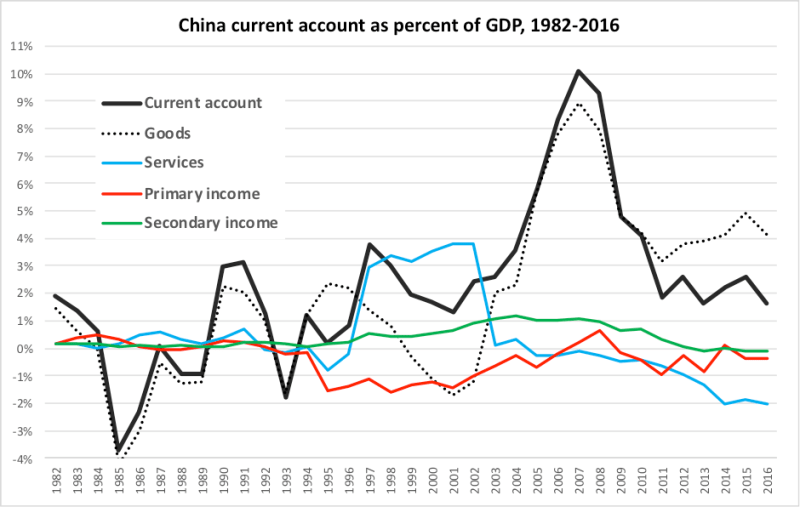
This share subsequently fell sharply due to a surge in exports from non-FFEs, although this was also in a context of falling current account surpluses as a proportion of GDP. As shown in the figure below, this was due to increasing deficits on China’s services account, which reached 2% of China’s GDP in 2014-16, knocking out about half of its goods surplus in 2014 and 2016.

China also returned to running deficits on its income account from 2009 onwards (with the slight exception of 2014), despite being a major international creditor. As explained by Yu Yongding, this is because China’s foreign assets mostly earn very low returns, such as in US treasury bills, whereas foreign investment in China is very profitable, possibly in excess of 20-30% per year, thereby cancelling out any of the balance of payments benefits that would normally accrue to being a major international creditor.

Graph Andrew Fischer article
Source: Author’s calculations from IMF balance of payments and international finance statistics (last accessed 21 March 2018).

Notably, the US is the mirror image of China: it is a major international debtor and yet it earns a surplus on its income account. Both situations were due to profit remittances, e.g. profits leaving China and entering the US. Indeed, Yilmaz Akyüz estimates that the net current account position of FFEs in China has been in deficit in recent years, meaning that their profit remittances were cancelling out their merchandise trade surpluses.

In other words, after the exceptional but historically brief period of running very large ‘twin surpluses’ (on both the current and financial accounts), the current account structure of China has reverted to a pattern that, as I explain in a recent article, is common among peripheral developing countries. The pattern is characterised by goods trade surpluses that counterbalance service account deficits (dominated by payments to foreign corporations) as well as the profit remittances of foreign corporations (and of other foreign investments, whether licit or illicit).

These rapid transformations have been reflective of the increasingly deep integration of China’s foreign trade into international networks dominated by Northern-based transnational corporations. The model has resulted in exceptional export performance, although this has occurred through the injection of considerable but underappreciated sources of vulnerability.

Indeed, as noted by Yu Yongding, from 2015 to 2017 the People’s Bank of China undertook the largest intervention in foreign exchange markets that any central bank has ever taken in order to prevent a run on the renminbi. This depleted its foreign exchange reserves by over 1 trillion US dollars. In another recent article, Yu adds that from 2011 to 2017, around 1.3 trillion US dollars of China’s foreign assets had effectively disappeared, probably reflecting capital flight. Together with the run on the renminbi, these were the principal reasons that the Bank of China put a hold on capital account liberalisation and tightened capital controls to an extent not seen since the East Asian financial crisis of the late 1990s.

Considering that much of such capital flight is destined for the US, either directly or indirectly via multiple offshore financial centres, in addition to the profitability that US corporations derive from China’s trade with the US, it is clear that the US is in the more powerful position in this bilateral relationship.

The imperial utility of trade decline discourses

From this perspective, the deep US trade deficits that have persisted since the early 1980s arguably represent a new form of advanced capitalist imperialism, the emergence of a system of tributes whereby states around the world effectively subsidise the expansion of US-centred capitalism. At the very least, the deficits are signs of a structural shift underlying global power relations, based on an increasingly predatory form of financialised capitalism, with the US still at its helm.

Much like with discourses of Soviet rivalry in the 1960s and 1970s, the current babble of US decline and lagging serve an ideological purpose within these continuing transmutations of US-centered power. It is effectively aimed at subordinating other countries and shifting the burden of adjustment onto them, while distracting attention away from the US-centered, corporate-led restructurings of global production systems that underlie US deficits in the first place.


Main photo: https://pixabay.com/en/donald-trump-politician-america-1547274/

About the author:

Andrew mug shot.JPGAndrew M. Fischer is Associate Professor of Social Policy and Development Studies at the ISS, and laureate of the European Research Council Starting Grant, which he won in the 2014 round. He is also the founding editor of the book series of the UK and Ireland Development Studies Association, published by Oxford University Press, titled Critical Frontiers of International Development Studies. He is also editor of the journal Development and Change. His forthcoming book, Poverty as Ideology, won the 2015 International Studies in Poverty Prize, awarded by the Comparative Research Programme on Poverty (CROP).


Deglobalisation Series | Backtracking from globalisation by Evan Hillebrand

By Posted on 2179 views

While globalisation still enjoys strong support in the Global South, major economies in the Global North now seem less enthusiastic about its purported benefits. This article explores how the United States through its previous policies came to backtrack from globalisation, showing that it is an altogether unsurprising development.


From the perspective of the United States (US), embodied in US president Donald Trump’s recent discourses, the liberal international trading system faces at least three major economic and socio-political challenges going forward: (1) income redistribution, (2) the rise of Asia and a potential shift in comparative advantage, and (3) the rise of China and the national security argument. Given the growing domestic unease with free trade and the fact that these exacerbating issues are worsening, I suggest that US policies will become less supportive of globalisation.

US withdrawal: surprising or expected?

In our 2011 article, “Backtracking from Globalization” (1), my coauthors and I discussed the declining support for globalisation in the United States and elsewhere. Since then the trend has gotten worse.

But why shouldn’t it? The US, after all, has only had a liberal trade policy for 60 or so years. In its early years, US policy focused on high tariffs, large subsidies to key industries, and infrastructure investment designed to create an industrial economy for the sake of military and economic power (sounds not too dissimilar to China today). The US moved to a freer-trade stance when the US was economically dominant and an expansion of global markets seemed as if it would be economically beneficial.

The US free trade strategy was also based on political theories and grand strategy. After World War II, trade expansion was seen as a good way to bolster Europe economically, tie it to the West, and strengthen the West against the Soviet Union. The US spurred the creation of the GATT/WTO in an effort to bring all countries into a democratic rule-based system under the assumption that trade would help all countries prosper under US leadership. Since 1980 or so, the US has tried to lure China into the world market system to foster interdependence and peace. In many respects, that policy can be considered a great success—ushering in a vast improvement in the material standard of living almost everywhere and many decades of great-power peace. China also did turn away from its Maoist phase of development.

 Ebbing enthusiasm for globalisation

Support for globalisation, however, is clearly headed in a negative direction and the ebbing of enthusiasm has been particularly dramatic in the United States. Recent polling data from the Pew Foundation and the Council on Foreign Relations (2) show that there is still support for international trade, but a majority worry that trade generates labor market costs in terms of job destruction and lower wages. This worry helped elect the current US president and his administration talks more about fair trade than free trade: ‘Nothing about the theory of comparative advantage would lend itself to a defense of a status quo that imposes higher barriers to exports on American producers than on foreign producers’ (Economic Report of the President 2018: 219) (3).

It is important to understand that it is not ignorance that has led US policy in this direction.

Many voters were lured to Donald Trump’s “America First” pitch because of a perception that wages were stagnant and communities were hurt because of globalisation. In reality it is more than just a hunch: income distribution in America has worsened and academic research by Paul Krugman (4) and others attributes some of that worsening to trade, although the magnitude of trade’s contribution is (and always will be) in dispute.

Support for globalisation has to some extent rested on the theory of comparative advantage, but that theory has never been the “slam dunk” argument that enthusiasts have made it out to be. It depends on so many assumptions that do not fit the current world economy, so the theory should only be relied upon as a general principle, not the decider of every policy dispute. Paul Samuelson (5) claimed in 1972 that the aggregate gains from trade are not necessarily positive. He expanded on this idea in his (2004) paper, ‘Where Ricardo and Mill Rebut and Confirm Arguments of Mainstream Economists Supporting Globalization’, saying that growth in the rest of the world can hurt a country if it takes place in sectors that compete with its native exports—where it has comparative advantage.

The rise of China

Relative, and even absolute, per capita GDP can fall in such a situation (6). Whether China’s rise can actually diminish the US is not clear, but the current Chinese government continues to employ active trade policies to push its industries up the value chain, aiming explicitly at sectors that have been the mainstay of US industrial pre-eminence. Samuelson says that ‘economic history is replete with examples like this, first insidiously, and later decisively’, pointing explicitly to British manufacturing being overtaken by US industry after 1850.

In addition to the economic threat posed by China, the US government has long worried about the security threat posed by China’s rise. The US-China Economic and Security Review Commission is an organisation chartered and funded by the US Congress and dedicated to the proposition that China poses a multifaceted threat to the US. It yearly issues a massive report that cites declines in the US defense industrial base, insecurity of defense supply lines, financial threats, Chinese ownership of critical US facilities, cyber threats, and other problems—all related to China. In the most recent report (7), it lists 26 recommendations for congressional action, many of which would amount to new trade restrictions.

Trade policies, while often rooted in interest groups scrambling for distributional gains, are also related to national economic and security concerns. In the past, pragmatic national interests have pushed trade policy in varying directions. There is no reason now to believe that the US is giving up on international trade, but there is every reason to believe that for a variety of national interests it will be much less enthusiastic about globalisation in the future.


References:
(1) Hillebrand, E.E., J. Lewer and J. Zagardo (2011) ‘Backtracking from Globalization’, Global Economy Journal 10(4).
(2) Poushter (2016) American Public, Foreign Policy Experts Sharply Disagree over Involvement in Global Economy. Pew Research Center, http://www.pewresearch.org/author/jpoushter.
(3) Council of Economic Advisors (2018) Economic Report of the President. Washington, D.C. https://www.whitehouse.gov/wp-content/uploads/2018/02/ERP_2018_Final-FINAL.pdf
(4) Krugman, P.R. (2008) ‘Trade and Wages, Reconsidered’, Proceedings of the Brookings Panel on Economic Activity. Spring conference. Available at: (http://www.princeton.edu/~pkrugman/pk-bpea-draft.pdf).
(5) Samuelson, P.A. (1972) ‘Heretical Doubts About the International Mechanism’, Journal of International Economics, 2(4): 443-453.
(6) Samuelson, P. (2004) ‘Where Ricardo and Mill Rebut and Confirm Arguments of Mainstream Economists Supporting Globalization’, Journal of Economic Perspectives 18(3): 135-146.
(7) U.S.-China Economic and Security Review Commission (2017) 2017 Report to Congress. Washington, D.C. Available at https://www.uscc.gov/sites/default/files/annual_reports/2017_Annual_Report_to_Congress.pdf

Also see: Deglobalisation Series | Is anti-globalisation only a preoccupation in the Global North? by Rory Horner, Seth Schindler, Daniel Haberly and Yuko Aoyama


UntitledAbout the author:

Professor Evan Hillebrand taught international economics at the Patterson School of Diplomacy and International Commerce at the University of Kentucky. His most recent book is Energy, Economic Growth, and Geopolitical Futures (MIT Press, 2015).