Tag Archives sexism

Pros and cons of a women-friendly rideshare app

As ride-sharing booms in Asia, women’s mobility is crucial. But it faces challenges like harassment due to the introduction of gendered strategies.

Photo by Hua Ling (Unsplash)

Ride-sharing platforms in Asia are thriving but their impact on women’s safety and mobility remains largely unexplored. This is concerning, given the prevalence of gender-based violence in conventional transport, particularly in South Asia where women face greater restrictions on independent mobility.

Enter TootleResearch conducted in Kathmandu, Nepal, shows that the issue of gender has featured centrally in the business strategy of the Nepali-owned ride share company.

Co-founder and CEO Sixit Bhatta describes Tootle, which launched in 2017, consistently as “not just a ride-sharing company, the whole idea revolves around encouraging freedom of movement“. Tootle seeks to expand the freedom of movement, especially as Kathmandu’s public transport has been unfriendly towards differently-abled people and women.

Without questioning Tootle’s social justice concerns, the focus on women was recognised as a business strategy as women comprise at least half of the potential passenger population and constitute a dormant pool of potential riders.

Women are also underrepresented in paid work. In Ethiopia, for example, these observations have contributed to the launch of a ride-sharing platform (Seregela) which worked with women drivers exclusively.

Recruiting more women as drivers is probably the most effective strategy to increase the share of women passengers. Women drivers convey a sense of safety and security to women passengers. Tootle has built this factor into its ride-sharing app by allowing passengers to ‘choose‘ between men and women drivers.

However, attracting more women drivers is a challenge. The ride-sharing platforms seek to address this by championing women as drivers in their advertisements and by depicting ride-sharing as a women’s practice, involving women drivers and women passengers.

The platforms also publish success stories about women drivers that carefully weave together the benefits of being a driver with aspects of women’s conventional gender roles. Tootle also sought to attract women drivers by not charging them a commission (initially it charged men drivers a 4 percent commission).

Tootle not only creates its supply of drivers in gendered ways, following the theoretical premise that platform companies are ‘in the business of making markets’ it does the same for demand. For the public this is less visible; yet, probably more impactful. In its driver’s interface, Tootle represents demand for ride-shares in hetero-normative ways: customers are presented as either female or male.

Research in 2019 suggests that drivers (who are mostly men), indeed, use this to give preference to women passengers. For example, women passengers rarely complained about long waits. One woman customer who mostly used Tootle said: “I never had to wait more than 10 minutes for a ride-request sent.” In contrast, men frequently complained. One said: “It will be a pleasant surprise if I ever get a ride without waiting for more than 30 minutes.”

Allowing drivers to give preference to women passengers can be argued to make ride-sharing more women-friendly because it reduces waiting times for women.

Unfortunately, it also facilitates sexism.

A male customer interviewed referred to a response he got when he complained to a (male) Tootle driver who picked him up after a long wait: “You should feel lucky, because you are my first male customer [today]. I never give rides to males but only to females. Why would I become a driver otherwise — it’s fun having a female on the back of my bike.”

While in this specific case no woman was negatively affected, the driver’s attitude mirrors those collected online from women passengers reporting harassment by male drivers both during and after the ride-share.

These incidents happen despite compulsory onboarding of new drivers in which ride-sharing platforms instruct newly recruited drivers about avoiding unwanted behaviour.

New drivers are told to not tease women customers, to refrain from comments that could be interpreted as sexual innuendos and to refrain from asking women customers to sit closer to the driver, or to brake in such a manner that the body of the woman passenger touches the driver.

Across Asia ride-sharing platforms have significantly transformed urban transportation, including in gendered ways. The expanded choice and availability of transport options is good news, especially for those women looking for and able to afford alternatives to existing gender-insecure forms of transport.

Recruitment efforts targeting women as drivers has not only created new opportunities for paid (part-time) work for women, it also contributed to further shifts in gender norms in urban transport.

However, the gender justice argument put forth by Nepal’s ride-sharing platforms must be recognised as a business strategy. When platforms make markets in gendered ways, this creates gendered tensions.

Most notably, allowing driver selection based on the passenger’s gender seems beneficial to women initially but it encourages sexist attitudes and creates the potential for gender-based violence.

Over recent years, Nepal’s ride-sharing platforms have improved complaint and tracking mechanisms to combat sexism. Yet, the failure to increase the share of women as drivers delimits the inclusiveness of ride-sharing platforms. Improving women’s riders working conditions may be the surest way to address this.


This article is part of a Special Report on the Asian Gig Economy, produced in collaboration with the Asian Research Centre – University of Indonesia


This article was originally published under Creative Commons by 360info™.


Opinions expressed in Bliss posts reflect solely the views of the author of the post in question.

About the authors:

Roy Huijsmans is an associate professor of childhood and youth studies. His research focuses on young people in processes of social development, which includes the emerging platform economy.

Pritee Hamal is an independent researcher based in Kathmandu, Nepal. She holds an MA in Development Studies and Gender Studies.

Are you looking for more content about Global Development and Social Justice? Subscribe to Bliss, the official blog of the International Institute of Social Studies, and stay updated about interesting topics our researchers are working on.


Brexit tales of discontent: the revenge of Empire by Helen M. Hintjens

By Posted on 2791 views

Nobody knows what happens after UK general elections on 12 December 2019: Brexit, a referendum on Irish unity, on Scottish independence, or a No-Deal exit from the EU?  In 1977, Tom Nairn in The Break up of Britain warned that during “extreme difficulties and contradictions, the prospect of break-down or being held forever in the gateway… may lead to… nationalist dementia for a society” (p. 349). The election taking place this week will decide whether the ghosts of imperial ancestors win the day, or whether younger generations can save the UK from its divided self.


Crisis? Which one?

Uncertainty over Brexit is wreaking havoc on the Brits. Those who want to remain in the EU are in despair; those who want to leave are angry. Most are sick of it. Britain’s collective mental health, already poor before Brexit, is worsening dramatically.

1.png

Illustration 1: anti-depressant prescriptions in England: another opioid crisis.

In 2012, the Jimmy Savile scandal erupted, resulting in a public crisis in confidence in the British establishment. The public enquiry under then-PM Teresa May into “Historic Child Sexual Abuse” involved serious charges against MPs, celebrities, and royals. The crisis recently resurfaced when Prince Andrew gave a BBC interview on his Epstein connection. He was soon forced to withdraw from UK public life. The Savile crisis is almost forgotten, yet in 2012, John Simpson in The Guardian called this “the worst crisis I can remember in my nearly 50 years at the BBC”. Brexit is now the second “worst crisis in 50 years” in less than a decade.

Myths and lies

Some see the 2016 Referendum result as based on myths and lies. The language of war—betrayal, surrender—gained currency. More recently, the Labour Party accused Johnson  and his rich friends of planning a ‘Big Short’ on a No-Deal Brexit. Pro-Brexiteers accuse Remainers (termed ‘Remoaners’) of thwarting the “will of the British people”. Tory MPs who are pro-Remain have been thrown out of the Conservative Party. Support for Brexit remains in rural, small-town and post-industrial England, despite the dire warnings of Operation Yellowhammer [1]. In London, Bristol and Birmingham, and across Scotland and Northern Ireland, the majority wants to Remain. Welsh opinion has moved towards Remain, or even Independence.

2.png

Illustration 2: Humour is essential

This joke sums up the dilemma for smaller UK countries: “An Irishman, a Scotsman and an Englishman go into a bar. The Englishman wants to leave, so they all have to leave”. Brexit humour abounds, and it helps a little, but only a little.

Macho English Nationalism

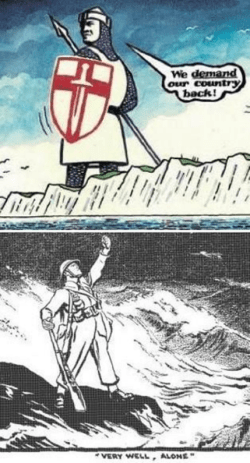
On Gender and Brexit, Aida Hozic and Jacqui True comment whilst “men took up 85% of the press space and 70% of television coverage”, during the Brexit campaign, “women [became]… visible as actors… to ‘clean-up’ the mess left by their male counterparts” (p. 276). Women and men voted similarly on Leave-Remain. Young people were notably more pro-Remain than their elders. Commenting in Third Text, Finlayson comments: “Farage’s Brexitism… opposes the small, ordinary, decent, local and familiar to the big, distant and untrustworthy”, showing a ‘little Englander’ mentality harking back to Empire. Pro-Brexit rhetoric centres on ‘guts’ and courage: “…phrases [that] invoke boyhood stories of wartime bravery against the odds and of standing up to boarding school bullies” (pp. 602-603), and tales of the Empire.

3.png

Illustration 3: Brexit and Dangerous Jingoism

Outdated imperial values are dangerous. Both racist and sexist, such values risk renewing sectarian violence in Northern Ireland. The murder of Labour MP Jo Cox and UK-wide spike in hate crime since the Referendum leaves minorities fearing the future. And small-minded English nationalism merely intensifies Scottish, Northern Irish, and Welsh nationalism. The 12 December 2019 elections are crucial.

Algorithms and Rule by Nobody

In today’s networked age, algorithm-based ‘filter bubbles’ limit social media users’ suggested content to their existing comfort zone. Guardian investigative journalist Carole Cadwalladr found that the Leave campaign defeated Remain by using such filtering algorithms effectively [2]. Causing suspicion of his motives, Boris Johnson recently refused to allow the publication of a parliamentary report on Russian social media interference in UK elections.

Pro-Brexiteers also frame Brexit as revolt against ‘faceless Brussels bureaucrats’, echoing Hannah Arendt’s ‘Rule by Nobody’. Yet EU neoliberalism could give way to UK financial deregulation, a danger with the UK constitution now collapsing. Abandoning compromise also means Britain could break into three or four national units. Sectarian and anti-minority violence would likely accompany this break-up.

End Thoughts

Nairn warned the Brits—especially the English—of the danger of rooting around in their imperial past for renewed nationalist identity symbols: “… once these well-springs have been tapped there is no real guarantee that the great forces released will be ‘controllable’” (p. 349). As minorities in the UK live in fear of the future, Brexiteers need constant reminding that words can be mortally dangerous. We are now in Karl Marx’s vision in The Eighteenth Brumaire where “[t]he tradition of all dead generations weighs like a nightmare on the brains of the living… [drawing]… from them names, battle slogans, and costumes in order to present this new scene in world history”. Rather than plunge back into its imperial past, and end up divided, it is hoped the UK electorate will vote to remain in the EU. The question now will be whether the EU will want us!


At a Research in Progress Seminar 12 December 2019 ‘BREXITLAND FAIRY TALES’, Helen Hintjens will elaborate on some of the points in this blog. 13.00-14.00, ISS. This happens to be on the same day as the UK national parliamentary elections!


[1] The latest Operation Yellowhammer document was released on 2 August 2019. It predicts shortages of medicine, “risk… panic buying… [which could] exacerbate food supply disruption”, “[u]rgent action… to ensure [continued] access to clean water”, “[the disruption of] [la]w enforcement data/information sharing UK-EU”, and “[p]rotests and counter-protests… across the UK” alongside “… a rise in public disorder and community tensions”.
In Northern Ireland “growth of the illegitimate economy” especially in cross-border areas“.
[2] https://www.spectator.co.uk/2019/11/exclusive-dominic-cummingss-secret-links-to-russia/
Cadwalladr also in:  https://www.theguardian.com/commentisfree/2017/may/17/dark-money-democracy-billionaires-funding

Image Credit Main Photo: Williams Murray Hamm on Flickr

20160917_190837

About the author:

Helen Hintjens is Assistant Professor in Development and Social Justice. She publishes on asylum policies and on post-genocide reconciliation in the African Great Lakes region, and Rwanda in particular.