
 By
By 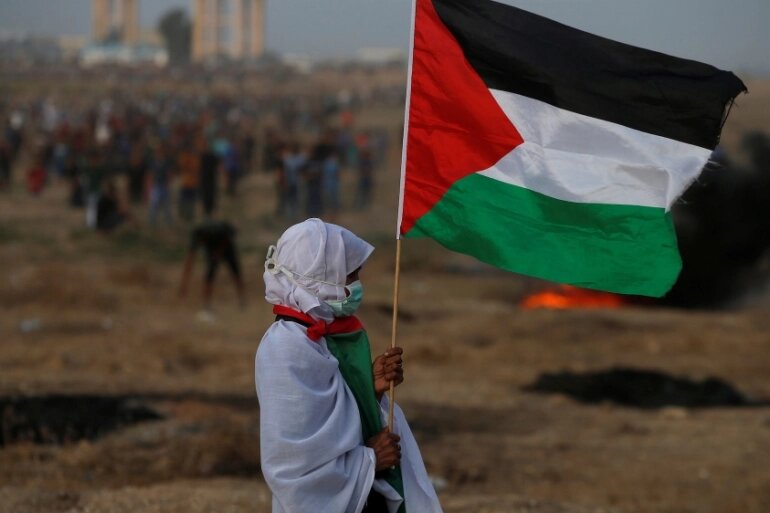
The noise never stops. The sky is filled with the buzzing of drones, echoing on and on, and with the sound of buildings collapsing as they are bombed. It’s not safe anywhere. There’s nowhere to flee to. And amidst a crumbling country and the chaos that is life in Palestine, people are trying to keep themselves upright. Rana Shubair in this article talks about life under the Israeli occupation and how parents have to stay strong as they watch their children face the hardships the occupation and grow up before their eyes.

Credits: Al Jazeera, available at: https://www.aljazeera.com/opinions/2019/3/30/how-the-great-march-of-return-resurrected-palestinian-resistance
These numbers are important for revealing the extent of violence and brutality on Palestinians by Israeli occupation, but it should not diminish other aspects of the daily struggle of those Palestinians who live under siege and occupation of Israeli forces. Apart from these killings and air attacks, Palestinians resist, struggle against, and experience everyday aggression, restrictions, and sanctions that affect their economy, wellbeing, health, and every other aspect of their life. The most vulnerable among them are children and women. This piece thus focuses on the life and struggles in Gaza and learns from the lens and perspective of a Palestinian woman, Rana Shubair, whom I interviewed about her lived experiences of the conflict and life in Gaza.
Rana Shubair is a survivor of latest aggression of 2021 in the Gaza Strip. She is an activist, mother of three, and author of two books. Her first book ‘In Gaza I Dare to Dream’ recounts details of her own life under the Israeli Occupation and the Gaza Siege. She presents Gaza as “a land where joy and grief are entwined, yet its people dare to dream, dare to love and struggle to gain their basic human rights”. Her second book, ‘My Lover Is A Freedom Fighter’, is a historical fiction that reflects about romance in Palestine while living under occupation.
While her narrative and personal experiences are heartfelt and reflect the hardship of Palestinians in present, in this interview she also reveals how Palestinians express their agency and determine their resilience and their power of resistance. You can listen to the entire interview (in English) at Global Development Review Podcast or watch it here. A shortened version of the interview follows.
Jaffer: How do you experience of being mother in Gaza at present, and what does it mean to be a mother in Gaza?
Rana: A mother in Gaza is a hero. We are stereotyped in the Western world as having domestic roles, but this is not the case. Mothers, wives, daughters, sisters – they all have a critical role in the Palestinian society and Palestinian resistance. So when I first had my children, I had hoped that by the time they grew up, this occupation would have ended. But I found myself confronted with new realities and much harsher ones. I grew up under occupation, but it wasn’t as brutal as the occupation my kids and their generation are witnessing. Because there was no aerial bombardment at that time.
So as my children grew up, they started asking me questions that sometimes I couldn’t find answers to.
One of my most famous entries I wrote in my book is when my two daughters were arguing with each other. One was saying, “we live in Gaza” and other was saying, “no we don’t live in Gaza, we live in Palestine”. I overheard it and my heart was broken because my own kids who live in their own country don’t know where they are located. They think that Palestine is a foreign land. They learn about Palestinian cities in their schools. But they have never seen those cities and were never allowed to go and visit their own country. So there was this dilemma that if we are living in Gaza, if we are living in Palestine, how come we can’t see it? As a mother I have come across situations where I can’t explain to them why we can’t go there.
This was one issue. Another issue that they were faced with the issue of Palestinian prisoners. One day my son came and wanted to make a poster that teachers often ask children to do for extra credit. When he came back, he brought a poster that was about a girl Wafa who was recently released from Israeli prison. And my son asked me innocently why she went prison. So I had to explain why they were in prison.
When we are walking down on the street, we see pictures of martyrs that are pasted on the walls. And they would ask you who these people were. Then you would have to say them that they are martyrs and explain what a martyr is. So one day my son came home and said, ‘mom I wanna go and see the hole where they put the martyrs in’. I was really shocked, because I don’t know where he got the information from.
For me, you can’t prevent your children from going outside. And this is something that is very painful for us as parents and as mothers. They don’t go through the normal phases of childhood that other children go through. They can tell you what kind of warplane is flying over them or what kind of rocket or missile is being launched. So as a Palestinian parent, you have to be strong, you have to be resilient, and you have no choice. It’s a heavy burden that we shoulder.
Jaffer: When people’s houses are destroyed, where do they go?
Rana: Those whose houses are targeted – the one that were recently targeted – were not as lucky as those who were prewarned. People living in the tall towers were warned. They could flee from their homes, some of them going to nearby relatives and some of them going to UNRWA schools (United Nations Relief and Work Agency Schools). And I believe that many of them took refuge in UNRWA schools because it is presumably safer, as it was assumed that Israel would not target a UN school. But in 2008 and 2014, Israel did target schools and they killed people who took refuge there. There is no safe place. If I want to leave my home and go to another home, it doesn’t mean that I am going to a safer place. Because what happened to two families that I know is that one of the women went to her parents’ house and she was killed there. So it’s like another displacement in the Gaza Strip and these people really have nowhere to go.
I would like to say that ordinary Palestinian life here is not ordinary. Israeli drones don’t leave our skies. And these drones are the surveillance drones, but they can also shoot and kill. So it’s not safe. So you think that it’s a surveillance drone, but a few years ago children were playing at the nearby park and they were killed and targeted by the drone on the spot. So by day and night, you can’t ignore the noise; you can’t pretend that it’s not there. I can’t really pretend that nothing is going to happen. So life here is very unstable and unpredictable.
Jaffer: As an international community, how can we support Palestine or how can we stand in solidarity with the Palestinians?
Rana: What I see is that the media outlets in the Western world is that they block the Palestinian narrative or twist the facts. So number one, I think we need to promote awareness about the Palestinian cause, no matter how small your role is. For me, connecting through this kind of online webinar or meeting between you and I is one way in which to do so.
In the recent attacks on Gaza, I have seen dozen of protests across the world, such as in America, in Britain, and even in Arab countries. They were people who responded to the protests and they are people who still protest to this day. And this is something that is very crucial. I think we have to keep making noise. Tell your government to keep making noise and keep being vocal about what the Palestinians are going through.
This article comes as a collaboration between Jaffer Latief Najar and Rana Shubair with an aim to spread awareness about the life and struggles in Palestine, especially Gaza. The collaboration was in the form of interview with Rana Shubair.
Opinions do not necessarily reflect the views of the ISS or members of the Bliss team.
About the author:

Jaffer latief Najar is a PhD researcher at International Institute of Social Studies, and Rana Shubair is a Palestinian survivor, activist and author of two books.
Are you looking for more content about Global Development and Social Justice? Subscribe to Bliss, the official blog of the International Institute of Social Studies, and stay updated about interesting topics our researchers are working on.
 By
By 
