Tag Archives girls

Women’s Week 2023 | From young girls to “bush wives”: Armed conflicts are traumatising girl soldiers in Africa, and post-conflict peacebuilding and rehabilitation efforts could be making it worse

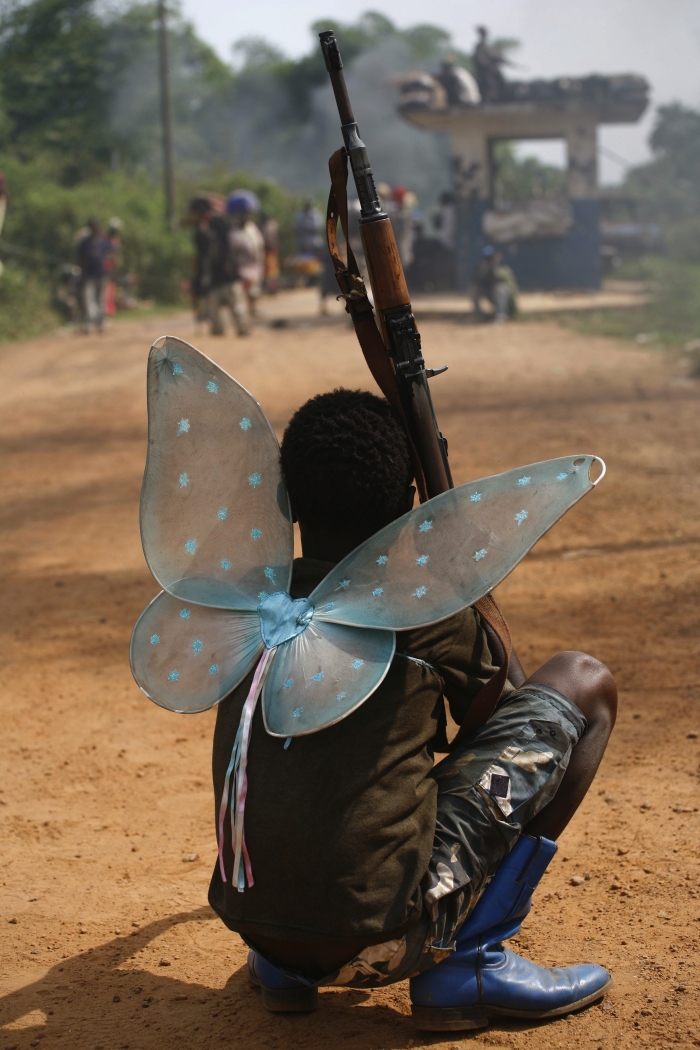
As armed conflicts persist across the world, children are repeatedly recruited into armed groups as soldiers, robbing them of their childhood. While some estimates reveal that girls comprise almost half of all child soldiers, they feature less prominently in post-conflict peacebuilding and rehabilitation efforts. Esther Beckley in her research explores the disproportionate impacts of war on girl soldiers, exposes the gender blindness of post-conflict peacebuilding efforts, and calls into question the legitimacy of peacebuilding programmes.

I joined the army by force in 2004. I was still a minor and married. I was harassed by the chief and it traumatised me a lot. I have a 7-year-old daughter who was born from this harassment.”

These are the words of Charlene Kahrikalembu, a young woman from Goma in the Democratic Republic of the Congo (DRC) who shared her experience with my co-researcher and I[1] about how she was forcefully recruited into the Patriotes Résistants Congolais (PARECO) armed group as a child soldier. Charlene’s narrative echoes that of the thousands of girls who are recruited across the world as fighters, chefs, sex slaves, brides, messengers, spies, and for other reasons in armed conflicts, yet remain unaccounted for during the post-conflict peacebuilding period.

Armed conflicts, wherever they occur, severely affect both people and material resources. Regrettably, the conscription of children, some as young as seven years old, into warring factions is a recurring tendency in armed conflicts, which affects their physical, mental, spiritual, emotional, and material well-being. In most situations, children are recruited to replace adults because they are vulnerable, subservient, and easily controlled.

Nonetheless, when the problem of child soldiers is examined, it is often depicted as a masculine phenomenon, i.e. the enlistment of boys. In researching this topic, I have found that this action is mostly influenced by mainstream perceptions of armed conflict as a phenomenon occurring between males who are ‘naturally’ strong and warrior-like. As Tickner (1992:2) puts it, “International Relations is a man’s world where war and power politics are special positions reserved for men”. This perception is further reinforced in the media with popular images of boys holding rifles, whereas girls are frequently deemed insignificant and rendered invisible within fighting forces. However, studies have shown that in contemporary wars, girls comprise 40% of children associated with fighting factions (Haer 2017).

More so, compared to girls not associated with fighting factions, girl soldiers are disproportionately affected by war. This is due to the lengthy period girl soldiers spend in the captivity of their respective armed groups, making them susceptible to persistent sexual violence, torture, drug use and abuse, and illness (Beckley 2021). For example, in Sierra Leone, the Revolutionary United Front (RUF) led by notorious rebel leader Foday Sankoh used the taboo on women’s nakedness as a weapon of war. This was done by parading naked girls on the frontlines in an attempt to nullify the traditional ‘juju’ (voodoo) used by the Civil Defence Forces (CDF), also known as ‘Kamajors’, who should not see naked women on the frontlines (Oluwaniyi 2019).

From my conversations with female ex-combatants in Goma, eastern DRC, I learnt that girl soldiers were distributed amongst commanders of armed groups to serve as wives, which entailed constant sexual violence and forced pregnancies. This was also the case for the Lord’s Resistance Army (LRA) led by rebel leader Joseph Kony in northern Uganda, which I studied as part of my Master’s research. In the north-eastern part of Nigeria, girls constitute most of the suicide bombers, performing a strategic role for Boko Haram terrorists (Oluwaniyi 2019).

Despite these prominent roles played by girl soldiers in various armed conflicts, they remain marginalised in peacebuilding efforts. Peacebuilding typically comes as a disappointment to most girl soldiers, since they are faced with an identity crisis of whether they should be considered soldiers or mere sex slaves and wives of commanders. This bolsters their exclusion from peace processes like the United Nations’ Disarmament, Demobilization, and Reintegration (DDR) programmes. DDR is the very first stage of the peacebuilding process, aimed at dissolving warring factions, retrieving weapons from ex-combatants, and providing trauma healing and socio-economic opportunities to ex-soldiers to facilitate their reintegration into civilian life.

Rhetorically, gender issues are pertinent to these tasks, but in reality, this is not always the case. First, the design of DDR programmes in most countries requires ex-soldiers to present a weapon to prove their participation in the conflict before they are eligible for DDR benefits. Now,

how does a girl soldier whose body was used as a weapon of war ‘prove’ that she was a soldier?

In Liberia, for instance, commanders had to testify to a girl soldier’s participation in their armed group before she could benefit from the DDR programme.

Consequently, most girl soldiers do not benefit from the DDR procedure due to its masculinist design. They are forced to self-reintegrate into their communities with no physical, mental, social, or economic support. They return to communities where they previously killed their neighbours and relatives with no form of community reintegration, which is included in the DDR package. Hence, they are stigmatised and labelled as ‘damaged goods’, ‘bush wives’, ‘unmarriageable’, etc. It is much worse for girl mothers who return with children labelled ‘bush babies’ and are rejected by their community members.

All in all, peacebuilding efforts remain gender-blind, and one must consider whether the end goal of so-called peacebuilding ventures like the DDR is long-term peace. This raises critical unanswered questions, such as: What are the underlying knowledge and principles used to address gender issues in peacebuilding? How are the categories of difference constructed? By whom and for what purpose? What are the implications of these on girl soldiers and sustainable peace in general? Such questions need to be urgently addressed in studies aimed at investigating gender imbalances in post-conflict peacebuilding.


References

Beckley, E.M and Oluwaniyi O.O (Forthcoming). ‘The Rhetorics of Education for Girl Ex-Combatants in Sierra Leone’s DDR Programme’. Africa Spectrum: SAGE.

Beckley, E.M. 2021, “DDR and the Education of Ex-Combatant Girls in Africa” in The Palgrave Handbook of African Women’s Studies, eds. O. Yacob-Haliso & T. Falola, 1st edn, Springer Nature, Switzerland, pp. 178.

Haer, R. 2017, “The study of child soldiering: issues and consequences for DDR implementation”, Third World Quarterly, vol. 38, no. 2, pp. 450-466.

Oluwaniyi, O. 2019, “Women’s Roles and Positions in African Wars” in The Palgrave Handbook of African Women’s Studies, eds. O. Yacob-Haliso & T. Falola, First edn, Palgrave Macmillan, Cham, Switzerland, pp. 85-105.

Tickner, J.A. 1992, Gender in International Relations: Feminist Perspectives on Achieving Global Security, Columbia University Press, United States of America.

[1] This blog article is based on research I conducted for my Master’s degree five years ago, on further research I am conducting in pursuit of a PhD on gender, conflict, and peacebuilding, as well as that of other researchers in this field.


Opinions expressed in Bliss posts reflect solely the views of the author of the post in question.

About the author:

Esther M. Beckley is a final-year PhD researcher at the University of Malta. She is also a visiting Research Fellow at the International Institute of Social Studies (ISS). Her areas of expertise include gender, conflict, child soldiers, postconflict peacebuilding and development, international interventions in conflict contexts, etc., with a regional focus on sub-Saharan Africa.

Are you looking for more content about Global Development and Social Justice? Subscribe to Bliss, the official blog of the International Institute of Social Studies, and stay updated about interesting topics our researchers are working on.

Women’s Week 2023 |“I am a girl, not a woman”: how recognizing diverse girlhoods can foster the inclusion of young mothers in debates on womanhood and girlhood.

In Uganda, young mothers are predominantly called women, although some young mothers contest that representation and prefer to be called girls.  The normative insistence on categorizing young mothers as women despite girlhood being a transitional phase locks young mothers in an in-between category, a space in which they can be neither girls, nor children, nor women. International Women’s Day celebrations further risk widening the gap between such girls whose daily realities centre on survival, writes Annah Kamusiime. The need to recognize diverse girlhoods is a first step in ensuring that girls are included in discussions on womanhood and girlhood.

During one of the interviews I conducted in 2021 for my PhD research on representations of young motherhood, Nandi, a 16-year-old Ugandan mother, told me, “Even though I am a mother, I am a girl, not a woman”. Her statement is an example of the agentic manoeuvres of girls whose voice remains silenced and their existence pushed to the liminal space – liminal because as mothers, they are in an in-between category where they are not girls anymore, nor children, and nor women, especially when they are not married.

Being a parent is the main marker of transition to adulthood/womanhood; in most of Uganda others also include menarche, a sexual debut, and wifehood. But the young mothers I spoke to did not consider themselves to be adults – women – despite having borne children. And, having borne children, they were no longer children themselves. As a result, their needs as young mothers may not be adequately addressed by efforts that separately target girls, children, or women. Young mothers who fall into none of the marked categories of girl, child, or woman thus face marginalization and exclusion.  In this article, I discuss why the recognition of a distinct category of diverse girlhoods is necessary to further their inclusion – also in celebrating International Women’s Day.


‘Girl’ or ‘woman’? How words make worlds

The terms we use are not neutral – the way in which words are combined allows for certain meanings to flourish and for others to be minimized. For instance, consider these two statements: “The girl-child is pregnant” versus “The girl is pregnant”. Both can be used to describe an adolescent mother. But an emphasis on a pregnant girl as a child (as the first statement does) may elicit a different interpretation and response when compared to using only the word ‘girl’. And often such word choices are deliberate. Words make worlds; struggles over meaning are not just about semantics – they are strategic, they have an effect, they shape discourses, actions and rhetoric, and they are contested. Thus, there is a need to be reflexive on how we frame different categories of persons because conceptions shape engagement.

Another example that shows how words matter for girls: While I was writing this article, my 18-year-old daughter read it and told me that at school, their teacher told them that a girl becomes a woman on the day of her sexual debut. I asked her whether that mattered and whether it would make a difference if a girl would be referred to as a woman or a girl. Yes, she said, ‘girl’ and ‘woman’ mean different things, and it matters which is used. As in the case of Nandi, the labels  ‘woman’ placed on a ‘girl’ has specific connotations – it means she engaged in sexual intercourse yet she is expected to be asexual, she is a mother at the wrong time, and she has ruptured normative notions of conceptions of ideal childhood and youth because she is expected to be innocent.  As a result, young mothers are stigmatized and are seen as a threat to the social morals and social order, which fuels their exclusion.

These two examples show that yes, the label of a woman that is placed on girls who are young mothers matter to them even when everyone else may not acknowledge it. Many of the young mothers I have spoken to choose to be called girls, not children, or girl-children, or women. The failure to consider the desire for this distinct categorization means that these young mothers’ voices remain unheard. I therefore argue that we need to reimagine and reconstruct girlhood as diverse and distinct in policy, practice, and debates at different levels-national and international.


Girls just wanna be girls

Several renowned scholars studying girlhood, including those highlighted by Claudia Mitchell, have advocated for what they have referred to as the girl-method. Rather than continue to lump girls under either the categories ‘children’, ‘young women’, or ‘women’, they argue that it is vital to add ‘girls’ as a distinct category.  This would remove girls from the shadows and place them in the centre of the discussion on diverse girlhoods, including those of young mothers.

My argument above does not mean that we should dismiss distinct moments like the UN Decade of the Girl Child (1991-2001) and International Day of the Girl Child. Indeed, such moments have been and continue to be an open platform for considering and rethinking issues girls face. However, a merger of ‘girl’ with ‘child’ in what is celebrated as the day of the ‘girl-child’ has been problematized as being passive, essentialist, and homogenizing. My sentiments of the ‘girl-child’ label are that it emphasizes their innocence, vulnerability, and dependency and brings out connotations of powerlessness while also infantilizing girls.

It also poses a risk of illuminating the ‘child’ and marginalizing the ‘girl’ because the ‘child’ may take precedence over the ‘girl’. There are words which are nice sounding, such as ‘girl-child’, and the nicer they sound, the more useful they are for those seeking to establish their moral authority. To counter the risk of applying labels to exclude and marginalize girls, the category ‘girl’ ought to be conceptualized, deconstructed, and reconstructed from their perspective.


How International Women’s Day can exclude girls

This is my first ever blog article. I decided to write it because I wanted to reflect on how International Women’s Day (IWD) celebrations relate to the experiences of young mothers in urban poor locales, such as those that I have continued to engage with as part of my PhD research. In rethinking this year’s IWD theme (‘DigitALL: innovation and technology for gender equality’), several questions came to mind. For example, are girls considered in this debate on gender equality? How relevant is this debate on the role of technology and innovation for young mothers living in poor locales in Uganda where only 9% of the populations aged 15 years and above own a smart phone? Moreover, where only 8% of females use internet? And why should young mothers care about such discussions? How will tech-driven developments benefit them?

Unable to answer these questions, I decided to read up on International Women’s Day. What initially sparked IWD were spontaneous demonstrations to protest inhumane working conditions women faced and to press for improved working conditions. Other issues, such as the right of women to vote, were consequently included, and today IWD marks efforts to enact gender equality more broadly.

What is interesting is that International Women’s Day is assumed to be for everyone, everywhere, and is intended to celebrate and encourage collective action in pursuit of gender equality and extended rights for women. However, discussions about women’s suffrage, gender equality and parity are often far removed from the daily realities of many girls and women, including the young mothers in impoverished areas that I worked with – those who are primarily concerned with meeting their survival needs. In this way, specific categories of girls, or even women, including young mothers, may find themselves being excluded from efforts to enact gender equality and from celebrations of these.

International Women’s Day was initiated by working-class women and while it has since significantly highlighted the plight of women and efforts to close the gender gap, it is at a risk of becoming too universalized and corporatized to include women who face a range of intersecting struggles that stretch beyond voting rights and workplace equity. In celebrating International Women’s Day, it is important to remember those girls and women whose voices still go unheard, who move around in the shadows, and whose intersecting struggles leave them far behind.

Opinions expressed in Bliss posts reflect solely the views of the author of the post in question.

About the author:

Annah Kamusiime is a PhD researcher at the International Institute of Social Studies, Erasmus University Rotterdam (ISS-EUR). Her research interests are in gender and adolescent and youth sexual and reproductive health and rights (SRHR). She is also a Director of Programmes at Nascent Research and Development Organization Uganda.

Are you looking for more content about Global Development and Social Justice? Subscribe to Bliss, the official blog of the International Institute of Social Studies, and stay updated about interesting topics our researchers are working on.