Tag Archives gender inequality violence

Women’s Week 2023 | From young girls to “bush wives”: Armed conflicts are traumatising girl soldiers in Africa, and post-conflict peacebuilding and rehabilitation efforts could be making it worse

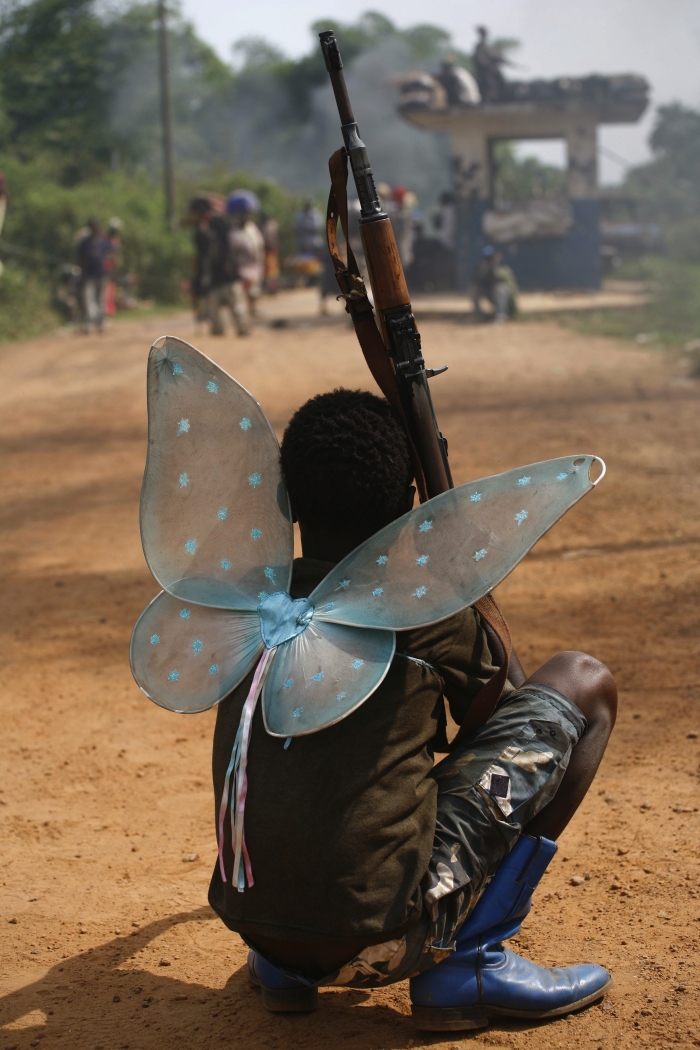
As armed conflicts persist across the world, children are repeatedly recruited into armed groups as soldiers, robbing them of their childhood. While some estimates reveal that girls comprise almost half of all child soldiers, they feature less prominently in post-conflict peacebuilding and rehabilitation efforts. Esther Beckley in her research explores the disproportionate impacts of war on girl soldiers, exposes the gender blindness of post-conflict peacebuilding efforts, and calls into question the legitimacy of peacebuilding programmes.

I joined the army by force in 2004. I was still a minor and married. I was harassed by the chief and it traumatised me a lot. I have a 7-year-old daughter who was born from this harassment.”

These are the words of Charlene Kahrikalembu, a young woman from Goma in the Democratic Republic of the Congo (DRC) who shared her experience with my co-researcher and I[1] about how she was forcefully recruited into the Patriotes Résistants Congolais (PARECO) armed group as a child soldier. Charlene’s narrative echoes that of the thousands of girls who are recruited across the world as fighters, chefs, sex slaves, brides, messengers, spies, and for other reasons in armed conflicts, yet remain unaccounted for during the post-conflict peacebuilding period.

Armed conflicts, wherever they occur, severely affect both people and material resources. Regrettably, the conscription of children, some as young as seven years old, into warring factions is a recurring tendency in armed conflicts, which affects their physical, mental, spiritual, emotional, and material well-being. In most situations, children are recruited to replace adults because they are vulnerable, subservient, and easily controlled.

Nonetheless, when the problem of child soldiers is examined, it is often depicted as a masculine phenomenon, i.e. the enlistment of boys. In researching this topic, I have found that this action is mostly influenced by mainstream perceptions of armed conflict as a phenomenon occurring between males who are ‘naturally’ strong and warrior-like. As Tickner (1992:2) puts it, “International Relations is a man’s world where war and power politics are special positions reserved for men”. This perception is further reinforced in the media with popular images of boys holding rifles, whereas girls are frequently deemed insignificant and rendered invisible within fighting forces. However, studies have shown that in contemporary wars, girls comprise 40% of children associated with fighting factions (Haer 2017).

More so, compared to girls not associated with fighting factions, girl soldiers are disproportionately affected by war. This is due to the lengthy period girl soldiers spend in the captivity of their respective armed groups, making them susceptible to persistent sexual violence, torture, drug use and abuse, and illness (Beckley 2021). For example, in Sierra Leone, the Revolutionary United Front (RUF) led by notorious rebel leader Foday Sankoh used the taboo on women’s nakedness as a weapon of war. This was done by parading naked girls on the frontlines in an attempt to nullify the traditional ‘juju’ (voodoo) used by the Civil Defence Forces (CDF), also known as ‘Kamajors’, who should not see naked women on the frontlines (Oluwaniyi 2019).

From my conversations with female ex-combatants in Goma, eastern DRC, I learnt that girl soldiers were distributed amongst commanders of armed groups to serve as wives, which entailed constant sexual violence and forced pregnancies. This was also the case for the Lord’s Resistance Army (LRA) led by rebel leader Joseph Kony in northern Uganda, which I studied as part of my Master’s research. In the north-eastern part of Nigeria, girls constitute most of the suicide bombers, performing a strategic role for Boko Haram terrorists (Oluwaniyi 2019).

Despite these prominent roles played by girl soldiers in various armed conflicts, they remain marginalised in peacebuilding efforts. Peacebuilding typically comes as a disappointment to most girl soldiers, since they are faced with an identity crisis of whether they should be considered soldiers or mere sex slaves and wives of commanders. This bolsters their exclusion from peace processes like the United Nations’ Disarmament, Demobilization, and Reintegration (DDR) programmes. DDR is the very first stage of the peacebuilding process, aimed at dissolving warring factions, retrieving weapons from ex-combatants, and providing trauma healing and socio-economic opportunities to ex-soldiers to facilitate their reintegration into civilian life.

Rhetorically, gender issues are pertinent to these tasks, but in reality, this is not always the case. First, the design of DDR programmes in most countries requires ex-soldiers to present a weapon to prove their participation in the conflict before they are eligible for DDR benefits. Now,

how does a girl soldier whose body was used as a weapon of war ‘prove’ that she was a soldier?

In Liberia, for instance, commanders had to testify to a girl soldier’s participation in their armed group before she could benefit from the DDR programme.

Consequently, most girl soldiers do not benefit from the DDR procedure due to its masculinist design. They are forced to self-reintegrate into their communities with no physical, mental, social, or economic support. They return to communities where they previously killed their neighbours and relatives with no form of community reintegration, which is included in the DDR package. Hence, they are stigmatised and labelled as ‘damaged goods’, ‘bush wives’, ‘unmarriageable’, etc. It is much worse for girl mothers who return with children labelled ‘bush babies’ and are rejected by their community members.

All in all, peacebuilding efforts remain gender-blind, and one must consider whether the end goal of so-called peacebuilding ventures like the DDR is long-term peace. This raises critical unanswered questions, such as: What are the underlying knowledge and principles used to address gender issues in peacebuilding? How are the categories of difference constructed? By whom and for what purpose? What are the implications of these on girl soldiers and sustainable peace in general? Such questions need to be urgently addressed in studies aimed at investigating gender imbalances in post-conflict peacebuilding.


References

Beckley, E.M and Oluwaniyi O.O (Forthcoming). ‘The Rhetorics of Education for Girl Ex-Combatants in Sierra Leone’s DDR Programme’. Africa Spectrum: SAGE.

Beckley, E.M. 2021, “DDR and the Education of Ex-Combatant Girls in Africa” in The Palgrave Handbook of African Women’s Studies, eds. O. Yacob-Haliso & T. Falola, 1st edn, Springer Nature, Switzerland, pp. 178.

Haer, R. 2017, “The study of child soldiering: issues and consequences for DDR implementation”, Third World Quarterly, vol. 38, no. 2, pp. 450-466.

Oluwaniyi, O. 2019, “Women’s Roles and Positions in African Wars” in The Palgrave Handbook of African Women’s Studies, eds. O. Yacob-Haliso & T. Falola, First edn, Palgrave Macmillan, Cham, Switzerland, pp. 85-105.

Tickner, J.A. 1992, Gender in International Relations: Feminist Perspectives on Achieving Global Security, Columbia University Press, United States of America.

[1] This blog article is based on research I conducted for my Master’s degree five years ago, on further research I am conducting in pursuit of a PhD on gender, conflict, and peacebuilding, as well as that of other researchers in this field.


Opinions expressed in Bliss posts reflect solely the views of the author of the post in question.

About the author:

Esther M. Beckley is a final-year PhD researcher at the University of Malta. She is also a visiting Research Fellow at the International Institute of Social Studies (ISS). Her areas of expertise include gender, conflict, child soldiers, postconflict peacebuilding and development, international interventions in conflict contexts, etc., with a regional focus on sub-Saharan Africa.

Are you looking for more content about Global Development and Social Justice? Subscribe to Bliss, the official blog of the International Institute of Social Studies, and stay updated about interesting topics our researchers are working on.

Dilemmas for aid agencies working in Afghanistan under Taliban’s gender apartheid rule.

In late December 2022, the Taliban announced that aid organizations would no longer be allowed to employ women. It was the next step in a series of measures that make it increasingly impossible for Afghan women to study, live or think independently. In response, many aid organizations have stopped their work, others are continuing. What will be the effect of all this and where are the boundaries for continuing assistance?

The consequences of the ban are disastrous. After the takeover of power by the Taliban in 2021, the economy of Afghanistan collapsed, the government currently hardly functions and health services have disappeared except for aid-managed programmes. Drought, floods and last summer’s big earthquake all made matters worse. Current estimates are that 20 million people depend on humanitarian assistance and the ban on women’s employment will certainly cost lives. In addition, jobs are very rare in today’s Afghanistan. Many women who work for aid organizations are the sole breadwinner in their family. These families will face poverty if these women resign from their jobs.

UN diplomats and aid organizations are on high alert and they are feverishly meeting to seek strategies that enable them to stand up for human rights and yet maintain aid  as much as possible. The UN Security Council, as well as many countries, has also condemned the ban. Global humanitarian aid coordinator, Martin Griffiths, will be travelling to Afghanistan in the coming weeks in an attempt to persuade the government to change its mind. For the time being, however, the Taliban do not seem sensitive to outside pressure.

There are currently about a hundred aid organizations that have stopped their work. Some agencies take a principled approach: they condemn excluding female employees as a gross violation of human rights and are reluctant to strike deals with the Taliban about the provision of aid. Other organizations emphasize the logistical implications of the ban: aid is not possible in Afghanistan without women, because only women can reach the vulnerable women and children who need it most.

There are some organizations that can continue their work without disruption, including Médecins sans Frontières (MSF). Their employees are not yet affected by the new measure. The Taliban appear to be divided over the matter. The ban was issued by the Afghan Ministry of Economic Affairs, which is under the influence of the hardliner Taliban. Most national aid organizations are registered under this ministry. This implies that the ban also affects the programmes of foreign aid organizations that work through local partners. On the other hand, foreign organizations that implement their own programmes, such as MSF, fall under the Ministry of Foreign Affairs, which has not adopted the measure. The Ministry of Health is also holding off the ban for the time being.

There are voices advocating that the aid organizations should draw a line and stop talking to the Taliban. However, many organizations will continue to look for a humanitarian space to uphold assistance in order not to let the population down. They are prepared to negotiate at a local level, where it is expected that some rulers may apply the ban more leniently. This is a common humanitarian strategy: negotiate where necessary and continue to look for ways to continue to provide aid. A disadvantage of this strategy may be that the Taliban can play off aid organizations against each other.

The ban is still fresh and evolving – new announcements are  expected soon. As far as I am concerned, there is one red line: organizations cannot agree to provide assistance when women are excluded from their services. Aid agencies, the UN and international governments should convey a common message: Aid that is reserved for men only is a no-go as this would contribute to the system of gender apartheid that prevails under the Taliban.


This blog is based on research that was supported by the European Research Council (ERC) Horizon 2020 programme [Advance grant number 884139].


Opinions expressed in Bliss posts reflect solely the views of the author of the post in question.

About the author:

Dorothea Hilhorst is professor of Humanitarian Studies at the International Institute of Social Studies of Erasmus University.


Are you looking for more content about Global Development and Social Justice? Subscribe to Bliss, the official blog of the International Institute of Social Studies, and stay updated about interesting topics our researchers are working on.

Nth Room Crimes and intensifying gender conflict in South Korea: attempting to unite a highly divided society

By Posted on 10214 views

The horrific case of videos showing the sexual exploitation of women in South Korea being sold on the social media platform Telegram was recently uncovered, prompting a public outcry and leading to feminist action in the country. Known as the Nth Room Crimes, this case shows just how far South Korean society still is from eliminating the oppression of women and addressing skewed gender relations. The strong backlash from men against efforts to redress gender inequality makes matters even worse. This article shows that toxic masculinity in South Korea urgently needs to be addressed for any real change to take place and suggests some possible first steps.

Source: Voice of America https://www.voanews.com/east-asia-pacific/south-koreas-metoo-movement-challenges-workplace-sexual-harassment

Disclaimer

This article carries a trigger warning. It contains descriptions of events related to sexual exploitation that may be distressing to sensitive readers.


Between 2018 and 2020, thousands of videos of women being sexually exploited were sold on the social media platform Telegram by a pimp known as Doctor. A copycat followed suit and even more videos were sold online. As the sordid details of these horrific crimes, known as the Nth Room Crimes, were uncovered, South Korean society was shaken to the core. Besides the fact that the perpetrator was a young man with a ‘good background’, the extent of the crimes also led to widespread shock and disbelief. More than 60,000 people had paid using cryptocurrency to watch these videos, and over 100 women had been sexually abused in the videos, including more than 20 minors.

In response, South Koreans signed an online petition pressing for the identities of the perpetrators to be made public; over two million signatures were collected in a short period. The perpetrators’ real names were pasted in the media for all to see and condemn. Yet this is not enough. These events should lead us to urgently question the extent of misogyny in South Korea and to come up with ways to counter it. This article looks at how gender stereotyping and misogyny are well alive in South Korea and what effect it has on the efforts to press for real and enduring change.

A highly unequal society

Despite the flourishing of activities promoting gender equality in South Korea, women are still suffering the burden of highly skewed gender relations. Economic development has resulted in the increased participation of women in the labour market; however, only 4.5% of women occupied executive positions in South Korean companies as recently as 2019. Digital technologies have also contributed to the rise of feminist movements and awareness-raising about gender issues (Kim, 2017; Hasunuma and Shin, 2019). Nevertheless, they have also increased cyber gender-based crimes, including the phenomenon of spycams, misogynistic commentary on social media platforms, and the Nth Room Crimes discussed above. It is clear that the commodification of female bodies has been accelerated through those online activities.

The current situation in South Korea has several roots: nation-building based on neoliberalism, Confucianism, and toxic masculinity. Specifically, neoliberal national building efforts apply a ‘(neo)-Confucian’ philosophy that supports traditional gender hierarchies and divisions (Kim, 1996; Lee, 2014). This patriarchal system has led South Korean women to become and remain second-class citizens and the men to become the breadwinners or “salaryman” ‘who were middle-class men and full-time salaried employees during the post-war period’ (Taga, 2005, cited in Lee and Parpart, 2018).

In response to these developments, the country’s feminist movement has led several activities. It joined the #MeToo movement, the #Iamfeminist movement, and the post-it movement. After a public testimony by female prosecutor Seo Ji Heyon of harassment and intimidation by male seniors in 2018, which made news headlines, not only activists, but also many citizens started to speak up, showing how widespread sexual harassment and assault were and criticising structural gender inequality (Hasunuma and Shin, 2019). However, little has changed; as the case of the Nth Room Crimes shows, gender inequality and misogynistic attitudes are well and alive.

Source: BBC https://www.bbc.com/news/world-asia-43534074

Contending discourses on the position of men: a nation divided

Some South Korean men have opposite views of the extent of gender discrimination in Korean society. In the view of young men, the social privileges enjoyed by men of the previous generation have been sharply diminished, and they feel isolated by the current government’s female-oriented policies (Kwon, 2019). Moreover, changing expectations about the role of men in running households and raising children has intensified gender conflict (Kwon, 2019). Furthermore, some Korean men feel disadvantaged when competing against women for job positions and feel that women have more opportunities to be appointed. Moreover, women are seen to benefit from self-improvement through employment and other opportunities made available to them, while men are conscripted, leading to widespread resentment among men towards women. Thus, while men’s opportunities to further themselves are perceived to decrease, those of women are sharply increasing.

Indeed, female participation in economic activity steadily increased between 2011 and 2019. However, The Economist in 2018 found that the gap between male and female labour participation remains large, with South Korea faring worst compared to other OECD countries (see graph below). Men still have an advantage over women in the labour market, yet they feel that women are unfairly benefiting from new opportunities for participation.

As seen above, men and women have different perspectives on gender inequality in South Korea. Lee and Parpart (2018) criticised inequitable gender divisions in terms of employment and emphasised that there is a need to deconstruct the silence on gender relations (p. 317). Nowadays, many South Korean women are attempting to make their voices heard and participate in the feminist movement, but some men are against it.

An ongoing dialogue between genders that is sorely needed is not yet taking place as men and women navigate gender conflicts separately instead of collaboratively.

But something is being done to attempt to change these conflicts. The Korean Institute for Gender Equality Promotion and Education (KIGEPE) under the Ministry of Gender Equality and Family of the Republic of Korea (MOGEF) has developed ‘GENDERON’, a knowledge-sharing platform seeking to promote gender equality and prevent gender violence through furthering education on gender equality. This platform offers free monthly educational video clips to introduce gender conflicts and gender-related laws to the public and encourages citizens to participate in discussions by offering incentives and staging competitions. Moreover, the MOGEF has attempted to develop an open forum for youth participation, giving young people the opportunity to directly propose policies related to gender equality and consult with relevant ministries.

Yet it is questionable whether these platforms are actually making a difference when it comes to such a deep-seated problem. Only those who seek to change the structural inequalities are likely to engage in discussions, and the discussions are likely to address just the tip of the iceberg. In the meantime, the support of young adult men for the current government continues to decline. It is clear than an active, open conversation between men and women is necessary to address gender hatred and conflict. Education programmes and measures to prevent online gender crimes can be a start. The media should also make an effort to adhere to the broadcasting ethics code in a way that would foster healthy discussions on gender inequality without amplifying gender conflicts. Above all, the government should pay attention to preventing men from feeling alienated in its preparation and implementation of gender-related policies and should encourage all genders to participate in an open conversation on gender issues that continue to divide this country.


References

BBC (2018) “#MeToo movement takes hold in South Korea”. Available at: https://www.bbc.com/news/world-asia-43534074 (Accessed: 4 February 2021).

Cho, Y (2020), “Nth Room case: How many years for ‘digital sex crime’ in Korea? [VIDEO]”, The Korean Times, October 22, Available at; https://www.koreatimes.co.kr/www/nation/2021/01/718_298005.html  (Accessed: 4 February 2021)

Kwon, J (2019) “South Korea’s young men are fighting against feminism”. Available at: https://edition.cnn.com/2019/09/21/asia/korea-angry-young-men-intl-hnk/index.html (Accessed: 4 February 2021).

GENDERON (2019). KIGEPE MEDIA, Available at: https://genderon.kigepe.or.kr/geme/inf/gemeIntro.do (Accessed: 4 February 2021).

Hasunuma. L and Shin. K (2019) “#MeToo in Japan and South Korea: #WeToo, #WithYou”, Journal of Women, Politics & Policy, 40:1, 97-111, Available at; DOI:10.1080/1554477X.2019.1563416 (Accessed: 6 January 2021)

Jeong, E, Y (2019), “South Korea’s Male-Dominated Workplaces in Spotlight After Sexual Harassment Accusations”, The Walls Street Journal, 20 August, Available at; https://www.wsj.com/articles/south-koreas-male-dominated-workplaces-in-spotlight-after-sexual-harassment-accusations-11597915806 (Accessed: 31 January 2021)

KIGEPE (2017), “main Project”, KIGEPE, Available at: https://www.kigepe.or.kr/eng/main/main.do?menuNo=22000 (Accessed: 4 February 2021).

Kim. K. (1996), “Nationalism: An advocate of, or a barrier to, feminism in South Korea”, Women’s Studies International Forum ,19, (1–2), pp 65–74, Available at; doi: 10.1016/0277-5395(95)00063-1. (Accessed: 4 February 2021).

Lee N (2014) “The Korean Women’s Movement of Japanese Military’ comfort Women’: Navigating between Nationalism and Feminism,” THE REVIEW OF KOREAN STUDIES, 17(1), pp. 71–92.

Lee, J. and Parpart, J. L. (2018) “Constructing Gender Identity through Masculinity in Csr Reports: The South Korean Case,” Business Ethics, 27(4), pp. 309–309. Available at: http://doi: 10.1111/beer.12191. (Accessed: 8 April 2021)

Statistics KOREA Government (2021) Index Korea, Available at: https://www.index.go.kr/potal/main/EachDtlPageDetail.do?idx_cd=1572 (Accessed: 4 February 2021).

The Economist (2019), “The glass-ceiling index”, Daily Chart , March 8,  Available at: https://www.economist.com/graphic-detail/2019/03/08/the-glass-ceiling-index (Accessed: 4 February 2021).

MOGEF(2019) “청년 참여 플랫폼, 청년이 주도하는 문화 혁신! [Youth participation outh participation platform, cultural innovation led by youth!(translated by author)]”, MOGEF, Available at: http://www.mogef.go.kr/nw/enw/nw_enw_s001d.do?mid=mda700&bbtSn=707617 (Accessed: 4 February 2021).

Yonhap (2020), “Sex crime chat room ignites public fury”, The Korea Herald, March 23, Available at; http://www.koreaherald.com/view.php?ud=20200323000289 (Accessed: 4 February 2021).

Opinions do not necessarily reflect the views of the ISS or members of the Bliss team.

About the authors:

Inhwa Jeong is currently studying Economics of Development in the MA program from Development Studies at ISS. She has five years of development cooperation experience, specialising in project management. Her interests lie in the economic empowerment of marginalised people and particularly keen on gender and environmental issues.

Kanae Inage is in the MA program of Human Rights, Gender and Conflict Studies at ISS. Her research interests focus on gender-based violence and feminist movements specifically in East Asian areas.


Are you looking for more content about Global Development and Social Justice? Subscribe to Bliss, the official blog of the International Institute of Social Studies, and stay updated about interesting topics our researchers are working on.