
 By
By 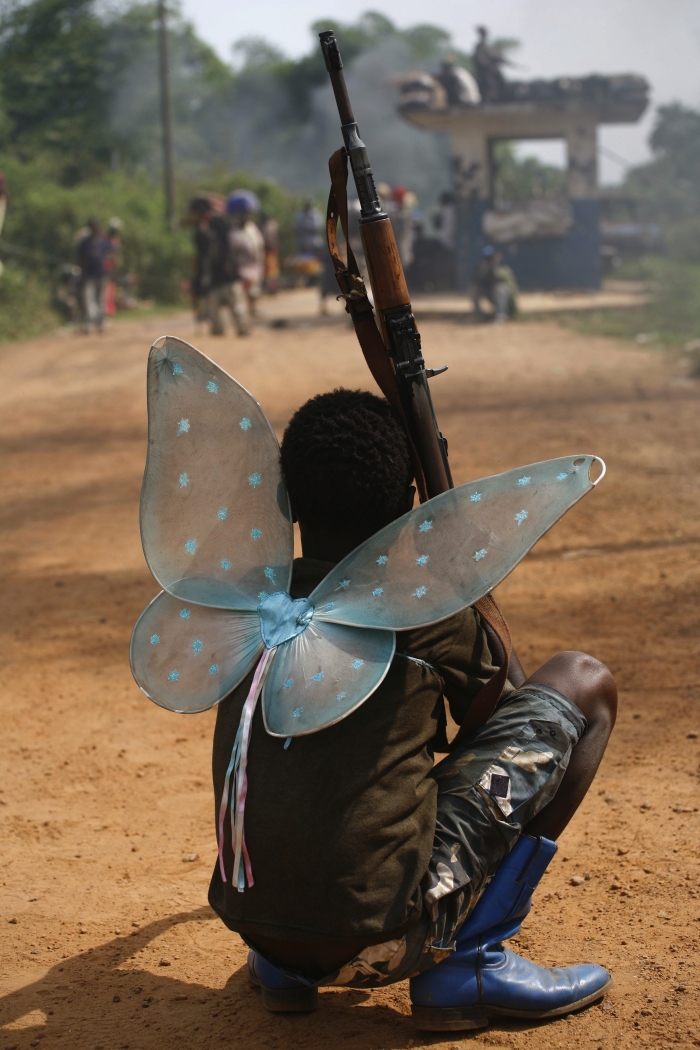
As armed conflicts persist across the world, children are repeatedly recruited into armed groups as soldiers, robbing them of their childhood. While some estimates reveal that girls comprise almost half of all child soldiers, they feature less prominently in post-conflict peacebuilding and rehabilitation efforts. Esther Beckley in her research explores the disproportionate impacts of war on girl soldiers, exposes the gender blindness of post-conflict peacebuilding efforts, and calls into question the legitimacy of peacebuilding programmes.

I joined the army by force in 2004. I was still a minor and married. I was harassed by the chief and it traumatised me a lot. I have a 7-year-old daughter who was born from this harassment.”
These are the words of Charlene Kahrikalembu, a young woman from Goma in the Democratic Republic of the Congo (DRC) who shared her experience with my co-researcher and I[1] about how she was forcefully recruited into the Patriotes Résistants Congolais (PARECO) armed group as a child soldier. Charlene’s narrative echoes that of the thousands of girls who are recruited across the world as fighters, chefs, sex slaves, brides, messengers, spies, and for other reasons in armed conflicts, yet remain unaccounted for during the post-conflict peacebuilding period.
Armed conflicts, wherever they occur, severely affect both people and material resources. Regrettably, the conscription of children, some as young as seven years old, into warring factions is a recurring tendency in armed conflicts, which affects their physical, mental, spiritual, emotional, and material well-being. In most situations, children are recruited to replace adults because they are vulnerable, subservient, and easily controlled.
Nonetheless, when the problem of child soldiers is examined, it is often depicted as a masculine phenomenon, i.e. the enlistment of boys. In researching this topic, I have found that this action is mostly influenced by mainstream perceptions of armed conflict as a phenomenon occurring between males who are ‘naturally’ strong and warrior-like. As Tickner (1992:2) puts it, “International Relations is a man’s world where war and power politics are special positions reserved for men”. This perception is further reinforced in the media with popular images of boys holding rifles, whereas girls are frequently deemed insignificant and rendered invisible within fighting forces. However, studies have shown that in contemporary wars, girls comprise 40% of children associated with fighting factions (Haer 2017).
More so, compared to girls not associated with fighting factions, girl soldiers are disproportionately affected by war. This is due to the lengthy period girl soldiers spend in the captivity of their respective armed groups, making them susceptible to persistent sexual violence, torture, drug use and abuse, and illness (Beckley 2021). For example, in Sierra Leone, the Revolutionary United Front (RUF) led by notorious rebel leader Foday Sankoh used the taboo on women’s nakedness as a weapon of war. This was done by parading naked girls on the frontlines in an attempt to nullify the traditional ‘juju’ (voodoo) used by the Civil Defence Forces (CDF), also known as ‘Kamajors’, who should not see naked women on the frontlines (Oluwaniyi 2019).
From my conversations with female ex-combatants in Goma, eastern DRC, I learnt that girl soldiers were distributed amongst commanders of armed groups to serve as wives, which entailed constant sexual violence and forced pregnancies. This was also the case for the Lord’s Resistance Army (LRA) led by rebel leader Joseph Kony in northern Uganda, which I studied as part of my Master’s research. In the north-eastern part of Nigeria, girls constitute most of the suicide bombers, performing a strategic role for Boko Haram terrorists (Oluwaniyi 2019).
Despite these prominent roles played by girl soldiers in various armed conflicts, they remain marginalised in peacebuilding efforts. Peacebuilding typically comes as a disappointment to most girl soldiers, since they are faced with an identity crisis of whether they should be considered soldiers or mere sex slaves and wives of commanders. This bolsters their exclusion from peace processes like the United Nations’ Disarmament, Demobilization, and Reintegration (DDR) programmes. DDR is the very first stage of the peacebuilding process, aimed at dissolving warring factions, retrieving weapons from ex-combatants, and providing trauma healing and socio-economic opportunities to ex-soldiers to facilitate their reintegration into civilian life.
Rhetorically, gender issues are pertinent to these tasks, but in reality, this is not always the case. First, the design of DDR programmes in most countries requires ex-soldiers to present a weapon to prove their participation in the conflict before they are eligible for DDR benefits. Now,
how does a girl soldier whose body was used as a weapon of war ‘prove’ that she was a soldier?
In Liberia, for instance, commanders had to testify to a girl soldier’s participation in their armed group before she could benefit from the DDR programme.
Consequently, most girl soldiers do not benefit from the DDR procedure due to its masculinist design. They are forced to self-reintegrate into their communities with no physical, mental, social, or economic support. They return to communities where they previously killed their neighbours and relatives with no form of community reintegration, which is included in the DDR package. Hence, they are stigmatised and labelled as ‘damaged goods’, ‘bush wives’, ‘unmarriageable’, etc. It is much worse for girl mothers who return with children labelled ‘bush babies’ and are rejected by their community members.
All in all, peacebuilding efforts remain gender-blind, and one must consider whether the end goal of so-called peacebuilding ventures like the DDR is long-term peace. This raises critical unanswered questions, such as: What are the underlying knowledge and principles used to address gender issues in peacebuilding? How are the categories of difference constructed? By whom and for what purpose? What are the implications of these on girl soldiers and sustainable peace in general? Such questions need to be urgently addressed in studies aimed at investigating gender imbalances in post-conflict peacebuilding.
References
Beckley, E.M and Oluwaniyi O.O (Forthcoming). ‘The Rhetorics of Education for Girl Ex-Combatants in Sierra Leone’s DDR Programme’. Africa Spectrum: SAGE.
Beckley, E.M. 2021, “DDR and the Education of Ex-Combatant Girls in Africa” in The Palgrave Handbook of African Women’s Studies, eds. O. Yacob-Haliso & T. Falola, 1st edn, Springer Nature, Switzerland, pp. 178.
Haer, R. 2017, “The study of child soldiering: issues and consequences for DDR implementation”, Third World Quarterly, vol. 38, no. 2, pp. 450-466.
Oluwaniyi, O. 2019, “Women’s Roles and Positions in African Wars” in The Palgrave Handbook of African Women’s Studies, eds. O. Yacob-Haliso & T. Falola, First edn, Palgrave Macmillan, Cham, Switzerland, pp. 85-105.
Tickner, J.A. 1992, Gender in International Relations: Feminist Perspectives on Achieving Global Security, Columbia University Press, United States of America.
[1] This blog article is based on research I conducted for my Master’s degree five years ago, on further research I am conducting in pursuit of a PhD on gender, conflict, and peacebuilding, as well as that of other researchers in this field.
Opinions expressed in Bliss posts reflect solely the views of the author of the post in question.
About the author:
 Esther M. Beckley is a final-year PhD researcher at the University of Malta. She is also a visiting Research Fellow at the International Institute of Social Studies (ISS). Her areas of expertise include gender, conflict, child soldiers, postconflict peacebuilding and development, international interventions in conflict contexts, etc., with a regional focus on sub-Saharan Africa.
Are you looking for more content about Global Development and Social Justice? Subscribe to Bliss, the official blog of the International Institute of Social Studies, and stay updated about interesting topics our researchers are working on.

