Tag Archives financial

Reforming the international financial system is no act of charity

Rolph van der Hoeven and Rob Vos are the authors of a chapter* of the recently published book ‘COVID-19 and International Development’. In this blog, they elaborate on their chapter, which is about the international financial system. They urge governments worldwide to implement four reforms, necessary to create more fiscal space and access to adequate external finance for developing countries.

Deep inequalities in pandemic response capacity

The global economic crisis provoked by the COVID-19 pandemic has painfully revealed the fundamental flaws in the international financial and fiscal system (IFFS). While advanced countries could engage in massive fiscal and monetary support measures, low- and middle-income countries lacked such capacities and were hit disproportionally. During the first year of the pandemic (2020), advanced countries provided fiscal stimuli to the tune of 12.5 percent of Gross Domestic Product (GDP) on average. This was three times more in relative terms than the stimulus in emerging and other middle-income countries, and almost 10 times more than governments in low-income countries could provide (Figure 1). This divergence in government support mimicked the inequality in vaccine roll-out.

Figure 1. Fiscal and monetary support in response to COVID-19, as of January 2021

Source: Van der Hoeven and Vos (2022), based on data from IMF (2021), Fiscal Monitor, Database of Country Fiscal Measures in Response to the COVID-19 Pandemic.

Four reforms to overcome financing flaws

As with past crises, a lack of adequate contingency financing forced poorer nations to take a big hit with lasting consequences. While high-income countries could engage in massive, and almost costless fiscal and monetary expansion, low-income countries saw their external debts increase to severe distress levels. In addition, they were forced to devalue their currencies, and curtail economic and social support programs. Consequently, an estimated 100 million to 150 million more people faced hunger during 2020, lifting the total number of people with not enough to eat to 810 million.[1]

The lack of fiscal space and access to adequate external finance for developing countries has its origins in the weaknesses of the International Financial and Fiscal System (IFFS). These structural weaknesses demand four urgent reforms, outlined below:

  1. Establish credible mechanisms for international tax coordination.

Such mechanisms would include, among other things, an internationally agreed, uniform corporate tax rate of approximately 25% to stop tax base erosion. This tax rate would hinder multinational companies shifting their profits to tax havens. Improved tax coordination should further include mandated publication of data on offshore wealth holdings. This would enable all jurisdictions to adopt effective progressive wealth taxes and facilitate the monitoring of income taxes effectively paid by the super wealthy. After years of deliberations, the G20 indeed agreed to a proposal for uniform corporate tax treatment in 2021. Unfortunately, at 15%, the rate is still significantly lower than we proposed, thereby falling short of making a more significant impact on boosting tax revenues and on limiting profit-shifting behaviour.[2]

  1. Establish a multilaterally backed sovereign debt workout mechanism.

Although existing mechanisms to renegotiate sovereign debts with private creditors have improved over the years, they are still far from adequate. This is due to the multiplicity of debt contracts, some of which are not subject to collective action clauses. These collective action clauses are perceived as preventing more drastic action in cases of crises; without them bonds could potentially lose a great amount of their value. A global institutional mechanism to renegotiate sovereign debts should, therefore, be put in place as soon as possible. To this day, sovereign debt solvency problems continue to be solved in an ad-hoc fashion, at little favourable terms to debt-distressed countries. Moreover, they are accompanied by policy conditionality. This leads to unnecessary hardship in affected countries.[3]

  1. Reform of policy conditionality attached to International Monetary Fund (IMF) contingency financing.

While the IMF has recognized the need for enhanced public spending by developing country governments, including those facing debt distress, in practice, however, it continues providing pro-cyclical policy advice. This means that the IMF asks for fiscal restraint, rather than deficit spending when economies are in recession.

  1. Increasing the availability of truly international liquidity by increasing Special Drawing Rights (SDRs) and making these available to developing countries.

As an important step in this direction, the IMF approved the issuance of US $650 billion in new SDRs in June 2021. However, no agreement has yet been reached regarding how these additional SDRs should be allocated to developing countries, and how they can leverage additional investment to foster sustainable development. Had such reforms been in place already, the pandemic response would have provided a fairer level playing field for emerging and developing countries. This would have mitigated the pandemic’s worst economic consequences.


Conclusion

None of these reforms should be seen as acts of charity. They are necessary to facilitate a global economic recovery that is both sustainable and equitable. As in past crises, government leaders have acted with a ‘me first’ attitude, as has been blatantly clear in the roll-out of vaccination programs. Some countries perceived this as a return to protectionism. This form of protectionism was evident in the unprecedented fiscal responses of high-income countries to protect the livelihoods of their own citizens, but which woefully disregarded the fate of people in low-income countries. The governments of those countries did not have the means to protect the livelihoods of their citizens to the same extent. Beggar-thy-neighbour policy responses, however, will affect global prosperity in the long term, and will make the Sustainable Development Goals elusive.


[1]  Laborde, D., Martin, W. and Vos, R. (2021) Impacts of COVID-19 on Global Poverty, Food Security and Diets, Agricultural Economics 52(3) https://doi.org/10.1111/agec.12624, and FAO, IFAD, UNICEF, WFP and WHO. 2021. The State of Food Security and Nutrition in the World 2021.  Transforming food systems for food security, improved nutrition and affordable healthy diets for all.  Rome: FAO. https://doi.org/10.4060/cb4474en

[2] A. Cobham, 2021 Is today a turning point against corporate tax abuse? Tax Justice Network, 4 June 2022

[3] INET. (2021). The pandemic and the economic crisis: A global agenda for urgent action (Interim report of the commission for global economic transformation). Institute for New Economic Thinking. https://www.ineteconomics.org/research/research-papers/the-pandemic-and-the-economic-crisis-a-global-agenda-for-urgent-action


Note

*This blog is based on: Rolph van der Hoeven and Rob Vos (2022), ‘Reforming the International Financial and Fiscal System for better COVID-19 and Post-Pandemic Crisis Responsiveness’, Chapter 2 in Papyrakis, E.(ed.). COVID19 and International Development, Springer

Opinions expressed in Bliss posts reflect solely the views of the author of the post in question.

About the authors:

Rolph van der Hoeven is Professor of Employment and Development Economics at the Institute of Social Studies (ISS)

Rob Vos is Director of Markets, Trade and Institutions Division at the International Food Policy Research Institute.

Are you looking for more content about Global Development and Social Justice? Subscribe to Bliss, the official blog of the International Institute of Social Studies, and stay updated about interesting topics our researchers are working on.


Deglobalisation Series | Financial deglobalisation: a North-South divide? by Haroldo Montagu

By Posted on 2437 views

The Financial Crisis of 2008/09 led to a structural break in financial globalisation, setting cross-border capital flows back to the average of the 1990s. Do differences between cross-border financial flows of the Global North and Global South disqualify the financial slowdown as deglobalisation? Will the 21st Century be a deglobalised century, or are we just witnessing a new (and maybe better) face of financial globalisation?


While it is clear that trade flows collapsed and slowed down after the global financial crisis of 2008/2009 and that deglobalisation in terms of international trade has occurred ever since, the picture is less clear for capital flows. Forbes argues that financial deglobalisation is visible in the sharp and sustained decline in cross-border financial flows associated with the recent global financial crisis, with no signs of recovery. Leading think tanks and international organisations, such as the McKinsey Global Institute (MGI), the Bank of International Settlements (BIS), and the International Monetary Fund (IMF), have, however, argued that financial deglobalisation is not a reality because the decrease of financial flows is not a broad-based and sustained phenomenon. Closer scrutiny of data related to this can help us to better understand whether financial deglobalisation is happening or not.

Graph 1: Cross-border financial flows (share of world GDP) reached a peak before the crisis and have since been at a lower level, with indications that they are now flattening out
Graph 1.png
Source: own elaboration based on IFS and WEO databases (2018) (see IMF data)

As illustrated in Graph 1, the financial crisis created a structural break in the level and pace of financial globalisation. In 2007, international financial flows peaked at more than 50% of world GDP, but then global cross-border flows fell significantly in 2008 and after some recovery levelled out at around 15% of world GDP (slightly above the average for the 1990s).

G7 versus BRICS

This global average, however, does not in itself reflect different experiences in the Global North and Global South. So, let’s take on one side the advanced economies gathered in the G7 (Canada, France, Germany, Italy, Japan, UK, US) representing the Global North and, on the other, emerging economies labelled as BRICS (Brazil, Russia, India, China and South Africa), as a Global South sample, and regard their own experiences to move beyond the aggregate picture that might not reveal differences in the extent of deglobalisation. Graph 2, like Graph 1, shows cross-border financial flows, but rather than focusing on global GDP displays the regional GDPs for the Global North (G7) and the Global South (BRICS).

Graph 2: Different experiences in G7 and BRICS (cross-border financial flows as a share of regional GDPs)
Financial deglobalisation(?)

Graph 2

Source: own elaboration based on IFS and WEO databases (2018) (see IMF data)

The graph clearly shows that the G7 grouping reached a financial peak in 2007, followed by a sharp decline in 2008/09 and poor recovery following the crisis. The graph, however, paints a very different picture for the BRICS economies. A number of factors are noteworthy in determining whether financial globalisation is also taking place in the BRICS grouping. First, the decrease in financial flows after the crisis, although important, is not as significant for the BRICS as for G7 countries. While the decline of the advanced economies was about 40 percentage points during 2008/09, amongst the BRICS economies the fall was only about 8 percentage points.

Second, in the BRICS grouping the financial flows recovery (both in level and in terms of speed) was quite remarkable. As a consequence, in 2010 the BRICS had recovered to a level well above the level in the 1990s, while the share of the G7 countries remained around 30 percentage points below the pre-crisis peak. These figures clearly show that nowadays the BRICS countries hold a similar share of financial integration (relative to their own GDPs) as the G7 countries(!). A third point worth mentioning is that BRICS’s financial flows, while insignificant in the 1990s and early 2000s, increased, on average, to about 2% of world GDP following the crisis (2010-2016). Again, this means that the gap between advanced and emerging economies is shrinking.

How global is financial deglobalisation?

The key issue is whether these dissimilarities would disqualify the labelling of the financial slowdown after the crisis as deglobalisation that after all is understood to be a widespread phenomenon. While G7 countries can’t recover financial momentum, the BRICS’s financial decline was neither sharp nor sustained. In short, there does not (yet) seem to be enough evidence to call it a collapse justifying the deglobalisation denomination.

The McKinsey Global Institute also points out here to other differences between advanced and developing countries. They argue that while cross-border capital flows for the whole world remain 60% below their peak finance momentum, in developing countries capital flows have rebounded. By estimating shares in constant terms, different than the current ones I showed, MGI arrived at the same conclusion. In addition, they emphasise the increase in South-South financial flows linked to foreign direct investment (FDI).

In the same vein the BIS argues here that even in the advanced economies, deglobalisation is restricted only to European countries. If focusing only on banking flows, consolidated by bank nationality—and not by bank location as the IMF usually presents—a broad-based deglobalisation trend is not evident. Rather, we are witnessing a European financial retreat.

Resetting financial globalisation

What is this diverse financial flows behaviour telling us? According to Mallaby, after the crisis financial flows show a “healthy correction”, defining the years leading up to the financial peak as an “aberration”. Accepting the “healthy correction” hypothesis would lead us to pose an alternative characterisation to the deglobalisation of financial markets. In this sense, words like “retreat”, “retrenchment” and even or “reverse” would be more appropriate for depicting the phenomenon. Moreover, can we say that post-crisis financial globalisation is healthier than the one registered before the crisis? Maybe it is not about lower shares, but better ones, leading to sounder financial markets where the financial globalisation reach is set by policymakers and regulators and not by an indomitable financial speculation, heading, as usual, to a crisis.

Whether is the rising regulation, the macro-prudential policies or just plain and simple risk aversion after the aberration (or a mix of all of them), financial globalisation’s newest phase looks, in general, the least volatile phase that might be least prone to crisis. However, is this new shape of globalisation good news? As usual, it depends. The Global North cannot afford to cause another boom-and-bust cycle whose impacts and costs are, indeed, globalised while their benefits are not. On the other hand, Global South recovery is not necessarily good news either. It is not clear that financial flows linked to ODA, debt, remittances or even FDI alone can drive economic growth or development.

Hence, cautionary measures should be taken (or reinforced) by governments to allocate foreign capital where is needed and do not validate unregulated financial speculation, especially the one triggered from the Global North. Despite their heterogeneity and criticism, the UN Sustainable Development Goals (SDGs) might be a good starting point regarding what is required to finance with foreign capital and what it’s not. Additionally, countries of the Global South must stand up and speak out, jointly, in international fora, warning about the dangers of financial aberrations. This should be presented as a global problem (even when it originated in the Global North) rather than a regional phenomenon or as a once-in-a-lifetime kind of thing, which it may not be.

Will the 21st Century be a deglobalised century, or are we just witnessing a new (and maybe better) face of financial globalisation? Only time and, hopefully, financial markets regulators, will tell.


Also see: Is anti-globalisation only a preoccupation in the Global North? by Rory Horner, Seth Schindler, Daniel Haberly and Yuko Aoyama


Untitled.pngAbout the author:

Haroldo Montagu is a recent graduate of the ISS. Before studying at ISS, the author was appointed as National Director of Development Strategies and Macroeconomic Policy at the Ministry of Economy and Public Finance of Argentina. He also worked as a consultant for the Economic Commission for Latin America and the Caribbean. He teaches topics in International Economics and Economic Development at university level in Argentina.


The imperial intentions of Trump’s trade war babble by Andrew M. Fischer

By Posted on 2775 views

In defence of his trade war with China, Trump claims that ‘when you’re $500bn down you can’t lose.’ The problem with this stance is that persistent US trade deficits with China are arguably a sign of US strength or even imperial privilege, not weakness. However, on this issue, he has much of conventional economics wisdom supporting him in his delusions that the US is being treated unfairly or is ‘behind’ based on these deficits.


Trump’s trade tirades are being vigorously disputed by liberal economists the world over, although the riposte is usually in defence of free trade and existing trade deals. However, many of these same economists have promulgated the underlying idea that US trade deficits are the result of some sort of disadvantage or decline.

For instance, as I discussed in 2009, 2010, 2011 and 2012, many prominent economists such as Paul Krugman argued then (and many still do now) that China’s undervalued currency gave it an unfair advantage, causing deficits and even financial bubbles in the US. Many economists on the left have taken a similar line of argument. For instance, Yanis Varoufakis argues that US trade deficits have planted the seeds for the downfall of the US ‘Minotaur’ because it has made the country increasingly dependent on the willingness of other countries to finance these deficits.

Beyond methodological nationalism

The problem with this reasoning is that international trade, income and financial data mostly represent the trade, income and asset movements made by corporations. Conversely, our system of international accounts is severely out of date given that these data are still reported on the basis of country residence rather than ownership. It also treats these flows as if they were arm’s length trades in final goods, or so-called ‘autonomous’ flows of income or finance, rather than the internalised operations of lead firms and their networks of subsidiaries, affiliates, or subcontractors.

The country-based framing of the international accounts serves to obscure the very resilient and virulent foundations of US power, based in the private corporate sector. Corporate ownership and/or control of trade, income and financial flows have become increasingly internationalised, even while remaining predominantly centred in the North and with a strong allegiance to maintaining US dominance. International efforts to track and govern these aspects of ownership or control from the 1970s onwards have also been systematically undermined, especially by the US. As a result, the antiquated international accounting system is very unfit for the task of tracking these corporate activities. Most of the discussion on global imbalances avoids this reality.

In this sense, as argued by Jan Kregel already a decade ago, the US shift to systemic trade deficits from the late 1970s onwards is best understood as a reflection of this internationalisation of US-centred corporations as well as the increased profitability of these US corporations operating in the international economy.

A simple stylised example is the iPhone. When Apple sends a production order to a subcontractor, this is not recorded as a service export from the US. However, the return export of the iPhone is reported as a goods export from China, even though the export is contracted by Apple, a US company. The iPhone is then sold in the US at many times its exported value, and the vast majority of the value of the final sale is accrued in the US. The US has a merchandise trade deficit in this production and distribution network, even though this deficit is associated with the immense value-added accrued in the US and the profitability of Apple. The same applies when Walmart exports from itself in China to itself in the US.

The idea that China’s surpluses and foreign exchange reserves constitute increasing power is similarly based on this flawed understanding of international accounts. As I have argued in 2010 and 2015, a rarely acknowledged attribute of the explosion of China’s surpluses in the 2000s was their rapid denationalisation. Foreign funded enterprises (FFEs)—most fully foreign funded—quickly came to dominate the exports of China, and then the trade surpluses themselves, to the extent that by 2011, FFEs accounted for over 84% of the merchandise trade surplus.

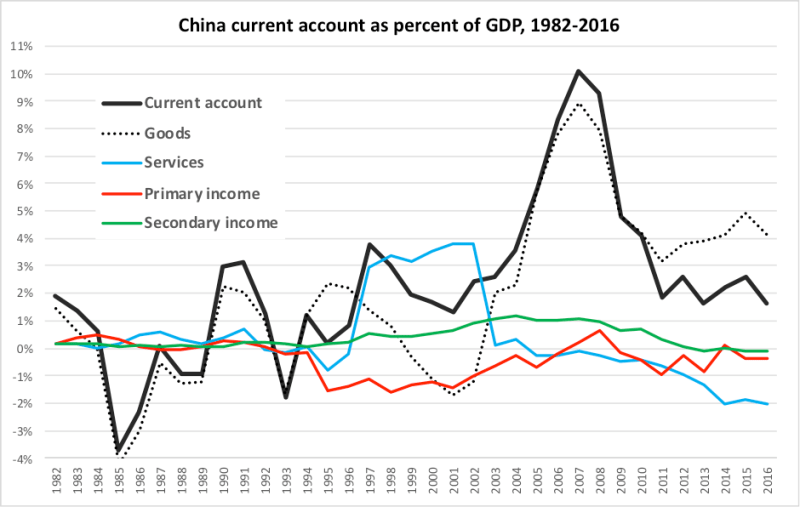
This share subsequently fell sharply due to a surge in exports from non-FFEs, although this was also in a context of falling current account surpluses as a proportion of GDP. As shown in the figure below, this was due to increasing deficits on China’s services account, which reached 2% of China’s GDP in 2014-16, knocking out about half of its goods surplus in 2014 and 2016.

China also returned to running deficits on its income account from 2009 onwards (with the slight exception of 2014), despite being a major international creditor. As explained by Yu Yongding, this is because China’s foreign assets mostly earn very low returns, such as in US treasury bills, whereas foreign investment in China is very profitable, possibly in excess of 20-30% per year, thereby cancelling out any of the balance of payments benefits that would normally accrue to being a major international creditor.

Graph Andrew Fischer article
Source: Author’s calculations from IMF balance of payments and international finance statistics (last accessed 21 March 2018).

Notably, the US is the mirror image of China: it is a major international debtor and yet it earns a surplus on its income account. Both situations were due to profit remittances, e.g. profits leaving China and entering the US. Indeed, Yilmaz Akyüz estimates that the net current account position of FFEs in China has been in deficit in recent years, meaning that their profit remittances were cancelling out their merchandise trade surpluses.

In other words, after the exceptional but historically brief period of running very large ‘twin surpluses’ (on both the current and financial accounts), the current account structure of China has reverted to a pattern that, as I explain in a recent article, is common among peripheral developing countries. The pattern is characterised by goods trade surpluses that counterbalance service account deficits (dominated by payments to foreign corporations) as well as the profit remittances of foreign corporations (and of other foreign investments, whether licit or illicit).

These rapid transformations have been reflective of the increasingly deep integration of China’s foreign trade into international networks dominated by Northern-based transnational corporations. The model has resulted in exceptional export performance, although this has occurred through the injection of considerable but underappreciated sources of vulnerability.

Indeed, as noted by Yu Yongding, from 2015 to 2017 the People’s Bank of China undertook the largest intervention in foreign exchange markets that any central bank has ever taken in order to prevent a run on the renminbi. This depleted its foreign exchange reserves by over 1 trillion US dollars. In another recent article, Yu adds that from 2011 to 2017, around 1.3 trillion US dollars of China’s foreign assets had effectively disappeared, probably reflecting capital flight. Together with the run on the renminbi, these were the principal reasons that the Bank of China put a hold on capital account liberalisation and tightened capital controls to an extent not seen since the East Asian financial crisis of the late 1990s.

Considering that much of such capital flight is destined for the US, either directly or indirectly via multiple offshore financial centres, in addition to the profitability that US corporations derive from China’s trade with the US, it is clear that the US is in the more powerful position in this bilateral relationship.

The imperial utility of trade decline discourses

From this perspective, the deep US trade deficits that have persisted since the early 1980s arguably represent a new form of advanced capitalist imperialism, the emergence of a system of tributes whereby states around the world effectively subsidise the expansion of US-centred capitalism. At the very least, the deficits are signs of a structural shift underlying global power relations, based on an increasingly predatory form of financialised capitalism, with the US still at its helm.

Much like with discourses of Soviet rivalry in the 1960s and 1970s, the current babble of US decline and lagging serve an ideological purpose within these continuing transmutations of US-centered power. It is effectively aimed at subordinating other countries and shifting the burden of adjustment onto them, while distracting attention away from the US-centered, corporate-led restructurings of global production systems that underlie US deficits in the first place.


Main photo: https://pixabay.com/en/donald-trump-politician-america-1547274/

About the author:

Andrew mug shot.JPGAndrew M. Fischer is Associate Professor of Social Policy and Development Studies at the ISS, and laureate of the European Research Council Starting Grant, which he won in the 2014 round. He is also the founding editor of the book series of the UK and Ireland Development Studies Association, published by Oxford University Press, titled Critical Frontiers of International Development Studies. He is also editor of the journal Development and Change. His forthcoming book, Poverty as Ideology, won the 2015 International Studies in Poverty Prize, awarded by the Comparative Research Programme on Poverty (CROP).


Deglobalisation Series | Deglobalisation 2.0: Trump and Brexit are but symptoms by Peter A.G. van Bergeijk

By Posted on 3993 views

We live in strange and usual times. Actually, this is what people always do. And all people always think that their era is unique. We seem to live in the times of Trumpism, Brexitism and deglobalisation. It definitely feels like something unique. But it is not.


Our grandparents have been here before. Of course, the voices and characters on the world stage are different. But the stories of the Great Depression of the 1930s and the Great Recession that we are still living today are similar.

The start is a financial crisis. Then follows a collapse of world trade and world investment that marks the end of decades of intensifying globalisation characterised by increasingly free international trade and capital flows. This collapse starts a period of deglobalisation that at first is hidden under the veil of recovery, but later becomes clear as a reduction of the share of international trade in production. This happened in the 1930s and it is happening now.

Graph Deglobalization 2.0
Deglobalisation 1.0 (in the 1930s) and 2.0 (today)—these two periods are shown in red. Index numbers 2007=100.

Many observers make the error of blaming Trump and Brexit for deglobalisation. They are wrong and confuse the symptoms and the causes of the disease. Why are Trump and Brexit only symptoms? Because the virus of deglobalisation is widespread: the Dutch referendum opposing the treaty with the Ukraine, and the Belgian opposition of the trade agreement between the EU and Canada, are just two examples. And in other countries such as Austria, Germany and France, anti-globalist election platforms have gained significant strength. An interesting observation is that anti-globalism now has a strong foothold in the Global North, with much different attitudes in the Global South, particular among the BRICS countries.

Déjà Vu: The 1930s (and today)

Although deglobalisation is a recurring phenomenon, scientists have so far treated the different periods of deglobalisation as isolated cases, limiting our knowledge of deglobalisation to a hermeneutic understanding of this real-world phenomenon. In science “one” is typically not enough, but economists and political scientists have unfortunately limited their research to the most recent manmade trade disaster at hand.

The problem is that we therefore do not learn from history, do not compare it with other occurrences of the phenomenon, and cannot correctly understand our current situation.

Of course, the two major phases of deglobalisation are not identical twins. I would like to add: fortunately so. One can only learn if both similarities and differences occur. The two phases of deglobalisation were equally triggered by a demand shock in the wake of a financial crisis. Both in the 1930s and in the 2000s the composition of trade was a second key determinant: manufacturing trade bore the brunt of the contraction.

Before the start of deglobalisation, income inequality increased significantly, and the recent rise in inequality has been linked to international trade. And as in the 1930s, the political institutions are key for understanding where and when deglobalisation of economies occurred. Unlike is often assumed, a “world” trade collapse and its deglobalisation aftermath is characterised by significant heterogeneity of country experiences and practices, implying that a one-size-fits-all approach to deglobalisation will be deemed to fail.

Democracy and deglobalisation

The differences, however, are equally important. In the 1930s, democracies supported free trade, and deglobalisation was driven by autocratic decisions to strengthen self-sufficiency. In the 2010s, political institutions are just as significant, but now democratic decisions drive the deglobalisation process worldwide. Indeed, while the industrialised countries this time avoided the pitfalls of protectionism and deflation, they have experienced different political dynamics.

It is important that their significance measurably and significantly occurs well before the presidential elections in the US or the Brexit referendum. Trump and Brexit are consequences of the underlying political dynamics. These manifestations have a self-reinforcing character, but fighting them will not cure the world economy from the deglobalisation virus.

This raises an important question regarding the concept of the liberal peace (trade between democracies reduces the probability of war by increasing the cost of conflict) that underpins the Bretton Woods institutions. Now that the 19th and 20th Century hegemons are repositioning towards lesser integration into the world economy, the maintenance of the multilateral rules for trade and investment are under threat; thus the very concept of the liberal peace may be eroding. It is interesting to see that the developing and emerging economies understand the importance of these rules and regulations against the power play of economic world leaders. China, the emerging hegemon of the 21st Century , is one of those important voices. In the era of Trump and Brexit, it is essential that this voice is heard.


 This contribution is the first of a series of blog articles on deglobalisation. It is based on a peer reviewed journal article that econometrically investigates the deglobalisations of the 1930s and the 2000s:
van Bergeijk, P.A.G. (2018) ‘On the brink of deglobalisation…again’, Cambridge Journal of Regions, Economy and Society rsx023. DOI: https://doi.org/10.1093/cjres/rsx023

pag van bergeijkPeter van Bergeijk is Professor of International Economics at the Institute of Social Studies (of Erasmus University Rotterdam), one of Europe’s leading development studies institutes. He is author of On the Brink of Deglobalization: An Alternative Perspective on the Causes of the World Trade Collapse, Edward Elgar 2010. His latest book, Deglobalisation 2.0, is to appear in 2018.