Tag Archives economic

Economic diplomacy: bilateral relations in a context of geopolitical change by Peter A.G. Bergeijk and Selwyn J.V. Moons

By Posted on 3538 views

Economic diplomacy, although perceived as marginally important by neoclassical economists, is a highly relevant topic first and foremost because it works in practice, but also because it provides an essential policy answer to the increasing uncertainty of international transactions. In this article, Peter A.G. van Bergeijk and Selwyn J.V. Moons, editors of the recently released Research Handbook on Economic Diplomacy, briefly introduce the topic of economic diplomacy and highlight the value of the new publication, to which several ISS researchers have contributed.


The eminent breakdown of multilateralism and supranationalism due to Trump and Brexit has led to a revival of the debate on economic diplomacy, properly understood as a broad field that comprises those aspects of diplomacy that are aimed at:

  • the opening of markets to stimulate bilateral cross-border economic activities such as imports, exports, mergers and acquisitions and greenfield foreign direct investments;
  • the building and use of bilateral cultural, political and economic relationships between countries in order to assist domestic companies; and
  • the use of bilateral economic relationships, including (the threat) to discontinue these activities, as a tool of diplomacy.

Neoclassically oriented economists in the past have considered this topic of marginal interest only. Their analysis typically heralds the costs of government intervention and the benefits of free international trade and investment flows. Consequently, the economic analysis of positive and negative diplomatic interactions did not feature prominently on their research agenda. But it is increasingly being recognised that economic diplomacy is  a highly relevant topic, especially in Development Studies, (a) because economic diplomacy works (Moons 2017, 2018, Muniz 2018), (b) because it is more important for developing countries and emerging markets (Rhana 2018) and (c) because it provides an essential policy answer to the increasing uncertainty of international transactions (Bergeijk and Moons 2018).

Surprise and confusion

The international economic reality of 2018 is surprising and confusing. Europe struggles with its trans-Atlantic ally, and the UK’s exit and a new Italian government with an anti-EU attitude contribute to this sense of confusion. America is separating itself from its traditional partners (the EU, NAFTA, and the OECD). The trade relationships between the world’s economic #1 and #2 are more strained than ever before. Trust in the multilateral backbone of the world economy evaporates and US hegemonism is weakening. Clearly a new and better understanding of the interactions between governments is necessary because of the changing playing field and dynamics.

Brave new world

Four key stylized facts that apply to this new environment make the Research Handbook on Economic Diplomacy: Bilateral relations in a context of geopolitical change timely and highly relevant:

  1. In the brave new world of Trump and Brexit, trade and investment uncertainty increases significantly with a negative impact on trade and investment;
  2. Trump’s open confrontational approach to foreign policy as a form of negative diplomacy bears costs both in the US and abroad;
  3. Bilateral relationships become more relevant and valuable, especially for developing and emerging economies; and
  4. Bilateral economic diplomacy needs to be carefully designed and properly managed in order to generate optimal impact.

9781784710835Representing a move away from Eurocentric books on the topic, the Research Handbook offers relevant and focused contributions that provide three valuable lessons for current and future policies. First, in addition to the full coverage of positive interactions, our contributors also explicitly consider the impact of negative interaction. Second, the Research Handbook in addition to the analysis of OECD markets provides a comprehensive set of detailed empirical analyses of developing and emerging economies in Africa, Asia and Latin America. The contributions by 31 leading experts from industrial nations, emerging economies and developing countries in five continents provide a unique perspective on both the heterogeneous dynamics of economic diplomacy and the tools to analyse the impact and efficiency of economic diplomats both qualitatively (case studies, interviews) and quantitatively (macro-economic gravity models, micro-economic firm level data, surveys, meta-analysis, cost benefit analysis). Third, the Research Handbook provides detailed discussions of information requirements, data coverage and the impact of (changes in) the level and quality of diplomatic representation. The studies in the Research Handbook thereby reveal how and under which conditions economic diplomacy can be effective, providing clear guidance for evidence-based policy.

Evidence base

What are the major findings and implications of recent research? First, economic diplomacy works and this is true both for positive and negative interaction. One can build on positive interaction to strengthen economic ties and similarly the twitter tsunami of the current US president and his increasing reliance on economic sanctions will carry a significant cost (Rose, 2018). Second, uncertainty itself already reduces international specialisation: the threat of trade disruption and discontinuation of treaties in itself influences perceptions and thereby the behaviour of consumers, firms and governments. Third, a one-size-fits-all approach does not work. Economic diplomacy should be aimed at the niche where its contribution can be most significant: complex products, complex markets and countries with diverging political, cultural and historical background (Moons 2017).

Relevance for developing countries and emerging markets

Bilateral economic diplomacy is important for building a good country image and to promote an emerging market as a reliable trading partner with high quality export products, especially in developing countries. It is a relatively more significant determinant of bilateral exports among African states compared to regional integration (Afesorgbor 2018). New modes of economic diplomacy and (development cooperation) are being developed based on China’s pioneering approach to development (De Haan and Warmerdam 2018). Economic diplomacy, however, is not a panacea as Maharani (2018) clarifies while discussing challenges such as lacking exporter preparedness, substandard logistic infrastructure and budgets that remain below those of neighboring countries.


References:
Afesorgbor, S.K., Economic Diplomacy in Africa: The Impact of Regional Integration versus Bilateral Diplomacy on Bilateral Trade chapter 20 in Research Handbook on Economic Diplomacy: Bilateral Relations in a Context of Geopolitical Change, editors P.A.G. van Bergeijk en S.J.V. Moons, Edward Elgar: Cheltenham, UK
Bergeijk, P.A.G. van en S.J.V Moons (2018) ‘Introduction to the Research Handbook on Economic Diplomacy’, chapter 1 in Research Handbook on Economic Diplomacy: Bilateral Relations in a Context of Geopolitical Change, editors P.A.G. van Bergeijk en S.J.V. Moons, Edward Elgar: Cheltenham, UK
Bergeijk, P.A.G. van, S.J.V. Moons en C. Volpe-Martincus (2018) ‘The future of economic diplomacy research’, chapter 23 in Research Handbook on Economic Diplomacy: Bilateral Relations in a Context of Geopolitical Change, editors P.A.G. van Bergeijk en S.J.V. Moons, Edward Elgar: Cheltenham, UK
Arjan de Haan and Ward Warmerdam China’s foreign aid: towards a new normal? chapter 22 in Research Handbook on Economic Diplomacy: Bilateral Relations in a Context of Geopolitical Change, editors P.A.G. van Bergeijk en S.J.V. Moons, Edward Elgar: Cheltenham, UK
Moons, S.J.V (2017) Heterogenous Effects of Economic Diplomacy: Instruments, Determinants and Developments. PhD thesis ISS.

pag van bergeijkAbout the authors: 

Peter van Bergeijk (www.petervanbergeijk.org) is Professor of International Economics and Macroeconomics at the ISS.

DJ_20170714_0642Selwyn Moons has a PhD in economics from ISS. His research focus is international economics and economic diplomacy. Selwyn is currently working as Partner in the public sector advisory branch of PwC the Netherlands. Previously he worked in the Dutch ministries of Economic Affairs and Foreign Affairs.

How oil rent contributes to Venezuela’s economic crisis by Blas Regnault

By Posted on 2880 views

The ‘Paradox of Plenty’, the ‘Dutch Disease’ or the ‘Resource Curse’ are often cited as reasons for Venezuela’s economic crisis. However, economic processes in such oil-exporting economies deserve deeper theoretical investigation to overcome the misunderstanding of oil rent as their main source of income. In Venezuela, declining oil rent alone may not explain the economic crisis of this oil-exporting economy—the mismanagement of oil rent due to the ambiguous conception of oil rents into the GDP strongly contributes.


The Venezuelan economy is experiencing a very complex crisis. Misguided economic policies have created profound distortions throughout the whole economy. Exchange rate parity has led to drastic reductions in foreign currency and a deterioration of the productive sectors, with damaging effects on the ability to import. This has resulted in crises in production and distribution of goods. The common sense view is to focus on the so-called resource curse and conclude that the high oil prices “feast” is over. But declining oil rent alone may not explain the economic crisis of this oil-exporting economy. As I will argue, oil rents are neither a blessing nor a curse. Oil rent is just a peculiar income stream that deserves a specific status in the GDP of oil-exporting economies[1].

What are oil rents?

The extraordinary profit observed in the global oil sector is due to the presence of very significant rents in the international oil market. These rents reflect fundamental differences in geological endowment of each oil producer, showing significant and systematic divergence from the average cost of production between countries. Table 1 shows that in 2016 the productivity of 463,305 wells located in the USA was 18.9 barrels per day. This was significantly less than the productivity in Saudi Arabia of 2,876.3 barrels per day.

Screen Shot 2018-04-18 at 14.37.22In addition, the price of oil is not determined by the average of production costs between all wells in the world. On the contrary, the price of a barrel is determined in 80% of cases by the production cost of the least productive region. This means wells located in the US determine world prices. Enormous differences between regional productivities allow the most productive regions to take advantage of their low production costs in the form of rents. This is what economic theory has called Differential or Ricardian rents. However, since 2014 the emergence of “shale oil” in US is also playing a key role in the oil price determination, transforming its productivity pattern.

Thus, oil rent is widely accepted as an inevitable and specific remuneration from any oil business. In historical terms, national oil companies, major oil companies, national states and private owners have struggled for control of oil rents. Whether in Texas, Alaska, Saudi Arabia, Kuwait, Norway, UK, Nigeria or Venezuela, the property rights regime represents the main legal tool used to keep part of the rent.

What is the problem with oil rent in the Venezuelan economy?

Ever since 1912, when Venezuela started to export crude, oil rents have historically provided recurrent income for Venezuela. However, oil rents remain absent in accounting for the national GDP. This invisibility is perhaps one of the main reasons for historic mismanagement of oil rents in the past. Indeed, the absence of the specific account for this income makes impossible the control by citizens and policy-makers of the way in which this rent is being spent. The problem becomes bigger when the entire economy bases its plans and policies (both in the oil and non-oil sectors) on oil rents as if these resources were a stable and more or less inexhaustible part of national income.

Why do falling oil rents create a crisis for the Venezuelan economy?

Crisis occurs in an oil rent-dependent economy when oil prices fall below the commitments made in the national budget. If the government and private sectors did not set funds aside in the form of savings as protection against episodes of decreases in oil prices, and if the economic system is not prepared for such fluctuations in oil rents, the crisis will always have the size of the commitment acquired.

However, the current Venezuelan crisis has three additional characteristics:

  • The national oil industry has suffered a significant deterioration in its productive capacity[2];
  • The non-oil sector, also dependent on oil rents, has suffered very serious damage to its productive capacity; and
  • The inefficiency in internal fiscal accounts and unsustainable exchange rate parity create profound distortions throughout the economy (non-official estimates indicate that inflation was near 2,616 per cent in 2017).

Non-productive solutions for the massive economic crisis.

The national government is still far from initiating a plan of national economic recovery that could boost production. On the contrary, the fall in oil rents has led the government to look for other sources of rents, exacerbating the extractive condition of the economy. At present, the government is trying to recover revenues through further indebtedness using a cryptocurrency called Petro. This only commits further, future barrels of oil into private hands and reverses rights obtained in 2001 with the Hydrocarbons Law. In addition, the government has created the Orinoco Mining Arc as a new source of rent for the exploitation of gold and other minerals, placing more than half of the southern province of Guayana at the disposal of large transnational mining corporations.

How to prevent mismanagement of oil rents? Build oil rents accountability.

In Venezuela, the public discussion about the uses of oil rents in national development started in 1934 and is still ongoing. However, the ambiguous conception of oil rents into the GDP has prevented a consensus on the uses of oil rents, leading to indebtedness and mismanagement of this income. Given the fact that the Venezuelan economy has to deal with oil rents as recurrent and fluctuating income, it is important to prevent further mismanagement and to build an institutional framework based on solid political interest to given this issue public visibility. This public visibility will allow for greater accountability for uses of oil rents, and will certainly prevent the historical mismanagement that this country has witnessed.


[1]Baptista (2008), Mommer (1989) and Regnault (2013) have developed an alternative GDP methodology for the oil exporting economies.
[2] According to the OPEC, the Venezuelan Oil production losses 604,000 barrels per day since 2016 (2.373 MBD 2016/ 1.769 MBD Jan 2018).


References
  1. Baptista, Asdrúbal. (2008). Bases Cuantitativas de la Economía Venezolana: 1830-2008, Fundación Polar, 2008.
  2. Mommer, Bernard (1989). ¿Es posible una política petrolera no rentista? In Revista BCV: Caracas, Volumen 4 – No. 3 – 1989; pp. 56-107.
  3. Murshed, S. Mansoob (2018) Revisiting the Resource Curse. Book Manuscript.
  4. OPEC (2018) Monthly Oil Market Report, 12th February 2018. Available in http://www.opec.org/opec_web/en/
  5. Regnault, Blas (2013). Neither a blessing nor a curse: National Accounts for oil-exporting economies (The Venezuelan case). International Institute of Social Studies, Erasmus University of Rotterdam http://iippe.org/wp/wp-content/uploads/2013/06/Blas-Regnault-Neither-a-Blessing-nor-a-curse-IIPPE.pdf

Photo credit: durdaneta


downloadAbout the author:

Blas Regnault is a Venezuelan sociologist and PhD researcher at the ISS, devoted to the study of global oil price cycles and its impact on the sustainable development in oil exporting economies.


Deglobalisation Series | Financial deglobalisation: a North-South divide? by Haroldo Montagu

By Posted on 2516 views

The Financial Crisis of 2008/09 led to a structural break in financial globalisation, setting cross-border capital flows back to the average of the 1990s. Do differences between cross-border financial flows of the Global North and Global South disqualify the financial slowdown as deglobalisation? Will the 21st Century be a deglobalised century, or are we just witnessing a new (and maybe better) face of financial globalisation?


While it is clear that trade flows collapsed and slowed down after the global financial crisis of 2008/2009 and that deglobalisation in terms of international trade has occurred ever since, the picture is less clear for capital flows. Forbes argues that financial deglobalisation is visible in the sharp and sustained decline in cross-border financial flows associated with the recent global financial crisis, with no signs of recovery. Leading think tanks and international organisations, such as the McKinsey Global Institute (MGI), the Bank of International Settlements (BIS), and the International Monetary Fund (IMF), have, however, argued that financial deglobalisation is not a reality because the decrease of financial flows is not a broad-based and sustained phenomenon. Closer scrutiny of data related to this can help us to better understand whether financial deglobalisation is happening or not.

Graph 1: Cross-border financial flows (share of world GDP) reached a peak before the crisis and have since been at a lower level, with indications that they are now flattening out
Graph 1.png
Source: own elaboration based on IFS and WEO databases (2018) (see IMF data)

As illustrated in Graph 1, the financial crisis created a structural break in the level and pace of financial globalisation. In 2007, international financial flows peaked at more than 50% of world GDP, but then global cross-border flows fell significantly in 2008 and after some recovery levelled out at around 15% of world GDP (slightly above the average for the 1990s).

G7 versus BRICS

This global average, however, does not in itself reflect different experiences in the Global North and Global South. So, let’s take on one side the advanced economies gathered in the G7 (Canada, France, Germany, Italy, Japan, UK, US) representing the Global North and, on the other, emerging economies labelled as BRICS (Brazil, Russia, India, China and South Africa), as a Global South sample, and regard their own experiences to move beyond the aggregate picture that might not reveal differences in the extent of deglobalisation. Graph 2, like Graph 1, shows cross-border financial flows, but rather than focusing on global GDP displays the regional GDPs for the Global North (G7) and the Global South (BRICS).

Graph 2: Different experiences in G7 and BRICS (cross-border financial flows as a share of regional GDPs)
Financial deglobalisation(?)

Graph 2

Source: own elaboration based on IFS and WEO databases (2018) (see IMF data)

The graph clearly shows that the G7 grouping reached a financial peak in 2007, followed by a sharp decline in 2008/09 and poor recovery following the crisis. The graph, however, paints a very different picture for the BRICS economies. A number of factors are noteworthy in determining whether financial globalisation is also taking place in the BRICS grouping. First, the decrease in financial flows after the crisis, although important, is not as significant for the BRICS as for G7 countries. While the decline of the advanced economies was about 40 percentage points during 2008/09, amongst the BRICS economies the fall was only about 8 percentage points.

Second, in the BRICS grouping the financial flows recovery (both in level and in terms of speed) was quite remarkable. As a consequence, in 2010 the BRICS had recovered to a level well above the level in the 1990s, while the share of the G7 countries remained around 30 percentage points below the pre-crisis peak. These figures clearly show that nowadays the BRICS countries hold a similar share of financial integration (relative to their own GDPs) as the G7 countries(!). A third point worth mentioning is that BRICS’s financial flows, while insignificant in the 1990s and early 2000s, increased, on average, to about 2% of world GDP following the crisis (2010-2016). Again, this means that the gap between advanced and emerging economies is shrinking.

How global is financial deglobalisation?

The key issue is whether these dissimilarities would disqualify the labelling of the financial slowdown after the crisis as deglobalisation that after all is understood to be a widespread phenomenon. While G7 countries can’t recover financial momentum, the BRICS’s financial decline was neither sharp nor sustained. In short, there does not (yet) seem to be enough evidence to call it a collapse justifying the deglobalisation denomination.

The McKinsey Global Institute also points out here to other differences between advanced and developing countries. They argue that while cross-border capital flows for the whole world remain 60% below their peak finance momentum, in developing countries capital flows have rebounded. By estimating shares in constant terms, different than the current ones I showed, MGI arrived at the same conclusion. In addition, they emphasise the increase in South-South financial flows linked to foreign direct investment (FDI).

In the same vein the BIS argues here that even in the advanced economies, deglobalisation is restricted only to European countries. If focusing only on banking flows, consolidated by bank nationality—and not by bank location as the IMF usually presents—a broad-based deglobalisation trend is not evident. Rather, we are witnessing a European financial retreat.

Resetting financial globalisation

What is this diverse financial flows behaviour telling us? According to Mallaby, after the crisis financial flows show a “healthy correction”, defining the years leading up to the financial peak as an “aberration”. Accepting the “healthy correction” hypothesis would lead us to pose an alternative characterisation to the deglobalisation of financial markets. In this sense, words like “retreat”, “retrenchment” and even or “reverse” would be more appropriate for depicting the phenomenon. Moreover, can we say that post-crisis financial globalisation is healthier than the one registered before the crisis? Maybe it is not about lower shares, but better ones, leading to sounder financial markets where the financial globalisation reach is set by policymakers and regulators and not by an indomitable financial speculation, heading, as usual, to a crisis.

Whether is the rising regulation, the macro-prudential policies or just plain and simple risk aversion after the aberration (or a mix of all of them), financial globalisation’s newest phase looks, in general, the least volatile phase that might be least prone to crisis. However, is this new shape of globalisation good news? As usual, it depends. The Global North cannot afford to cause another boom-and-bust cycle whose impacts and costs are, indeed, globalised while their benefits are not. On the other hand, Global South recovery is not necessarily good news either. It is not clear that financial flows linked to ODA, debt, remittances or even FDI alone can drive economic growth or development.

Hence, cautionary measures should be taken (or reinforced) by governments to allocate foreign capital where is needed and do not validate unregulated financial speculation, especially the one triggered from the Global North. Despite their heterogeneity and criticism, the UN Sustainable Development Goals (SDGs) might be a good starting point regarding what is required to finance with foreign capital and what it’s not. Additionally, countries of the Global South must stand up and speak out, jointly, in international fora, warning about the dangers of financial aberrations. This should be presented as a global problem (even when it originated in the Global North) rather than a regional phenomenon or as a once-in-a-lifetime kind of thing, which it may not be.

Will the 21st Century be a deglobalised century, or are we just witnessing a new (and maybe better) face of financial globalisation? Only time and, hopefully, financial markets regulators, will tell.


Also see: Is anti-globalisation only a preoccupation in the Global North? by Rory Horner, Seth Schindler, Daniel Haberly and Yuko Aoyama


Untitled.pngAbout the author:

Haroldo Montagu is a recent graduate of the ISS. Before studying at ISS, the author was appointed as National Director of Development Strategies and Macroeconomic Policy at the Ministry of Economy and Public Finance of Argentina. He also worked as a consultant for the Economic Commission for Latin America and the Caribbean. He teaches topics in International Economics and Economic Development at university level in Argentina.


Deglobalisation Series | China: ‘restarting’ globalisation? by Chenmei Li

By Posted on 1801 views

After benefiting from international trade and investment for the past 30 years, China’s global position is starting to change. This is perhaps most evident when regarding its position at the centre of an ongoing ‘trade war’ with the United States. Given its role as leader in international trade, will China be able to ‘restart’ globalisation and offer an alternative to globalisation and deglobalisation as defined by the West?


As developed countries appear to step back from globalisation, China senses an opportunity to step forward and set new rules for globalisation. A major component of the Chinese strategy to lead changes in how globalisation is thought of and practiced is the One Belt and One Road Initiative (OBOR) of the Chinese government. Aimed at improving infrastructure and connectivity between China and the world, this initiative comprises more than physical connections. The Chinese government argues that this initiative includes not just economic, but also socio-cultural linkages, ultimately leading to mutual benefits for all countries involved. The OBOR defines China’s idea of globalisation in a new era in which emerging economies backed by rising economic power and strong alliances are seeking greater influence on global issues.

2000px-One-belt-one-road.svg.png
Figure 1. Map of China’s One Belt One Road Initiative, with China in red and the land (black) and sea (blue) routes indicated. Source: https://en.wikipedia.org/wiki/One_Belt_One_Road_Initiative

China’s push for globalisation has evoked mixed reactions across the world, and Beijing has had to deal with multiple obstructions to its vision. Moreover, logistical and bureaucratic issues are plaguing countries participating in the OBOR. For instance, although China has signed bilateral cooperation agreements with Pakistan, Hungary, Mongolia, Russia, Tajikistan, and Turkey, with a number of projects planned under those agreements, the proposed projects have not been implemented. Most such projects are infrastructure-related, for example a proposed train connection between eastern China and Iran, which eventually may be expanded to Europe. Powerful Western economies and neighbouring Asian giants have remained cautious in their assessments and acceptance of the initiative.

Sustaining the benefits of globalisation

An important motivation behind the OBOR is the endeavour to continue to benefit from globalisation. Since 1979, China has implemented an Opening and Reforming Strategy. However, its export in percentage of GDP (trade openness) in 1980 was only 5.9% and outward Foreign Direct Investment (FDI) was 1.7 billion US dollars. Only after the 1990s China’s globalisation process really began. Joining the WTO in 2001 pushed its trade openness to the highest point—higher than the world average and the levels of the UK and US (Figure 2).

openness
Figure 2. Trade openness from 1960 to 2016 for four of the world’s largest economies, with the world average also indicated. Source: World Development Indicators (2018).

China is said to have been the largest beneficiary of globalisation until the economic crisis hit in 2008. After the economic crisis, the international market became weak and the Chinese economy could no longer count on export as its most powerful economic ‘carrier’ (besides investment and consumption). Immediately following the crisis, the Chinese government injected 4 trillion renminbi (RMB) into the economy and boosted short-term investment and consumption. Its long-term plan, which was not clear until 2012, is to further stimulate trade openness and integration into the world economy. China thus seeks to leverage the global market and resources to boost its economic growth.

At the helm of rebuilding globalisation efforts?

China does not only want to continue to benefit from globalisation, but also wants to lead the rebuilding of a global system where it could assume a leading role. The current deglobalisation phenomenon does not mean that the general globalisation trend will cease, because the core driver of globalisation is technology, which is advancing faster than ever. However, it does suggest a splintering (if not collapse) of the current globalisation system created after World War II and shaped to its current state largely by developed economies.

Trumpism and Brexitism are both symbols of the deglobalisation phenomenon but are not evidence that the traditional leaders of globalisation are deglobalising their economies. Instead, such symbols show the recognition of the need for a new globalisation system by both ‘traditional’ world leaders like the US and UK as well as emerging powers who were largely excluded from the last global rulemaking process and now hold a share of the world GDP so significant that they cannot be ruled out again.

However, globalisation in China has always been selective, well-managed, and restricted mainly to economic and trade-related activities. Besides its achievement regarding global trade, China shows little achievement or/and willingness to be globalised in terms of, for example, finance, human resources, and culture. The exchange rate is under careful control. English education in China is mandatory since middle school, but the real usage of English is still quite limited. China is known to be the most difficult country for foreigners to attain residence permits, and to date it blocks direct access to the global internet. These are all signs that Beijing is not too eager to participate in all forms of globalisation.

China needs to tread carefully

And thus its attitude may jeopardise China’s idea of globalisation through the OBOR initiative. The explanation often used by Chinese government for the selectivity related to the initiative is its desire to minimise the negative effect of Western-Defined Globalisation and to respect China’s special country situation. However, China’s attitude towards the OBOR must be open-minded and holistic, both tolerable of and acceptable to a wide range of ideologies.

The Chinese government seems to realise that and is promoting the OBOR as ‘the most inclusive globalisation system’. Formally, the OBOR emphasises five key areas of cooperation, including economic, financial and social exchanges, and the private sector is encouraged and expected to be the main driver of the initiative. Unfortunately, the current situation suggests that OBOR has been largely driven by state-owned enterprises and government-level trade agreements, and is limited to global trade. The areas that are not engaged by the plan, such as culture, education, data sharing and immigration, are likely to hinder China’s efforts towards globalisation, especially in a digital world where technology is developed at such a high speed.

In conclusion, China will continue to seek leadership in restoring the globalisation system, with the OBOR initiative as its core measure. However, both traditional leaders and other emerging powers still have a say in how and whether the globalisation system is re-established. Consensus may not have been reached between countries, but the globalisation trend is likely to continue—and at a faster pace due to new technologies. If China truly wants to become a major global leader in the quest to ‘restart’ globalisation, private sector involvement in areas other than trade need to be encouraged through a more open-minded attitude.


Also see: Deglobalisation 2.0: Trump and Brexit are but symptoms by Peter. A.G. van Bergeijk and Challenges to the liberal peace by Syed Mansoob Murshed


untitled.pngAbout the author:

Chenmei Li is a Project Analyst at Institute of New Structural Economics, Peking University—one of the top 25 think tanks in China. She is working on economic transformation of developing countries (especially in Africa) and China’s engagement with LDCs. She received a Master’s degree from the ISS in 2016.


The imperial intentions of Trump’s trade war babble by Andrew M. Fischer

By Posted on 2840 views

In defence of his trade war with China, Trump claims that ‘when you’re $500bn down you can’t lose.’ The problem with this stance is that persistent US trade deficits with China are arguably a sign of US strength or even imperial privilege, not weakness. However, on this issue, he has much of conventional economics wisdom supporting him in his delusions that the US is being treated unfairly or is ‘behind’ based on these deficits.


Trump’s trade tirades are being vigorously disputed by liberal economists the world over, although the riposte is usually in defence of free trade and existing trade deals. However, many of these same economists have promulgated the underlying idea that US trade deficits are the result of some sort of disadvantage or decline.

For instance, as I discussed in 2009, 2010, 2011 and 2012, many prominent economists such as Paul Krugman argued then (and many still do now) that China’s undervalued currency gave it an unfair advantage, causing deficits and even financial bubbles in the US. Many economists on the left have taken a similar line of argument. For instance, Yanis Varoufakis argues that US trade deficits have planted the seeds for the downfall of the US ‘Minotaur’ because it has made the country increasingly dependent on the willingness of other countries to finance these deficits.

Beyond methodological nationalism

The problem with this reasoning is that international trade, income and financial data mostly represent the trade, income and asset movements made by corporations. Conversely, our system of international accounts is severely out of date given that these data are still reported on the basis of country residence rather than ownership. It also treats these flows as if they were arm’s length trades in final goods, or so-called ‘autonomous’ flows of income or finance, rather than the internalised operations of lead firms and their networks of subsidiaries, affiliates, or subcontractors.

The country-based framing of the international accounts serves to obscure the very resilient and virulent foundations of US power, based in the private corporate sector. Corporate ownership and/or control of trade, income and financial flows have become increasingly internationalised, even while remaining predominantly centred in the North and with a strong allegiance to maintaining US dominance. International efforts to track and govern these aspects of ownership or control from the 1970s onwards have also been systematically undermined, especially by the US. As a result, the antiquated international accounting system is very unfit for the task of tracking these corporate activities. Most of the discussion on global imbalances avoids this reality.

In this sense, as argued by Jan Kregel already a decade ago, the US shift to systemic trade deficits from the late 1970s onwards is best understood as a reflection of this internationalisation of US-centred corporations as well as the increased profitability of these US corporations operating in the international economy.

A simple stylised example is the iPhone. When Apple sends a production order to a subcontractor, this is not recorded as a service export from the US. However, the return export of the iPhone is reported as a goods export from China, even though the export is contracted by Apple, a US company. The iPhone is then sold in the US at many times its exported value, and the vast majority of the value of the final sale is accrued in the US. The US has a merchandise trade deficit in this production and distribution network, even though this deficit is associated with the immense value-added accrued in the US and the profitability of Apple. The same applies when Walmart exports from itself in China to itself in the US.

The idea that China’s surpluses and foreign exchange reserves constitute increasing power is similarly based on this flawed understanding of international accounts. As I have argued in 2010 and 2015, a rarely acknowledged attribute of the explosion of China’s surpluses in the 2000s was their rapid denationalisation. Foreign funded enterprises (FFEs)—most fully foreign funded—quickly came to dominate the exports of China, and then the trade surpluses themselves, to the extent that by 2011, FFEs accounted for over 84% of the merchandise trade surplus.

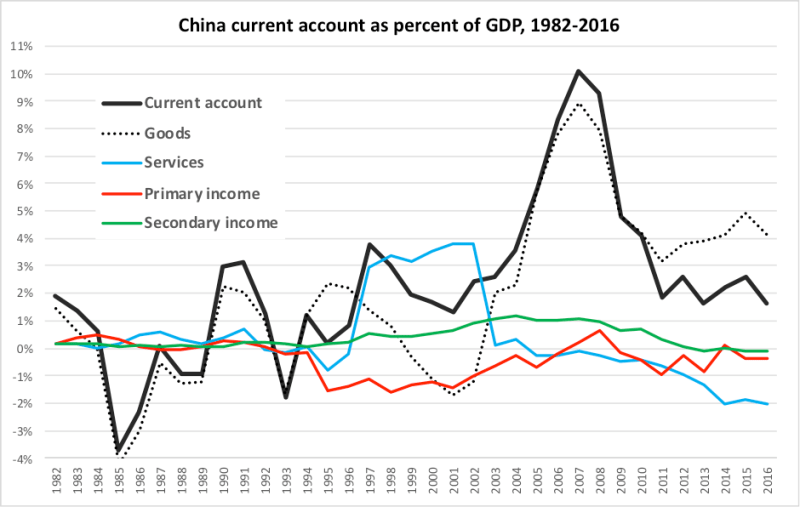
This share subsequently fell sharply due to a surge in exports from non-FFEs, although this was also in a context of falling current account surpluses as a proportion of GDP. As shown in the figure below, this was due to increasing deficits on China’s services account, which reached 2% of China’s GDP in 2014-16, knocking out about half of its goods surplus in 2014 and 2016.

China also returned to running deficits on its income account from 2009 onwards (with the slight exception of 2014), despite being a major international creditor. As explained by Yu Yongding, this is because China’s foreign assets mostly earn very low returns, such as in US treasury bills, whereas foreign investment in China is very profitable, possibly in excess of 20-30% per year, thereby cancelling out any of the balance of payments benefits that would normally accrue to being a major international creditor.

Graph Andrew Fischer article
Source: Author’s calculations from IMF balance of payments and international finance statistics (last accessed 21 March 2018).

Notably, the US is the mirror image of China: it is a major international debtor and yet it earns a surplus on its income account. Both situations were due to profit remittances, e.g. profits leaving China and entering the US. Indeed, Yilmaz Akyüz estimates that the net current account position of FFEs in China has been in deficit in recent years, meaning that their profit remittances were cancelling out their merchandise trade surpluses.

In other words, after the exceptional but historically brief period of running very large ‘twin surpluses’ (on both the current and financial accounts), the current account structure of China has reverted to a pattern that, as I explain in a recent article, is common among peripheral developing countries. The pattern is characterised by goods trade surpluses that counterbalance service account deficits (dominated by payments to foreign corporations) as well as the profit remittances of foreign corporations (and of other foreign investments, whether licit or illicit).

These rapid transformations have been reflective of the increasingly deep integration of China’s foreign trade into international networks dominated by Northern-based transnational corporations. The model has resulted in exceptional export performance, although this has occurred through the injection of considerable but underappreciated sources of vulnerability.

Indeed, as noted by Yu Yongding, from 2015 to 2017 the People’s Bank of China undertook the largest intervention in foreign exchange markets that any central bank has ever taken in order to prevent a run on the renminbi. This depleted its foreign exchange reserves by over 1 trillion US dollars. In another recent article, Yu adds that from 2011 to 2017, around 1.3 trillion US dollars of China’s foreign assets had effectively disappeared, probably reflecting capital flight. Together with the run on the renminbi, these were the principal reasons that the Bank of China put a hold on capital account liberalisation and tightened capital controls to an extent not seen since the East Asian financial crisis of the late 1990s.

Considering that much of such capital flight is destined for the US, either directly or indirectly via multiple offshore financial centres, in addition to the profitability that US corporations derive from China’s trade with the US, it is clear that the US is in the more powerful position in this bilateral relationship.

The imperial utility of trade decline discourses

From this perspective, the deep US trade deficits that have persisted since the early 1980s arguably represent a new form of advanced capitalist imperialism, the emergence of a system of tributes whereby states around the world effectively subsidise the expansion of US-centred capitalism. At the very least, the deficits are signs of a structural shift underlying global power relations, based on an increasingly predatory form of financialised capitalism, with the US still at its helm.

Much like with discourses of Soviet rivalry in the 1960s and 1970s, the current babble of US decline and lagging serve an ideological purpose within these continuing transmutations of US-centered power. It is effectively aimed at subordinating other countries and shifting the burden of adjustment onto them, while distracting attention away from the US-centered, corporate-led restructurings of global production systems that underlie US deficits in the first place.


Main photo: https://pixabay.com/en/donald-trump-politician-america-1547274/

About the author:

Andrew mug shot.JPGAndrew M. Fischer is Associate Professor of Social Policy and Development Studies at the ISS, and laureate of the European Research Council Starting Grant, which he won in the 2014 round. He is also the founding editor of the book series of the UK and Ireland Development Studies Association, published by Oxford University Press, titled Critical Frontiers of International Development Studies. He is also editor of the journal Development and Change. His forthcoming book, Poverty as Ideology, won the 2015 International Studies in Poverty Prize, awarded by the Comparative Research Programme on Poverty (CROP).


Deglobalisation Series | Challenges to the liberal peace by Syed Mansoob Murshed

By Posted on 4186 views

We may have reached a stage where economic interactions have become so internationalised that further increases in globalisation cannot deliver greater prospects of peace.[1] But the logic of the capitalist peace still holds water; the intricate nature of the economic interdependence between advanced market economies almost entirely rules out war, but other hostile attitudes can still persist, and even grow.  


Liberal peace theories posit that peace among nations is not a result of a balance of power, but rests on the pacific nature of commonly held values, economic interdependence, and mutual membership of international organisations. Ideal theories of the liberal peace can be traced back to the work of Immanuel Kant, who in his essay on the Perpetual Peace[2] argued that although war is the natural state of man, peace could be established through deliberate design. This requires the adoption of a republican constitution simultaneously by all nations, which inter alia would check the war-like tendencies of monarchs and the citizenry; the cosmopolitanism that would emerge among the comity of nations would preclude war. The European Union is the most obvious, albeit imperfect, example.

Mirroring Kant’s thoughts is the contemporary philosopher John Rawl’s [3] notion of peace between liberal societies, which he refers to as peoples and not states. He speaks of well-ordered peoples. These are mainly constitutional liberal democracies, which arrive at such a polity based on an idea of public reason. In a well-ordered society, based on public reason, human rights are respected, and the distribution of primary goods (a decent living standard, dignity, respect and the ability to participate) for each citizen’s functioning is acceptably arranged.

Another version of the liberal peace theory based on economic interdependence is the ‘capitalist’ peace notion.[4] The intensity of international trade in an economy is the least important feature in the peace engendered by capitalism. The nature of advanced capitalism makes territorial disputes, which are mainly contests over resources, less likely, as the market mechanism allows easier access to resources. The nature of production makes the output of more sophisticated goods and services increasingly reliant on “ideas” that are research and development intensive, and the various stages of production occur across national boundaries. Moreover, the disruption to integrated financial markets makes war less likely between countries caught up in that web of inter-dependence. It is also argued that common foreign policy goals reflected in the membership of international treaty organisations (such as NATO and the European Union) also produce peace.

The chances of the well-ordered, tolerant societies envisaged by Rawls living in peace within themselves and with one another have greatly diminished with the recent rise in inequality, the growing wealth and income share of the richest 1-10% of the population, and the rise in varieties of populist politics. Also, the quality of Kant’s foedus pacificum has been dealt a severe blow by nations such as the UK choosing to leave the European Union, adversely affecting the utilisation of soft power via common membership of international organisations.

We also may have come to a stage where economic interactions such as the exchange of goods, provision of services and the movement of finance have become so internationalised that further increases in globalisation cannot deliver greater prospects of peace.[5] But the logic of the capitalist peace still holds water; the intricate nature of the economic interdependence between advanced market economies almost entirely rules out war, but other hostile attitudes can still persist, and even grow, given recent developments. This includes the rise in populist politics.

The rise of populist politics

The growth in inequality, but more especially the creeping rise in the social mobility inhibiting inequality of opportunity, has spawned the illiberal backlash manifesting itself in the rise in mainly right wing populist politics. A large segment of immiserated voters vote for populists knowing that, once elected, the populist politician is unlikely to increase their economic welfare, as long as they create discomfiture for certain establishment circles, vis-à-vis whom these voters see themselves as relatively deprived. Immigrants and immigration is scapegoated and made responsible for all economic disadvantage and social evils following the simplistic and simple-minded message of right-wing demagogues. It has to be said that left-wing populism, too, has emerged in many societies, mainly among educated millenarians whose economic prospects are often bleaker than those of their parents, and in regions (such as Latin America) with a strong Peronist tradition.

By contrast, during the golden age, which lasted for a little over a quarter of a century after World War II, no particular group in society was disadvantaged by economic growth and the advance of capitalism. The elites appeared to internalise the interests of the median and below-median income groups in society. Social mobility was palpably present, and social protection cushioned households against systemic and idiosyncratic economic shocks. The growth in inequality linked to globalisation and labour-saving technological progress since the early 1980s has disadvantaged vast swathes of the population: it first pauperised the former manufacturing production worker through either job offshore relocation or stagnating real wages, and latterly it is emasculating even median service sector occupations. At the same time the income and wealth share of the top 1-10% of the population grows at an accelerating pace, faster than the rise in national income.[6]

In developing countries there has been a growth in autocratic tendencies, the liberal half of a liberal democracy, even when the other part of democracy, the electoral process, is broadly respected. The use of plebiscites by strong men to garner greater power has been a frequently used tool. There is even talk of autocratic rulers delivering development and economic growth and autocratic tendencies may be greater in nations that have achieved economic structural transformation. But the logic of the “modernisation”[7] hypothesis that argues that democracy is demanded by society as it becomes affluent may still ring true, even if the process is non-linear, and other complex factors need to be taken into account.

A hyper-globalisation trilemma?

Faced with these challenges, we need to abandon our “Panglossian” faith in the ability of markets to always do good. The rules of globalisation and capitalism only serve elites who are owners of internationally mobile skills and wealth. There may be a hyper-globalisation trilemma[8], whereby the simultaneous achievement of national sovereignty, democracy and hyper-globalisation is impossible. It is worth reiterating that hyper-globalisation refers to a situation where for the collective the pains from increased globalisation in terms of adverse distributional consequences outweigh the gains in terms of enhanced income.

Earlier advances of globalisation was made relatively more acceptable in Europe compared to the United States, given the greater prevalence of social protection in the continent. Gradually, after 1980, and especially since the dawn of the new millennium, more and more groups have been disadvantaged by globalisation, and the politics of austerity has diminished social protection, fraying pre-existing domestic social contracts. Thus, many advocate a more limited globalisation, akin to the halcyon days of the golden age, also known as the Bretton Woods era (1945-73), whose hallmark was that the demands of globalisation never exercised veto powers on the domestic social contract.

A retreat from hyper-globalisation is desirable, but not through channels that diminish international cooperation and partnership, like Brexit and President Trump’s protectionist sabre rattling that undermine agreements like NAFTA. What is needed is internationally coordinated checks on hyper-globalisation and agreements on certain wealth taxes on the richest individuals, which is needed to address the alarming rise in wealth inequality given the fact that social protection can only have a palliative, and not curative, impact on these stupendous inequalities.


References:
[1] Rodrik, Dani (2017) Straight Talk on Trade: Ideas for a Sane World Economy, Princeton: University Press.
[2] Kant, Immanuel (1795) Perpetual Peace and Other Essays on Politics, History and Morals, reprinted 1983. Indianapolis: Hackett Publishing.
[3] Rawls, John (1999) The Law of Peoples, Cambridge, MA: Harvard University Press.
[4] Gartzke, Erik (2007) ‘The Capitalist Peace’, American Journal of Political Science 51(1): 166-191.
[5] Rodrik, Dani (2017) Straight Talk on Trade: Ideas for a Sane World Economy, Princeton: University Press.
[6] Piketty, Thomas (2014) Capital in the Twenty-first Century, Cambridge, Massachusetts: Harvard University Press.
[7] Lipset, Seymour (1960) Political Man: The Social Bases of Politics. New York: Doubleday.
[8] Argued by Dani Rodrik; see, for example, Rodrik (2017), op. cit.

Also see: Backtracking from globalisation by Evan Hillebrand


csm_6ab8a5ef34f1a5efe8b07dff07d52162-mansoob-murshed_0833a7fcf4About the author:

Syed Mansoob Murshed is Professor of the Economics of Peace and Conflict at the International Institute of Social Studies (ISS), Erasmus University Rotterdam in the Netherlands. His research interests are in the economics of conflict, resource abundance, aid conditionality, political economy, macroeconomics and international economics.


Deglobalisation Series | Backtracking from globalisation by Evan Hillebrand

By Posted on 2179 views

While globalisation still enjoys strong support in the Global South, major economies in the Global North now seem less enthusiastic about its purported benefits. This article explores how the United States through its previous policies came to backtrack from globalisation, showing that it is an altogether unsurprising development.


From the perspective of the United States (US), embodied in US president Donald Trump’s recent discourses, the liberal international trading system faces at least three major economic and socio-political challenges going forward: (1) income redistribution, (2) the rise of Asia and a potential shift in comparative advantage, and (3) the rise of China and the national security argument. Given the growing domestic unease with free trade and the fact that these exacerbating issues are worsening, I suggest that US policies will become less supportive of globalisation.

US withdrawal: surprising or expected?

In our 2011 article, “Backtracking from Globalization” (1), my coauthors and I discussed the declining support for globalisation in the United States and elsewhere. Since then the trend has gotten worse.

But why shouldn’t it? The US, after all, has only had a liberal trade policy for 60 or so years. In its early years, US policy focused on high tariffs, large subsidies to key industries, and infrastructure investment designed to create an industrial economy for the sake of military and economic power (sounds not too dissimilar to China today). The US moved to a freer-trade stance when the US was economically dominant and an expansion of global markets seemed as if it would be economically beneficial.

The US free trade strategy was also based on political theories and grand strategy. After World War II, trade expansion was seen as a good way to bolster Europe economically, tie it to the West, and strengthen the West against the Soviet Union. The US spurred the creation of the GATT/WTO in an effort to bring all countries into a democratic rule-based system under the assumption that trade would help all countries prosper under US leadership. Since 1980 or so, the US has tried to lure China into the world market system to foster interdependence and peace. In many respects, that policy can be considered a great success—ushering in a vast improvement in the material standard of living almost everywhere and many decades of great-power peace. China also did turn away from its Maoist phase of development.

 Ebbing enthusiasm for globalisation

Support for globalisation, however, is clearly headed in a negative direction and the ebbing of enthusiasm has been particularly dramatic in the United States. Recent polling data from the Pew Foundation and the Council on Foreign Relations (2) show that there is still support for international trade, but a majority worry that trade generates labor market costs in terms of job destruction and lower wages. This worry helped elect the current US president and his administration talks more about fair trade than free trade: ‘Nothing about the theory of comparative advantage would lend itself to a defense of a status quo that imposes higher barriers to exports on American producers than on foreign producers’ (Economic Report of the President 2018: 219) (3).

It is important to understand that it is not ignorance that has led US policy in this direction.

Many voters were lured to Donald Trump’s “America First” pitch because of a perception that wages were stagnant and communities were hurt because of globalisation. In reality it is more than just a hunch: income distribution in America has worsened and academic research by Paul Krugman (4) and others attributes some of that worsening to trade, although the magnitude of trade’s contribution is (and always will be) in dispute.

Support for globalisation has to some extent rested on the theory of comparative advantage, but that theory has never been the “slam dunk” argument that enthusiasts have made it out to be. It depends on so many assumptions that do not fit the current world economy, so the theory should only be relied upon as a general principle, not the decider of every policy dispute. Paul Samuelson (5) claimed in 1972 that the aggregate gains from trade are not necessarily positive. He expanded on this idea in his (2004) paper, ‘Where Ricardo and Mill Rebut and Confirm Arguments of Mainstream Economists Supporting Globalization’, saying that growth in the rest of the world can hurt a country if it takes place in sectors that compete with its native exports—where it has comparative advantage.

The rise of China

Relative, and even absolute, per capita GDP can fall in such a situation (6). Whether China’s rise can actually diminish the US is not clear, but the current Chinese government continues to employ active trade policies to push its industries up the value chain, aiming explicitly at sectors that have been the mainstay of US industrial pre-eminence. Samuelson says that ‘economic history is replete with examples like this, first insidiously, and later decisively’, pointing explicitly to British manufacturing being overtaken by US industry after 1850.

In addition to the economic threat posed by China, the US government has long worried about the security threat posed by China’s rise. The US-China Economic and Security Review Commission is an organisation chartered and funded by the US Congress and dedicated to the proposition that China poses a multifaceted threat to the US. It yearly issues a massive report that cites declines in the US defense industrial base, insecurity of defense supply lines, financial threats, Chinese ownership of critical US facilities, cyber threats, and other problems—all related to China. In the most recent report (7), it lists 26 recommendations for congressional action, many of which would amount to new trade restrictions.

Trade policies, while often rooted in interest groups scrambling for distributional gains, are also related to national economic and security concerns. In the past, pragmatic national interests have pushed trade policy in varying directions. There is no reason now to believe that the US is giving up on international trade, but there is every reason to believe that for a variety of national interests it will be much less enthusiastic about globalisation in the future.


References:
(1) Hillebrand, E.E., J. Lewer and J. Zagardo (2011) ‘Backtracking from Globalization’, Global Economy Journal 10(4).
(2) Poushter (2016) American Public, Foreign Policy Experts Sharply Disagree over Involvement in Global Economy. Pew Research Center, http://www.pewresearch.org/author/jpoushter.
(3) Council of Economic Advisors (2018) Economic Report of the President. Washington, D.C. https://www.whitehouse.gov/wp-content/uploads/2018/02/ERP_2018_Final-FINAL.pdf
(4) Krugman, P.R. (2008) ‘Trade and Wages, Reconsidered’, Proceedings of the Brookings Panel on Economic Activity. Spring conference. Available at: (http://www.princeton.edu/~pkrugman/pk-bpea-draft.pdf).
(5) Samuelson, P.A. (1972) ‘Heretical Doubts About the International Mechanism’, Journal of International Economics, 2(4): 443-453.
(6) Samuelson, P. (2004) ‘Where Ricardo and Mill Rebut and Confirm Arguments of Mainstream Economists Supporting Globalization’, Journal of Economic Perspectives 18(3): 135-146.
(7) U.S.-China Economic and Security Review Commission (2017) 2017 Report to Congress. Washington, D.C. Available at https://www.uscc.gov/sites/default/files/annual_reports/2017_Annual_Report_to_Congress.pdf

Also see: Deglobalisation Series | Is anti-globalisation only a preoccupation in the Global North? by Rory Horner, Seth Schindler, Daniel Haberly and Yuko Aoyama


UntitledAbout the author:

Professor Evan Hillebrand taught international economics at the Patterson School of Diplomacy and International Commerce at the University of Kentucky. His most recent book is Energy, Economic Growth, and Geopolitical Futures (MIT Press, 2015).


Deglobalisation Series | Is anti-globalisation only a preoccupation in the Global North? by Rory Horner, Seth Schindler, Daniel Haberly and Yuko Aoyama

A remarkable ‘big switch’  has emerged from the turn of the millennium in terms of attitudes towards and discourses over globalisation. But while the world is currently witnessing a new backlash against economic globalisation, considerable support for globalisation within some parts of the Global South should not be overlooked.


While the world is currently witnessing a new backlash against economic globalisation, considerable support for globalisation within some parts of the Global South should not be overlooked. Supporters of the UK’s exit from the European Union seek to “take back control” from Brussels, while Donald Trump’s economic ethno-nationalism has promised to put “America first”. In contrast, the picture that emerges in the Global South is quite different, as part of a remarkable ‘big switch’ that has been taking place from the turn of the millennium in terms of attitudes towards and discourses over globalisation.

Support for globalisation in the global South

The polling company YouGov, in a 2016 survey of people across 19 countries, found that France, the US and the UK were the places where the fewest people believe that “globalisation has been a force for good”. In contrast, the survey found the most enthusiasm for globalisation in East and Southeast Asia, where over 70% of respondents in all countries believed it has been a force for good. The highest approval rate, 91%, was in Vietnam.

From a poor starting point, many in the Global South have experienced some improvement in basic development indicators in the 20th and 21st Centuries. People living in Asia accounted for the vast majority of those who experienced relative income gains from 1988 to 2008. In comparison with the 1990s, the Global South now earns a much larger share of world GDP, has more middle-income countries, more middle-class people, less dependency on foreign aid, considerably greater life expectancy, and lower child and maternal mortality rates.

Less of a backlash in the Global South necessarily means support for neoliberal globalisation—and the optimism in countries such as Vietnam may paradoxically be a result of an earlier rejection thereof. China, in particular, has not followed the same approach to economic globalisation as that which was encouraged by the US and organisations such as the IMF and World Bank in the late 20th Century.

Meanwhile, many of the world’s poorest in the Global South have seen very little improvement in quality of life in recent years, yet they are much more marginal and less well-positioned to express their frustrations than the ‘losers’ in countries such as the US and UK. They must not be forgotten.

China and India warn against deglobalisation

Most notably, the last two World Economic Forum gatherings at Davos have seen explicit statements from the respective leads of China and India warning against deglobalisation. In January 2017, China’s president Xi Jinping said that his country would assume the leadership of 21st Century globalisation. Defending the current economic order, Xi said that China was committed to making globalisation work for everyone—its responsibility as “leaders of our times”.

At Davos in 2018, Narendra Modi, prime minister of India, warned against deglobalisation:

It feels like the opposite of globalisation is happening. The negative impact of this kind of mindset and wrong priorities cannot be considered less dangerous than climate change or terrorism.

 The ‘big switch’ on globalisation

It is remarkable that the backlash most associated with the Brexit referendum in the UK and the election of Donald Trump in the US has emerged from the right of the political spectrum, in countries long recognised as the chief architects and beneficiaries of economic globalisation.

At the turn of the millennium, the primary opposition to globalisation was concerned with its impacts in the Global South. Joseph Stiglitz, former chief economist at the World Bank, in his 2006 book Making Globalization Work wrote that “the rules of the game have been largely set by the advanced industrial countries”, who unsurprisingly “shaped globalization to further their own interests.” Their political influence was represented through dominant roles in organisations such as the World Bank, the International Monetary Fund and the WTO, and the corporate dominance of their multinationals.

Untitled
Protests in Seattle against the WTO in 1999. By Steve Kaiser from Seattle via Wikimedia CommonsCC BY-SA

In the 1990s the anti-globalisation movement opposed neoliberal economic integration from a range of perspectives, with a particular emphasis on the Global South. The movement was populated by activists, non-governmental organisations and groups with a variety of concerns: peace, climate change, conservation, indigenous rights, fair trade, debt relief, organised labour, sweatshops, and the AIDS pandemic.

Yet, in the aftermath of the Brexit vote, UK prime minister Theresa May offered a sceptical assessment at the 2017 World Economic Forum at Davos, arguing that “talk of greater globalisation can make people fearful. For many, it means their jobs being outsourced and wages undercut. It means having to sit back as they watch their communities change around them.” The US, under Trump, subsequently began renegotiating NAFTA and withdrew from the Trans-Pacific Partnership.

Significant proportions of the population in the US and other countries in the Global North have experienced limited, if any, income gains in the most recent era of globalisation. Leading global inequality expert Branko Milanovic has explored changes in real incomes between 1988 and 2008 to show who particularly lost out on relative gains in income. He found two groups lost most: the global upper middle class—those between the 75th and 90th percentiles on the global income distribution scale, of whom 86% were from advanced economies—and the poorest 5% of the world population.

Emerging evidence indicates that increased global trade has played a role in economic stagnation or decline for people in the North, especially in the US. MIT economist David Autor and his colleagues suggest that the ‘China shock’ has had major redistributive effects in the US, leading to declines in manufacturing employment.

Economists had previously argued that the “losers” from trade could be compensated by transfers of wealth. Autor and his colleagues found that while there have been increases in welfare payments to regions of the US hardest hit by the trade shock, they fall far short of compensating for the income loss.

Not just globalisation

Not all of the stagnation and decline experienced in the Global North can be attributed to economic globalisation. Technological change is a big factor and national policy choices around taxation and social welfare have also played key roles in shaping inequality patterns within countries. In such a context, ‘globalisation’ has been deployed as a scapegoat by some governments, invoking external blame for economic problems made at home.

The current backlash is not just about economic globalisation. It has involved ethno-nationalist and anti-immigrant components, for example among supporters of Trump and Brexit.

A key lesson from the late 20th Century is to be wary of wholesale attacks on, and sweeping defences of, 21st Century economic globalisation. In light of the difficulties of establishing solidarity between ‘losers’ in different parts of the world, the challenge of our times is for an alter-globalisation movement which addresses all of them.

Moreover, if the stellar growth rates of the last 15-20 years slow down, the relatively positive view of globalisation in much of the global South may not continue, with the possibility of a backlash (re)emerging beyond the Global North.


Also see: Deglobalisation 2.0: Trump and Brexit are but symptoms by Peter A.G. van Bergeijk


About the authors:

Rory_Horner_work_profile_photo.JPGRory Horner, Lecturer, Global Development Institute, University of Manchester321250

Daniel Haberly, Lecturer In Human Geography, University of Sussex;

seth

Seth Schindler, Lecturer, Department of Geography, University of Sheffield, and Aoyama2016


Yuko Aoyama, Professor of Economic Geography, Clark University