Tag Archives brexit

Brexit tales of discontent: the revenge of Empire by Helen M. Hintjens

By Posted on 2859 views

Nobody knows what happens after UK general elections on 12 December 2019: Brexit, a referendum on Irish unity, on Scottish independence, or a No-Deal exit from the EU?  In 1977, Tom Nairn in The Break up of Britain warned that during “extreme difficulties and contradictions, the prospect of break-down or being held forever in the gateway… may lead to… nationalist dementia for a society” (p. 349). The election taking place this week will decide whether the ghosts of imperial ancestors win the day, or whether younger generations can save the UK from its divided self.


Crisis? Which one?

Uncertainty over Brexit is wreaking havoc on the Brits. Those who want to remain in the EU are in despair; those who want to leave are angry. Most are sick of it. Britain’s collective mental health, already poor before Brexit, is worsening dramatically.

1.png

Illustration 1: anti-depressant prescriptions in England: another opioid crisis.

In 2012, the Jimmy Savile scandal erupted, resulting in a public crisis in confidence in the British establishment. The public enquiry under then-PM Teresa May into “Historic Child Sexual Abuse” involved serious charges against MPs, celebrities, and royals. The crisis recently resurfaced when Prince Andrew gave a BBC interview on his Epstein connection. He was soon forced to withdraw from UK public life. The Savile crisis is almost forgotten, yet in 2012, John Simpson in The Guardian called this “the worst crisis I can remember in my nearly 50 years at the BBC”. Brexit is now the second “worst crisis in 50 years” in less than a decade.

Myths and lies

Some see the 2016 Referendum result as based on myths and lies. The language of war—betrayal, surrender—gained currency. More recently, the Labour Party accused Johnson  and his rich friends of planning a ‘Big Short’ on a No-Deal Brexit. Pro-Brexiteers accuse Remainers (termed ‘Remoaners’) of thwarting the “will of the British people”. Tory MPs who are pro-Remain have been thrown out of the Conservative Party. Support for Brexit remains in rural, small-town and post-industrial England, despite the dire warnings of Operation Yellowhammer [1]. In London, Bristol and Birmingham, and across Scotland and Northern Ireland, the majority wants to Remain. Welsh opinion has moved towards Remain, or even Independence.

2.png

Illustration 2: Humour is essential

This joke sums up the dilemma for smaller UK countries: “An Irishman, a Scotsman and an Englishman go into a bar. The Englishman wants to leave, so they all have to leave”. Brexit humour abounds, and it helps a little, but only a little.

Macho English Nationalism

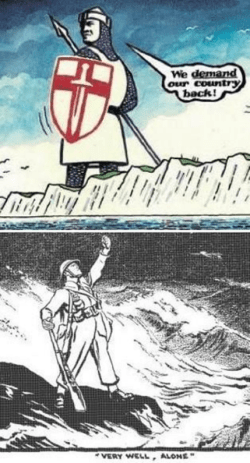
On Gender and Brexit, Aida Hozic and Jacqui True comment whilst “men took up 85% of the press space and 70% of television coverage”, during the Brexit campaign, “women [became]… visible as actors… to ‘clean-up’ the mess left by their male counterparts” (p. 276). Women and men voted similarly on Leave-Remain. Young people were notably more pro-Remain than their elders. Commenting in Third Text, Finlayson comments: “Farage’s Brexitism… opposes the small, ordinary, decent, local and familiar to the big, distant and untrustworthy”, showing a ‘little Englander’ mentality harking back to Empire. Pro-Brexit rhetoric centres on ‘guts’ and courage: “…phrases [that] invoke boyhood stories of wartime bravery against the odds and of standing up to boarding school bullies” (pp. 602-603), and tales of the Empire.
3.png

Illustration 3: Brexit and Dangerous Jingoism

Outdated imperial values are dangerous. Both racist and sexist, such values risk renewing sectarian violence in Northern Ireland. The murder of Labour MP Jo Cox and UK-wide spike in hate crime since the Referendum leaves minorities fearing the future. And small-minded English nationalism merely intensifies Scottish, Northern Irish, and Welsh nationalism. The 12 December 2019 elections are crucial.

Algorithms and Rule by Nobody

In today’s networked age, algorithm-based ‘filter bubbles’ limit social media users’ suggested content to their existing comfort zone. Guardian investigative journalist Carole Cadwalladr found that the Leave campaign defeated Remain by using such filtering algorithms effectively [2]. Causing suspicion of his motives, Boris Johnson recently refused to allow the publication of a parliamentary report on Russian social media interference in UK elections.

Pro-Brexiteers also frame Brexit as revolt against ‘faceless Brussels bureaucrats’, echoing Hannah Arendt’s ‘Rule by Nobody’. Yet EU neoliberalism could give way to UK financial deregulation, a danger with the UK constitution now collapsing. Abandoning compromise also means Britain could break into three or four national units. Sectarian and anti-minority violence would likely accompany this break-up.

End Thoughts

Nairn warned the Brits—especially the English—of the danger of rooting around in their imperial past for renewed nationalist identity symbols: “… once these well-springs have been tapped there is no real guarantee that the great forces released will be ‘controllable’” (p. 349). As minorities in the UK live in fear of the future, Brexiteers need constant reminding that words can be mortally dangerous. We are now in Karl Marx’s vision in The Eighteenth Brumaire where “[t]he tradition of all dead generations weighs like a nightmare on the brains of the living… [drawing]… from them names, battle slogans, and costumes in order to present this new scene in world history”. Rather than plunge back into its imperial past, and end up divided, it is hoped the UK electorate will vote to remain in the EU. The question now will be whether the EU will want us!


At a Research in Progress Seminar 12 December 2019 ‘BREXITLAND FAIRY TALES’, Helen Hintjens will elaborate on some of the points in this blog. 13.00-14.00, ISS. This happens to be on the same day as the UK national parliamentary elections!


[1] The latest Operation Yellowhammer document was released on 2 August 2019. It predicts shortages of medicine, “risk… panic buying… [which could] exacerbate food supply disruption”, “[u]rgent action… to ensure [continued] access to clean water”, “[the disruption of] [la]w enforcement data/information sharing UK-EU”, and “[p]rotests and counter-protests… across the UK” alongside “… a rise in public disorder and community tensions”.
In Northern Ireland “growth of the illegitimate economy” especially in cross-border areas“.
[2] https://www.spectator.co.uk/2019/11/exclusive-dominic-cummingss-secret-links-to-russia/
Cadwalladr also in:  https://www.theguardian.com/commentisfree/2017/may/17/dark-money-democracy-billionaires-funding

Image Credit Main Photo: Williams Murray Hamm on Flickr

20160917_190837

About the author:

Helen Hintjens is Assistant Professor in Development and Social Justice. She publishes on asylum policies and on post-genocide reconciliation in the African Great Lakes region, and Rwanda in particular.


The New World “Order”: Brexit, Trump and the Developing Countries by Peter A.G. van Bergeijk

By Posted on 2763 views

Deglobalisation is not the mirror image of globalisation. The losers of globalisation will thus not be the winners of deglobalisation. Indeed, the vulnerable and poor will be the big losers of deglobalisation both in the Global North and Global South.


In the world economy, the guards are changing: we see the emergence of China as the major trading economy of the world continue and at the same time the crumbling of the economic power of the United States of America. Handing over world economic leadership is always a painful process, and it is certainly not a new phenomenon. The rise of the British Empire ended the period of Dutch hegemony. After the Second World War, the USA became global leader, and now we see China emerging on top of many economic rankings. Both before and during these phases of geo-economic transformation, similar processes occurred that reflected shifts in the costs and benefits of hegemony.[1]

SHIFTING POWER IS PAINFUL

A non-contested hegemon has significant market power and can appropriate a substantial part of the benefits of the rules and regulations of the world order. These benefits enable the hegemon to finance the costs of world order maintenance. However, when an emerging economic power contests the incumbent, the balance of costs and benefits shifts to the detriment of the hegemon. It also becomes apparent that the division of the benefits of the world order are not proportional to the costs. Clearly, US actions currently are being fed by popular sentiments (and also feed these sentiments!), but a rational explanation of what we see happening is certainly not beside the point. Modelling exercises of a great diversity of trade disturbances and trade wars show that the United States hurts itself, but that China has to pay a higher price (Figure 1).

Figure 1

Source: J. Bollen and H. Rojas-Romagosa, 2018, ‘Trade wars: Economic impacts of US tariff increases and retaliations. An international perspective’, CPB Netherlands Bureau for Economic Analysis, The Hague.

Making America the Greatest Again can be done in two ways: either by putting more effort into improving the US economy, or by trying to hurt China more. In the current context, the outcome of the second option is more certain, especially in the short run. Economists therefore cannot but conclude that this form of neomercantilism for the United States in a political sense is quite effective. A trade war that involves the United States, China, and the European Union (the blue bars in figure 1) consistently finds that the negative impact in other regions is always larger than for the United States. For an all-out trade war of the US with all advanced economies (the orange bars in Figure 1), a somewhat different picture emerges, but still China is hurt most.

It is important to recognise that the current context extends well beyond trade disturbances and that this is part of a new long downward phase. Indeed, an important empirical finding is that Make America Great Again and Brexit should be seen as symptoms rather than causes of deglobalisation: already long before the elections and referendum, a significant break could be observed in the pace and direction of internationalisation of leading democratically oriented economies.[2] It is not obvious that a change can be expected with respect to these trends in the near future. Indeed, policy uncertainty is on a clearly upward trend and has entered uncharted territory (Figure 2). This increase in uncertainty already has a negative impact on investment decisions of firms and consumers. Certainly, deglobalisation has a much broader palette than the trade disturbances that presently make the headlines.

Figure 2 Global policy uncertainty (monthly data 2000-2018)

Figure-2.png

Source: S. J. Davis, 2016. “An Index of Global Economic Policy Uncertainty,” Macroeconomic Review, October, http://www.policyuncertainty.com

The impact of deglobalisation goes further and also includes development cooperation and other international flows. Attacks on global institutions and multilateral agreements is an essential element of neomercantilism and its impact is felt all around the globe. A comprehensive deglobalisation scenario of the International Futures Model shows that the long-run losses are large and always negative (Table 1). The impact in the US in this scenario is relatively limited, and strong losses in income level appear on other continents. A recent study of the German Institute for Development has analysed the impact of Brexit and finds that losses outside the UK are important. In particular, the impact on the least developing countries is significant.[3]

Table 1 Estimated impact of deglobalisation on per capita income in 2035

Table-1-615838125-1551382381492.png

Source: Hillebrand, E. E., 2010, ‘Deglobalization scenarios: who wins? Who loses?’ Global Economy Journal 10 (2) article 3 available at: http://www.ifsprev.du.edu/assets/documents/hilldeglob.pdf

The European Union can make a difference here. It is clear that developing countries are not part of the conflict between the big powers and that their plight is due to collateral damage. The European Union has always supported trade as a means to achieve development. It should step up efforts to facilitate trade and help the least-developed countries to divert their trade so as to make up for the losses caused by the deglobalisationists.


[1] Z. Olekseyuk and I.O. Rodarte How Brexit Affects Least Developed Countries, Deutsches Institut für Entwicklungspolitik, Briefing Paper 2/2019

[2] P.A.G. van Bergeijk, On the brink of deglobalization … again, Cambridge Journal of Regions, Economy and Society 11, 59–72. In the same vein China’s support for the multilateral trade and investment system did not come unexpectedly.

[3] P.A.G. van Bergeijk, Deglobalization 2.0: Trade and openness during the Great Depression and the Great Recession, Edward Elgar Cheltenham 2019. https://www.e-elgar.com/shop/deglobalization-2-0 https://www.e-elgar.com/shop/deglobalization-2-0


In 2018, Bliss Blog featured a series on deglobalisation. Articles of this series can be read here, here and here.


About the author:

pag van bergeijk

Peter van Bergeijk (www.petervanbergeijk.org) is Professor of International Economics and Macroeconomics at the ISS.

Economic diplomacy: bilateral relations in a context of geopolitical change by Peter A.G. Bergeijk and Selwyn J.V. Moons

By Posted on 3597 views

Economic diplomacy, although perceived as marginally important by neoclassical economists, is a highly relevant topic first and foremost because it works in practice, but also because it provides an essential policy answer to the increasing uncertainty of international transactions. In this article, Peter A.G. van Bergeijk and Selwyn J.V. Moons, editors of the recently released Research Handbook on Economic Diplomacy, briefly introduce the topic of economic diplomacy and highlight the value of the new publication, to which several ISS researchers have contributed.


The eminent breakdown of multilateralism and supranationalism due to Trump and Brexit has led to a revival of the debate on economic diplomacy, properly understood as a broad field that comprises those aspects of diplomacy that are aimed at:

  • the opening of markets to stimulate bilateral cross-border economic activities such as imports, exports, mergers and acquisitions and greenfield foreign direct investments;
  • the building and use of bilateral cultural, political and economic relationships between countries in order to assist domestic companies; and
  • the use of bilateral economic relationships, including (the threat) to discontinue these activities, as a tool of diplomacy.

Neoclassically oriented economists in the past have considered this topic of marginal interest only. Their analysis typically heralds the costs of government intervention and the benefits of free international trade and investment flows. Consequently, the economic analysis of positive and negative diplomatic interactions did not feature prominently on their research agenda. But it is increasingly being recognised that economic diplomacy is  a highly relevant topic, especially in Development Studies, (a) because economic diplomacy works (Moons 2017, 2018, Muniz 2018), (b) because it is more important for developing countries and emerging markets (Rhana 2018) and (c) because it provides an essential policy answer to the increasing uncertainty of international transactions (Bergeijk and Moons 2018).

Surprise and confusion

The international economic reality of 2018 is surprising and confusing. Europe struggles with its trans-Atlantic ally, and the UK’s exit and a new Italian government with an anti-EU attitude contribute to this sense of confusion. America is separating itself from its traditional partners (the EU, NAFTA, and the OECD). The trade relationships between the world’s economic #1 and #2 are more strained than ever before. Trust in the multilateral backbone of the world economy evaporates and US hegemonism is weakening. Clearly a new and better understanding of the interactions between governments is necessary because of the changing playing field and dynamics.

Brave new world

Four key stylized facts that apply to this new environment make the Research Handbook on Economic Diplomacy: Bilateral relations in a context of geopolitical change timely and highly relevant:

  1. In the brave new world of Trump and Brexit, trade and investment uncertainty increases significantly with a negative impact on trade and investment;
  2. Trump’s open confrontational approach to foreign policy as a form of negative diplomacy bears costs both in the US and abroad;
  3. Bilateral relationships become more relevant and valuable, especially for developing and emerging economies; and
  4. Bilateral economic diplomacy needs to be carefully designed and properly managed in order to generate optimal impact.

9781784710835Representing a move away from Eurocentric books on the topic, the Research Handbook offers relevant and focused contributions that provide three valuable lessons for current and future policies. First, in addition to the full coverage of positive interactions, our contributors also explicitly consider the impact of negative interaction. Second, the Research Handbook in addition to the analysis of OECD markets provides a comprehensive set of detailed empirical analyses of developing and emerging economies in Africa, Asia and Latin America. The contributions by 31 leading experts from industrial nations, emerging economies and developing countries in five continents provide a unique perspective on both the heterogeneous dynamics of economic diplomacy and the tools to analyse the impact and efficiency of economic diplomats both qualitatively (case studies, interviews) and quantitatively (macro-economic gravity models, micro-economic firm level data, surveys, meta-analysis, cost benefit analysis). Third, the Research Handbook provides detailed discussions of information requirements, data coverage and the impact of (changes in) the level and quality of diplomatic representation. The studies in the Research Handbook thereby reveal how and under which conditions economic diplomacy can be effective, providing clear guidance for evidence-based policy.

Evidence base

What are the major findings and implications of recent research? First, economic diplomacy works and this is true both for positive and negative interaction. One can build on positive interaction to strengthen economic ties and similarly the twitter tsunami of the current US president and his increasing reliance on economic sanctions will carry a significant cost (Rose, 2018). Second, uncertainty itself already reduces international specialisation: the threat of trade disruption and discontinuation of treaties in itself influences perceptions and thereby the behaviour of consumers, firms and governments. Third, a one-size-fits-all approach does not work. Economic diplomacy should be aimed at the niche where its contribution can be most significant: complex products, complex markets and countries with diverging political, cultural and historical background (Moons 2017).

Relevance for developing countries and emerging markets

Bilateral economic diplomacy is important for building a good country image and to promote an emerging market as a reliable trading partner with high quality export products, especially in developing countries. It is a relatively more significant determinant of bilateral exports among African states compared to regional integration (Afesorgbor 2018). New modes of economic diplomacy and (development cooperation) are being developed based on China’s pioneering approach to development (De Haan and Warmerdam 2018). Economic diplomacy, however, is not a panacea as Maharani (2018) clarifies while discussing challenges such as lacking exporter preparedness, substandard logistic infrastructure and budgets that remain below those of neighboring countries.


References:
Afesorgbor, S.K., Economic Diplomacy in Africa: The Impact of Regional Integration versus Bilateral Diplomacy on Bilateral Trade chapter 20 in Research Handbook on Economic Diplomacy: Bilateral Relations in a Context of Geopolitical Change, editors P.A.G. van Bergeijk en S.J.V. Moons, Edward Elgar: Cheltenham, UK
Bergeijk, P.A.G. van en S.J.V Moons (2018) ‘Introduction to the Research Handbook on Economic Diplomacy’, chapter 1 in Research Handbook on Economic Diplomacy: Bilateral Relations in a Context of Geopolitical Change, editors P.A.G. van Bergeijk en S.J.V. Moons, Edward Elgar: Cheltenham, UK
Bergeijk, P.A.G. van, S.J.V. Moons en C. Volpe-Martincus (2018) ‘The future of economic diplomacy research’, chapter 23 in Research Handbook on Economic Diplomacy: Bilateral Relations in a Context of Geopolitical Change, editors P.A.G. van Bergeijk en S.J.V. Moons, Edward Elgar: Cheltenham, UK
Arjan de Haan and Ward Warmerdam China’s foreign aid: towards a new normal? chapter 22 in Research Handbook on Economic Diplomacy: Bilateral Relations in a Context of Geopolitical Change, editors P.A.G. van Bergeijk en S.J.V. Moons, Edward Elgar: Cheltenham, UK
Moons, S.J.V (2017) Heterogenous Effects of Economic Diplomacy: Instruments, Determinants and Developments. PhD thesis ISS.

pag van bergeijkAbout the authors: 

Peter van Bergeijk (www.petervanbergeijk.org) is Professor of International Economics and Macroeconomics at the ISS.

DJ_20170714_0642Selwyn Moons has a PhD in economics from ISS. His research focus is international economics and economic diplomacy. Selwyn is currently working as Partner in the public sector advisory branch of PwC the Netherlands. Previously he worked in the Dutch ministries of Economic Affairs and Foreign Affairs.

Deglobalisation Series | Is anti-globalisation only a preoccupation in the Global North? by Rory Horner, Seth Schindler, Daniel Haberly and Yuko Aoyama

A remarkable ‘big switch’  has emerged from the turn of the millennium in terms of attitudes towards and discourses over globalisation. But while the world is currently witnessing a new backlash against economic globalisation, considerable support for globalisation within some parts of the Global South should not be overlooked.


While the world is currently witnessing a new backlash against economic globalisation, considerable support for globalisation within some parts of the Global South should not be overlooked. Supporters of the UK’s exit from the European Union seek to “take back control” from Brussels, while Donald Trump’s economic ethno-nationalism has promised to put “America first”. In contrast, the picture that emerges in the Global South is quite different, as part of a remarkable ‘big switch’ that has been taking place from the turn of the millennium in terms of attitudes towards and discourses over globalisation.

Support for globalisation in the global South

The polling company YouGov, in a 2016 survey of people across 19 countries, found that France, the US and the UK were the places where the fewest people believe that “globalisation has been a force for good”. In contrast, the survey found the most enthusiasm for globalisation in East and Southeast Asia, where over 70% of respondents in all countries believed it has been a force for good. The highest approval rate, 91%, was in Vietnam.

From a poor starting point, many in the Global South have experienced some improvement in basic development indicators in the 20th and 21st Centuries. People living in Asia accounted for the vast majority of those who experienced relative income gains from 1988 to 2008. In comparison with the 1990s, the Global South now earns a much larger share of world GDP, has more middle-income countries, more middle-class people, less dependency on foreign aid, considerably greater life expectancy, and lower child and maternal mortality rates.

Less of a backlash in the Global South necessarily means support for neoliberal globalisation—and the optimism in countries such as Vietnam may paradoxically be a result of an earlier rejection thereof. China, in particular, has not followed the same approach to economic globalisation as that which was encouraged by the US and organisations such as the IMF and World Bank in the late 20th Century.

Meanwhile, many of the world’s poorest in the Global South have seen very little improvement in quality of life in recent years, yet they are much more marginal and less well-positioned to express their frustrations than the ‘losers’ in countries such as the US and UK. They must not be forgotten.

China and India warn against deglobalisation

Most notably, the last two World Economic Forum gatherings at Davos have seen explicit statements from the respective leads of China and India warning against deglobalisation. In January 2017, China’s president Xi Jinping said that his country would assume the leadership of 21st Century globalisation. Defending the current economic order, Xi said that China was committed to making globalisation work for everyone—its responsibility as “leaders of our times”.

At Davos in 2018, Narendra Modi, prime minister of India, warned against deglobalisation:

It feels like the opposite of globalisation is happening. The negative impact of this kind of mindset and wrong priorities cannot be considered less dangerous than climate change or terrorism.

 The ‘big switch’ on globalisation

It is remarkable that the backlash most associated with the Brexit referendum in the UK and the election of Donald Trump in the US has emerged from the right of the political spectrum, in countries long recognised as the chief architects and beneficiaries of economic globalisation.

At the turn of the millennium, the primary opposition to globalisation was concerned with its impacts in the Global South. Joseph Stiglitz, former chief economist at the World Bank, in his 2006 book Making Globalization Work wrote that “the rules of the game have been largely set by the advanced industrial countries”, who unsurprisingly “shaped globalization to further their own interests.” Their political influence was represented through dominant roles in organisations such as the World Bank, the International Monetary Fund and the WTO, and the corporate dominance of their multinationals.

Untitled
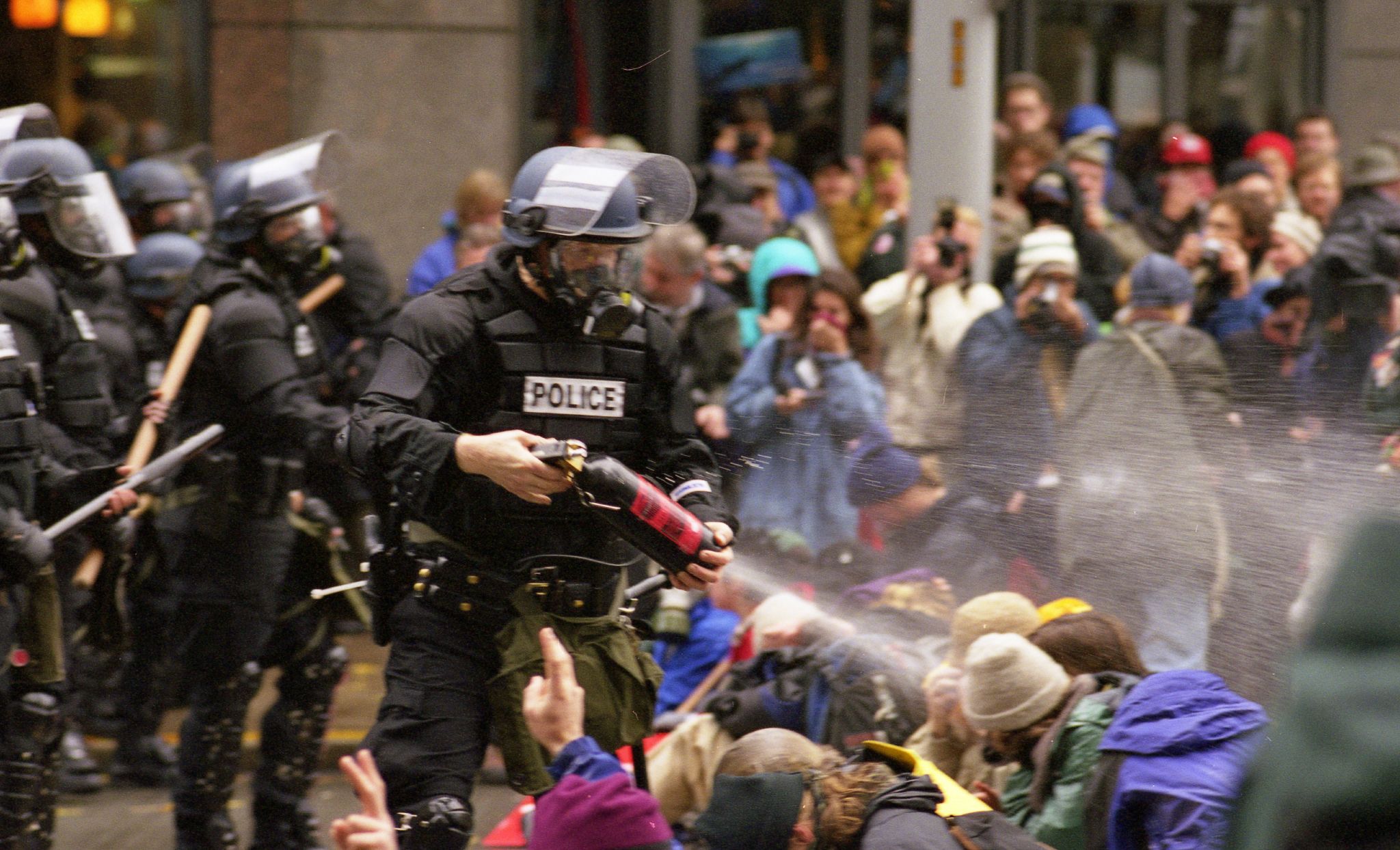
Protests in Seattle against the WTO in 1999. By Steve Kaiser from Seattle via Wikimedia CommonsCC BY-SA

In the 1990s the anti-globalisation movement opposed neoliberal economic integration from a range of perspectives, with a particular emphasis on the Global South. The movement was populated by activists, non-governmental organisations and groups with a variety of concerns: peace, climate change, conservation, indigenous rights, fair trade, debt relief, organised labour, sweatshops, and the AIDS pandemic.

Yet, in the aftermath of the Brexit vote, UK prime minister Theresa May offered a sceptical assessment at the 2017 World Economic Forum at Davos, arguing that “talk of greater globalisation can make people fearful. For many, it means their jobs being outsourced and wages undercut. It means having to sit back as they watch their communities change around them.” The US, under Trump, subsequently began renegotiating NAFTA and withdrew from the Trans-Pacific Partnership.

Significant proportions of the population in the US and other countries in the Global North have experienced limited, if any, income gains in the most recent era of globalisation. Leading global inequality expert Branko Milanovic has explored changes in real incomes between 1988 and 2008 to show who particularly lost out on relative gains in income. He found two groups lost most: the global upper middle class—those between the 75th and 90th percentiles on the global income distribution scale, of whom 86% were from advanced economies—and the poorest 5% of the world population.

Emerging evidence indicates that increased global trade has played a role in economic stagnation or decline for people in the North, especially in the US. MIT economist David Autor and his colleagues suggest that the ‘China shock’ has had major redistributive effects in the US, leading to declines in manufacturing employment.

Economists had previously argued that the “losers” from trade could be compensated by transfers of wealth. Autor and his colleagues found that while there have been increases in welfare payments to regions of the US hardest hit by the trade shock, they fall far short of compensating for the income loss.

Not just globalisation

Not all of the stagnation and decline experienced in the Global North can be attributed to economic globalisation. Technological change is a big factor and national policy choices around taxation and social welfare have also played key roles in shaping inequality patterns within countries. In such a context, ‘globalisation’ has been deployed as a scapegoat by some governments, invoking external blame for economic problems made at home.

The current backlash is not just about economic globalisation. It has involved ethno-nationalist and anti-immigrant components, for example among supporters of Trump and Brexit.

A key lesson from the late 20th Century is to be wary of wholesale attacks on, and sweeping defences of, 21st Century economic globalisation. In light of the difficulties of establishing solidarity between ‘losers’ in different parts of the world, the challenge of our times is for an alter-globalisation movement which addresses all of them.

Moreover, if the stellar growth rates of the last 15-20 years slow down, the relatively positive view of globalisation in much of the global South may not continue, with the possibility of a backlash (re)emerging beyond the Global North.


Also see: Deglobalisation 2.0: Trump and Brexit are but symptoms by Peter A.G. van Bergeijk


About the authors:

Rory_Horner_work_profile_photo.JPGRory Horner, Lecturer, Global Development Institute, University of Manchester321250

Daniel Haberly, Lecturer In Human Geography, University of Sussex;

seth

Seth Schindler, Lecturer, Department of Geography, University of Sheffield, and Aoyama2016


Yuko Aoyama, Professor of Economic Geography, Clark University