Germany is a deeply racist country―stop pretending otherwise

While Germany has been lauded for agreeing to take in 1,700 refugees from refugee camp Moria that recently burned to the ground, the country has been cited as a role model for its rational, yet humane stance toward refugees ever since it took in more than one million people in a single year during Europe’s so-called ‘refugee crisis’. However, within the country a different type of crisis is brewing—one characterized by deep structural and societal racism. Only if Germany and international observers shake the deceptive perception of the country as ‘welcoming’, change can finally happen, writes Josephine Valeske.

Antirassismus Demo Berlin
Anti-racism demonstration in Berlin, September 2018. The banner reads ‘Refugees welcome! Against racism and right-wing violence’. Credit:
Uwe Hiksch on Flickr

Two weeks ago, only days after a ring of right-wing extremists was discovered in the German police force in the state of North Rhine-Westphalia, the police in what can be seen as a PR campaign asked Twitter users to use the hashtag #dankepolizei (‘thank you, police’) to tweet why they are grateful to the German police. The campaign backfired spectacularly. Within hours, there were hundreds of tweets using the hashtag to recount horrific instances of police violence, racial profiling, and verbal and physical abuse, many of them with an explicit focus on racism.

These instances are likely just the tip of the iceberg. Since the Black Lives Matter movement has put racism and police brutality on the public agenda in the USA, police violence has become a hotly debated topic also in Germany and elsewhere in Europe. Left-leaning voices argue that racism in the German police force consists not, as leading police officials and politicians insist, of ‘Einzelfälle’ ―individual cases, exceptions to the rule―but that it is a structural problem. Despite mounting pressure on the ministry for interior affairs to gauge the extent and urgency of the problem, the German home minister, seen as one of the most right-leaning figures in Merkel’s cabinet, has repeatedly refused to conduct a study enabling a better understanding.

Meanwhile, the ‘Einzelfälle’ keep piling up. As far back as 2011, it became known that a right-wing group calling itself ‘NSU’ (National Socialist Underground) had murdered 10 people between 2000 and 2007, nine of them with Turkish roots. The crimes had been covered up for years by regional police forces and German secret services, partially by blaming the murders on the victims’ families while making use of racist stereotypes. The extent of the state’s involvement in the NSU and the cover up is yet unknown. Last year saw at least 1,664 attacks on refugees or refugee shelters in Germany, as visualised on this map. And on 20 February this year, a right-wing extremist gunman murdered nine people with a migration background and his mother in the town of Hanau.

This is just one form of direct violence driven by racism. Several less visible forms of racism plague Germany society. The question then arises: How come such multi-dimensional racism that has persisted throughout Germany has not been in the spotlight until now?

In White Innocence, Gloria Wekker in a fascinating dissection of racism in the Netherlands argues that the Dutch self-perception as an open, tolerant culture has led to many Dutch people ignoring racism even if it is staring them in the face. In a societal equivalent of “I have a black friend, so I cannot be racist”, instances of day-to-day racism are written off by referring to the Netherlands’ multicultural society. Although Germany’s culture and history are quite different, this observation struck a chord with me. Germany is often praised for how it remembers and deals with the crimes committed under Nazi rule, and a large share of the population likes to believe that it is anti-fascist. We all spent at least a year in high school studying and condemning the Holocaust, reading Anne Frank’s diary, and visiting former concentration camps―so we are obviously enlightened and anti-racist Germans!

This self-perception is wrong and incredibly dangerous. It takes the knowledge about a historical period and its atrocities as proof of a general ‘immunity’ to racist thought and behaviour. Because we know very well what happened in the past, we surely won’t repeat this, this logic goes. But while German education and commemorative culture emphasizes this historical period, others are completely erased. Perhaps only a few German students are aware of Germany’s colonial past and the genocide of the Herero and Nama in what was once German South West Africa (today’s Namibia), for example. This intentional forgetting has been labelled ‘colonial amnesia’. The German government has yet to answer to Namibia’s call for an official apology and reparations. The point is that Germany is selectively anti-racist and that racism in fact pervades everyday life, rooted in a ‘colonial amnesia’ and denial of structural racism and islamophobia that has persisted, albeit less visibly, after the Second World War.

When it comes to Germany’s supposedly humane refugee policy, Merkel is either lauded or hated for temporarily suspending the Dublin Agreement in 2015 and granting around one million refugees the possibility to apply for asylum in Germany. Whether her decision was indeed fuelled by humanitarian motives or simply a calculated move to combat Germany’s skilled worker shortage, we will never know. The Guardian recently called this Merkel’s “great migrant gamble”, as if the lives of a million people were no more than stakes in a game that could yield positive returns.

German government officials have time and time again emphasised they want to “fight the causes of flight”, leading to dubious development assistance deals that typically benefit the German economy more than the receiving countries – and to the death of thousands. In March 2016, Germany was the driving force behind a deal with Turkey in which the latter country gets paid to keep refugees out of Europe, after which the number of refugees entering Germany decreased considerably. Several such deals have since been made with North African countries like Libya even after full awareness that refugees are being tortured in Libyan detention camps financed with German and EU money. Germany is also a major contributor to Frontex, the European border ‘protection’ and coast guard agency that forces refugees to rely on ever-harder routes to Europe and has reportedly pushed back refugees, which makes it indirectly responsible for the deaths of thousands of people every year in the Mediterranean Sea.

Ironically, if Germany was serious about “fighting the causes of flight”, it should probably shut down its ministry of foreign affairs and its many weapons manufacturing companies first. Looking at the number of persons driven from their homes by wars in which the US and its allies, including Germany, are involved, and at the havoc Germany’s economic policies are wreaking in the Global South, the handful of refugees Germany has ‘accepted’ from Moria seem to be no more than a tool to keep up the country’s appearance as humanitarian and welcoming. Finally, it must be acknowledged that Germany is profiting from and supporting the global division of labour that is at the root cause of systemic poverty and thus causes many forms of migration in the first place.

The first step we can take as Germans is to stop pretending that we’re doing enough and that we’re doing it well, and to critically look at and address the myriad forms of racism originating in the country. We are failing spectacularly at making Germany a safe haven for those who need safety most―and we have the moral obligation to change that.

About the author:

Josephine Valeske

Josephine Valeske holds a MA degree in Development Studies from the ISS and a BA degree in Philosophy and Economics. She currently works for the Transnational Institute and is the manager of the ISS Blog Bliss. She can be found on Twitter @josephine_on_tw.

Are you looking for more content about Global Development and Social Justice? Subscribe to Bliss, the official blog of the International Institute of Social Studies, and stay updated about interesting topics our researchers are working on.


COVID-19 | Remembering the ongoing assassination of human rights defenders in Colombia

By Posted on 3903 views


When a peace agreement was signed in 2016 in Colombia between the government and armed forces (FARC), citizens and activists seized the opportunity to make longstanding grievances heard and press for change. But between September 2016 and March 2020, 442 social leaders were assassinated. As death becomes part of the daily discourse, especially during the COVID-19 pandemic, we should look beyond these shocking numbers and understand that the massive killing of social leaders is not only a humanitarian crisis, but also a threat to the process of social transformation and local empowerment.

Postales para la memoria

Hope for change

The peace agreement signed in 2016 in Colombia signaled change. Since the political exclusion of government dissidents and others critical of the political regime is considered to have been one of the root causes of the conflict, the agreement sought to create spaces to promote the organization and participation of diverse actors with diverse voices and included a series of provisions to strengthen the presence of the state in marginalized areas to address issues such as poverty, inequality, and unequal distribution of land. In this context, the signature of the peace agreement opened a window of opportunity for activists and citizens to present to the state their long overdue demands for changes related to such issues, which had taken the back seat during the conflict.

The persistence of violent repression

In the period shortly before the peace agreement was signed in 2016, a reduction in homicidal violence and conflict-related deaths following the de-escalation of violence seemed to signify the end of an era characterized by violence. This reduction in violent acts provided space for activists and citizens to present their demands to the state in a way that was not possible in the preceding years, when violence made mobilization riskier. However, sectors within the country not interested in peace talks started to exert violence on citizens, continuing a growing trend since 2016. Consequently, during the post-agreement period, Colombia has experienced a dramatic increase in the cases of murders and threats against social leaders. According to figures from the NGO Somos Defensores, between September 2016 and March 2020, 442 social leaders had been killed. According to a recent report of the U.N., which we analyzed in a previous article, these worrying figures situate Colombia as the country with most killings of human right defenders in Latin America.

Assassinated activists and human rights defenders were individuals linked to organizations attempting to mobilize society for the implementation of the peace accords and strengthening of statehood. Those maimed were peasant leaders, environmentalists, land defenders, women, indigenous leaders, and afro-descendants representing marginalised communities.

COVID-19: obscuring intensified killings

This trend has worsened in Colombia during the COVID-19 pandemic, as illustrated by a sharp increase in assassinations of social leaders by 53% between January and April this year[1]. However, as the attention of political leaders and citizens is focused on the response of the government to address the crisis of the COVID-19 pandemic, civil society groups fear that the assassination of community leaders will go unnoticed and unpunished. As the attention of political leaders and citizens is focused on the response of the government to protect and ensure the health of their citizens from COVID-19, groups often resorting to violence in Colombia (right-wing paramilitary groups, drug traffickers, dissident guerrilla members, and other armed organizations) are taking advantage of the pandemic to divert attention from violence that would otherwise be observed.

As people are getting used to seeing figures of death daily, it is critical to remember that we need to see beyond the numbers and understand that the massive killing of social leaders is a humanitarian crisis with different impacts. At the individual level, the right to life of the leader is violated, and at the social level, the assassinations affect the representation of collective interests, becoming a threat to the process of social change and local empowerment.

Social leaders are the voice of the communities that have been historically forgotten. Hence, when they are threatened, there is a further weakening in the social fabric of these groups. According to the testimonies of several social leaders who were interviewed in a recent study by CNC, CODHES and USAID, after an attack, the members of the community became afraid to participate, to organize, and the formation of new leaders was also obstructed. That is how the killing of social leaders has a long-term effect that impacts the deepening of democracy in Colombia, benefiting the interests of those who want to maintain the status quo and continue to use violence to do so.

The effect of the COVID-19 response on social organization

Whereas civil society has improved its capacity to hold the government accountable with regards to the assassination of social leaders, their capacity to pressure the government has been diminished due to the restrictions on gatherings due to the pandemic, and due to the focus of public opinion on the risk of COVID-19. This makes it more difficult for organizations to centre the defence of the lives of social activists in public discourse and increases the likelihood of the assassination of community leaders being obscured.

In this context, we want to contribute to an ongoing campaign started by civil society groups in Colombia to use opinion articles and other spaces of communication to raise awareness about the severity of this situation and to tell the stories of those who are at risk. As part of this initiative, the newspaper El Espectador on its front page of June 14th 2020 published a list with the names of the 442 people who have been killed with the title “Let’s not forget them” (“No los olvidemos” in Spanish). Let this become the start of a movement to continue highlighting mass killings of social leaders and to problematize them. It is not okay, and we will not accept it. #NoLosOlviDemos.

[1] In comparison with the number of assassinations taking place between January and April 2019.

This article is part of a series about the coronavirus crisis. Read all articles of this series here.

About the authors:

Fabio Andrés Díaz PabónFabio Andres Diaz Pabon is a Colombian political scientist. He is a research associate at the Department of Political and International Studies at Rhodes University in South Africa and a researcher at the ISS. Fabio works at the intersection between theory and practice, and his research interests are related to state strength, civil war, conflict and protests in the midst of globalisation.


Ana María Arbeláez Trujillo

Ana María Arbeláez Trujillo is a lawyer, specialist in Environmental Law and holds an Erasmus Mundus Master in Public Policy. She works as a legal consultant in Climate Focus, where she focuses on climate change policies and forest governance. Her research interests are the political economy of extractivist industries, environmental conflicts, and rural development.

COVID-19 | New modalities of online activism: using WhatsApp to mobilize for change by Lize Swartz

As the COVID-19 pandemic progresses, we are slowly settling in to a ‘new normal’. For many of us, having lived our lives online the last few weeks has made us question the necessity of meeting in person to get things done. Can we also organize online to enact change? While internet access is not yet universal, a recent study shows that WhatsApp can be an important tool for mobilizing. Lize Swartz discusses how new forms of online activism can emerge on WhatsApp and whether it promotes inclusivity.


A recent post by Duncan Green on the drawbacks of online activism left me deep in thought. Green mentioned that not all people have access to a stable and reliable internet connection, leading to the exclusion of some groups and the domination of other groups in online campaigning. He also discussed how issues can be hyped on social media, how attention to the issues are based on the life span of content on different social media channels, and how ‘woke’ online activists need to be. Successful online activism therefore seems to involve the ability to connect to the internet and use it as a tool, for example by building an online presence and communications strategy.

Online activism is often equated to clicktivism and online campaigning for funds or signatures, but can be something else entirely. Being an online activist does not only mean subscribing to campaign emails and following campaigns online, donating money online to your favourite cause, or hashtagging or hyping issues you care about on social media. These are all tired forms of online activism that are seen as the lowest-hanging fruit. And being online does not mean working on a computer, being a ‘digital native’, or keeping up to date with and shaping how debates are developing by being online all the time.

Research I conducted about responses to the collapse of urban water supply systems in South Africa shows the tremendous potential of WhatsApp as a platform for organization and social learning. Mobile phones are the primary way of accessing the internet in South Africa, where I’m from and where I’ve been conducting research on social mobilization. Online activism through channels such as WhatsApp is part of people’s daily lives because the mobile phone has become the primary means of communication for many—a companion that follows us everywhere and helps us make sense of our lives.

Mobile phone users can become activists whenever they share pictures or information on WhatsApp with the hope of changing someone’s perspective or encouraging action. But WhatsApp can also be used to mobilize in different ways. It can either be used to organize physical protests or to organize initiatives or stage protests that take place entirely online.

I studied responses of water users in three South African towns to the interruption of municipal water supplies following the depletion of the towns’ water sources. Through WhatsApp, water users in these towns were able to inform each other about the collapse, including the date on which the municipal water supply would be shut off, where they could access water once this happened, and who needed help. Once the water ran out, people were able to organize at a national level through WhatsApp to collect and transport bottled and bulk water to towns in need (these are called ‘water drives’ in South Africa).

In the process, water users produced knowledge not only on how to adapt, but also about what drove the collapses that ultimately informed certain adaptation strategies. This includes the role they played in bringing about the collapse through how they interact with water. This may not be considered conventional online activism, but it clearly shows how WhatsApp can be used to mobilize for change, in this case by informing choices about preferred adaptation strategies and ways to access water. It also informed strategies to hold actors perceived responsible for the collapse accountable, for example by ‘going off the water grid’ (using private water instead of state-supplied water).

Several things about organizing through WhatsApp could be observed. The most important are:

You don’t need to be a ‘digital native’ or tech savvy to organize online. Most of the water users on the WhatsApp groups were middle-aged or retired persons who use WhatsApp to stay connected and share information. Many of the water users I interviewed for my research who are active on these groups do not own or regularly use a computer, neither do all of them have WiFi. Most of them surf the internet on their mobile phones using mobile data. They are more likely than hyperconnected ‘digital natives’ to call each other. And they regularly talk to each other and share information on WhatsApp. Something as rudimentary as WhatsApp can lead to sophisticated activist strategies that are not based on an extensive online presence or knowledge of how to promote your organization or hashtag the hell out of an issue to get your point across.

Not everyone needs to be on WhatsApp to be involved in campaigns or initiatives. Many participants on WhatsApp groups represented households. They would share information with family and friends in their personal capacity through personal connections on WhatsApp. This means that online participants linked to their networks to mobilize or share information.

You don’t need to be ‘woke’ about current issues. The participants in WhatsApp groups were part of the group based on a shared concern—a lack of water. Other WhatsApp groups exist in these communities for other issues, including an unstable energy supply (sharing information on ‘load shedding’) or neighbourhood security (organizing neighbourhood watch schedules). One thing I’ve noticed about these communities (of largely middle-class white people) is how there seems to be a WhatsApp group for everything: to organize a baby shower, a birthday gift, a water collection drive, or a protest. Thus, a central concern and an assertive, practical approach to addressing it, rather than the desire to hype an issue on social media, drives engagement and collaboration.

You don’t need to be part of an organization. WhatsApp users were organized loosely around a central concern they collectively identified, not one imposed ‘from above’ by NGOs or other ‘civil society organizations’. The WhatsApp groups emerged organically, with a central administrator and leader, but without any clear hierarchies or agenda. The freedom to set and pursue an agenda was enabled through this, facilitating social learning and deeper impacts.

Some other things should be kept in mind when organizing through WhatsApp:

A concrete goal is important. Do you want the WhatsApp group to be used to share information, to coordinate collective efforts, or to learn?

Think about who you want the message to reach. To make online activism successful, the measures need to reach the right people and have the right clout to place pressure for change. Visual imagery such as videos and photos may prove particularly effective in showing decision-makers, the media or the general public that real persons are concerned about and affected by an issue. It’s even better if social media and physical mobilization are combined.

Opportunism isn’t a problem, it’s strategic. If COVID-19 is seen as a moment of reality, is it so bad if its momentum is used to drive wider or deeper change not directly related to the pandemic? The restriction of movement for example has encouraged environmental activists to emphasize the link between human activity and climate change. Over the last three months I’ve heard how Venice’s water is crystal clear for the first time in years, of wild animals roaming the streets now that humans are not, and how visibility has increased due to the sudden decrease in air pollution. Linking your cause to wider developments can give it momentum to be propelled forward.

A number of concerns regarding the use of WhatsApp remain that require careful consideration. These include the way in which it and other social media platforms can exclude, privacy concerns, and the propensity of using it to circulate fake news. These concerns will be addressed in a future blog.


This article is part of a series about the coronavirus crisis. Find more articles of this series here.


Lize Swartz

About the author:

Lize Swartz is a PhD researcher at the ISS focusing on water user interactions with sustainability-climate crises in the water sector, in particular the role of water scarcity politics on crisis responses and adaptation processes. She is also the editor of the ISS Blog Bliss.


Dignity Over Austerity in Puerto Rico’s Food Sovereignty Movement by Salena Fay Tramel

By Posted on 2809 views

As the Puerto Rican food movement looks into the future, Comedores Sociales has a slogan that says it all: ‘We don’t eat austerity; we cook dignity.’ This organization in Puerto Rico that runs community kitchens is an overtly political group that directly connects hunger and poverty to the island’s capitalist and colonial system, rebelling through alternative food provision mechanisms. Such communal initiatives have shown their importance in a time of rising precarity driven by the COVID-19 pandemic and its links to the global capitalist system, writes Salena Fay Tramel.


A few weeks ago, Grassroots International got word that a leading Puerto Rican food sovereignty activist was arrested while demonstrating against uneven political responses to the COVID-19 pandemic. As a fierce defender of social justice, Giovanni Roberto’s recent activities have included organizing food deliveries to people in lockdown, as well as island-wide ‘caravan for life’. Thankfully, he was released after a short time; however, the crackdown on social justice movements in Puerto Rico remains a cause for alarm.

Giovanni works with Comedores Sociales (community kitchens), a Grassroots International partner in the organization’s new Puerto Rico program. Comedores Sociales is an overtly political group that directly connects hunger and poverty on the Caribbean island to the capitalist and colonial system. In fact, Puerto Rico may be the oldest colony in the world; first, the island was wrested from the hands of the Indigenous Taíno peoples by Christopher Columbus and his marauding crew, and it was then acquired by the U.S. as booty after the Spanish-American war.

Today, the island remains an unincorporated territorial possession of the U.S. This means that while Puerto Ricans pay taxes and are encouraged to serve the interests of the ‘mainland’, for example as members of its armed forces, they are not entitled to congressional representation, nor are they able to vote in presidential elections.

Giovanni and his comrades at Comedores Sociales are well aware that it is food that is often weaponized by the powerful to ensure that subaltern classes remain subordinate. Puerto Rico imports some 85% of its food from the U.S., mostly through the hundred-year-old Jones Act, which stipulates that all goods entering the island must do so on ships that are built in the U.S. and owned and operated by Americans.

Cutting Puerto Rico off from its Caribbean neighbors not only forces its citizens to pay exorbitant prices for basic goods, but also causes food shortages when disasters like hurricanes strike, as they do more frequently in the contemporary era of climate chaos. When the eye of Hurricane Maria passed over Puerto Rico as part of its deadly march up the Antilles in 2017, the food disparities that followed unfolded along the existing lines of race, class, and gender and fed on U.S.-imposed dependence.

However, food sovereignty activists on the island are quick to point out that if Puerto Rico once grew most of its own food—not to mention the food that was extracted to satiate its colonizers, coffee for Spain and sugarcane for the U.S.—it can do it again.

Across the island, the food movement insists on meeting people where they are at. ‘Organization has to be based on people’s needs, not just an ideology,’ said Giovanni. He explained that movements have to ask themselves critical questions: ‘What could we do to fortify social change projects? How do we do it in a way that does not depend on anyone else: not on the state, not on the Federales (U.S. government), not on the foundations?’

Comedores Sociales hinges its work on the consumer side of food politics, such as through its delivery of food aid during the coronavirus lockdown. In times of free movement, the group operates Cocina Rebelde (rebel kitchen), a beautiful community space where people can access food for a fair price. The resources obtained through Cocina Rebelde, a solidarity economy project, help to sustain the Comedores Sociales permanently, as well as provide salaries. These projects intentionally involve young people, particularly by linking them to their island’s rich heritage of jíbaras and jíbaros (peasant farmers). Understanding these intersections between production and consumption is a way out of the impasse.

In addition to a rootedness in place and territory in Puerto Rico, the food movement is also branching out abroad with allies in the broader social justice space. For instance, activists from Comedores Sociales, La Colectiva Feminista en Construcción (the feminist collective under construction), and La Jornada se Acabaron las Promesas (the day the promises are over) have travelled to Brazil to participate in the Movimento dos Trabalhadores Rurais Sem Terra (Landless Workers Movement, MST) radical peasant organizing school.

There is still much to do, especially at a time in which almost everyone is worried about the impending economic fallout of an uncertain political moment. But as the Puerto Rican food movement looks into the future, Comedores Sociales has a slogan that says it all: ‘We don’t eat austerity; we cook dignity.’


This article was first published on Grassroots International. The title image shows Giovanni Roberto from Comedores Sociales Cocina Rebelde during a Grassroots International solidarity delegation to Puerto Rico in 2019. Photo Credit: Brooke Anderson, Movement Generation.


Salena TramelAbout the author:

Salena Fay Tramel is a journalist and PhD researcher at the International Institute of Social Studies (ISS) in The Hague, where her work is centered on the intersections of resource grabs, climate change mitigation, and the intertwining of (trans)national agrarian/social justice movements.

Revindicating the Black Power Movement by Bob Brown and Ana María Arbeláez Trujillo

By Posted on 4439 views

Ana María Arbeláez Trujillo in conversation with Bob Brown, organizer of the All-African People’s Revolutionary Party (GC)

Since the 1960s, the leaders of the Black Power Movement have fought tirelessly to challenge institutional racism, to reclaim and reinterpret the history of black people and for the right to establish and change the terms to define them and their relationships with society. Committed to this long legacy and revindication of black history, longtime activist and researcher Bob Brown visited the ISS in February 2020 to participate in an event titled  “Black Power and the Politics of Liberation, in comparative perspective”. He talked about the origins of the Black Panther Party for Self-Defense and the larger Black Panther Movement worldwide. We conversed afterward. Here is what he had to say.


Can the current presidential campaign make a difference for black people?

I have not been involved in any political campaign since the 1990s. I see no candidate right now who I can support. I do not think that conventional politics, right or left, is the way forward for the US. American society has, for centuries, deliberately and systematically excluded black people from political participation. We need more than regime change. What we need is a transformation in the values and the ideology upholding the racist political system.

The possibilities for black people to seize power through electoral politics in the US are virtually nonexistent. Obama was a black figurehead in a white racist and sexist system, which structurally limited what he could do. He could be the best guy in the world, but he implemented racist and sexist policies.

When we focus on the colour or the gender of the candidates, we are looking at individuals when we should be looking at the system. It is not only about having black people or women in power; it is about recognizing and addressing the racist and gendered dynamics within the institutions.

So, do you believe that politics have transformative potential?

Yes, everything is political, but I only believe in politics with revolutionary objectives and values. I helped Harold Washington to take the Mayor’s office in Chicago. He never controlled it. He fought to control the Democratic Party in Chicago. Unfortunately, he died within four years. We had revolutionary plans; we had the Black Panther clinics and many other ideas.

Politics can be changed, even if it is minimal and incremental. If nothing else, we got Obamacare. Obama did not create it, but it was passed during his time. The program has had a positive effect in our community, especially for older people like me who cannot afford health care and for young people who were previously not insured. That is incremental change. The Black Panther Party started programs for feeding children; these programs were and are also being funded by the government.

DSC02365 (2)
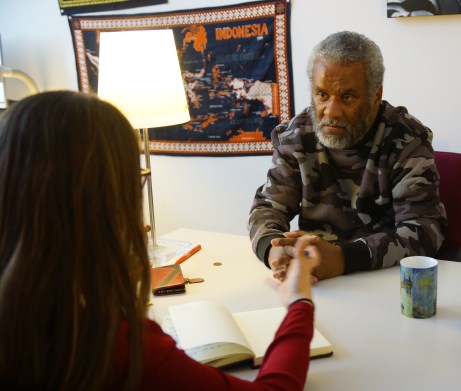
Bob Brown and Ana María Arbeláez Trujillo in conversation. Credit: Martin Blok

And what about academia: how do you see the role of academia in social change?

Academia is very problematic right now. The Black Panther Party for Self-Defense is predominantly regarded as an entertainment industry in academia. You don’t know how many people write books, articles, and PhD dissertations about it. When I read them, I laugh because they all reproduce the same lies.

First, I go to the index, and I see how many times the word ‘race’ and ‘class’ are mentioned. Yes, it is included one or two times, but the authors undermine, or are not aware of, their interconnection and role.

Another example is that academics are saying that Fred Hampton was killed because he was feeding children. That is not true. We did not only fight for black people; we also struggled for a different and true interpretation of history. So, if some people in academia are perpetuating the same old lies, then we must fight against those lies.

Do you think that social media have contributed to making social movements more horizontal? For example, is the Black Lives Matter movement more horizontal than the movement in the 1960s?

I have a problem with this concept of the horizontal versus the vertical. There is nothing leaderless in our culture, historically or currently. That is an illusion and ideological concept with which I don’t agree. I have a problem with those academics who are teaching that, because they are telling people something that is not true. How is the Black Lives Matter movement a leaderless organization when the Democratic Party and related forces are funding and controlling it?  They were potentially one of the most progressive movements in the country. Where are they now and what are they doing? I have a problem with the sector of the movement that says that they are a leaderless organization. That may be their ideal, but they are not there yet and never will be.

Black Lives Matter is not a monolithic or revolutionary movement. You cannot say that when the Ford or Soros Foundations offer funds to ten to fifteen of these organizations. They own the leadership of most of the movements in our community and around this country. Even if the Black Lives Matter people are not leaders, George Soros is. All we have to do is to follow the money trail. That shows confusion, and that is not a leaderless movement.

What do you think about the current focus of the media on white environmental activists?

The environmental movement is not white. It is a people’s movement with 7+ billion members worldwide. The overwhelming majority of the people worldwide are not white. The most funded and public version of it is white, but that is, again, a product of institutional racism.

This perception of the environmental movement being white has passed through generations, but it is wrong to say that. If you look from the invisible to top-down, it looks white. But you have to go through history. There are black people like Ben Chavis, Damu Smith and Connie Tucker. They coined the term “environmental racism” and were leaders of the “environmental justice movement.” Al Gore, the so-called leader of the green movement, brought “environmental justice movement” into the White House and coopted it. It is therefore disrespectful and racist to say that the environmental movement is white.


About the authors:

bob-brown1

Bob Brown is the co-founder and ex-member of the Chicago Chapter of the Black Panther Party (March 1968 to March 1969) and author of several books, including his most recent Malcolm X and Kwame Ture (Stokely Carmichael). He is currently a member of the A-APRP (GC).

perfil PID (2)Ana María Arbeláez Trujillo is a lawyer, specialist in Environmental Law and holds an Erasmus Mundus Master in Public Policy. She works as a researcher for PID Amazonia, a civic society platform to address deforestation in the Colombian Amazon. Her research interests are the political economy of extractivist industries, environmental conflicts, and rural development.


Title Image Credit: Martin Blok


EADI/ISS Series | The Battle is on: Civic Space & Land Rights by Barbara Oosters and Saskia van Veen

By Posted on 2221 views

Defenders of land rights all over the world struggle with shrinking civic space. The more that space for people to peacefully claim their land rights is restricted, the more intense land disputes become. In 2017, Global witness recorded that globally an unprecedented number of 197 land rights defenders were killed. A recent Oxfam Novib learning lab identified strategies for associations working in the area of land rights to deal with an environment of shifting and shrinking civic space.


My (Barbara)’s fascination and interest for the issue of civic space started in Indonesia. Local organisations struggled with the introduction of a vaguely framed law for Non-Governmental Organisations (NGOs), warning them not to work on issues going against ‘’Indonesian’’ values. A few years later I found myself supporting initiatives in more than 15 countries spread across the globe, struggling with shifting and shrinking civic space. Although this is just a fraction of countries facing a reduced space to assemble, associate and speak up freely, it enabled me to learn from a variety of contexts on how people resist, adapt and reclaim civic space. To me the key to win this battle is exactly this: learn from and connect those who face similar challenges fast and on a wide scale. Our opponents are doing exactly the same. We need to become faster and smarter in connecting and learning.

The civic space you have as an individual or organization depends very much on the issue you want to address. Some battle grounds are fiercer than others. Land rights are such a hot potato, touching on the interests of many. Small farmers or indigenous communities who defend their century-old reliance on forests find themselves in front of large agriculture or extractive investment projects. Concerned that land disputes can fuel social disorder, local and national governments limit the space for civil society to assist affected communities. The more that space for people to peacefully claim their land rights is restricted, the more intense land disputes become.  In 2017, Global witness recorded that globally an unprecedented number of 197 land rights defenders were killed.

How to tackle land rights in a complex environment?

In 2019 we at Oxfam Novib scoped the interest of some of our offices and partners working on land rights to document their strategies, successes and brilliant failures to remain influential in a shrinking civic space context. We also looked for Oxfam country offices facing a similar shrinking space while fighting for land rights and looking for inspirational ideas forward. Our vision: bringing them together in a unique participatory learning way in order for all parties to gain from this exchange. As an end-product we envisage a toolbox with actionable tactics that help to resist, adapt and reclaim civic space while working on land rights.

Oxfam country offices, partners and allies from Cambodia, Vietnam and Myanmar took part in this learning lab on land rights and civic space. Cambodian and Vietnamese Civil Society Organizations (CSOs) have had documented some successful outcomes of their land advocacy before, and are having a close look at the adaptive strategies that made these positive gains possible. Over the past number of years, Myanmar has been marked by shifting and shrinking civic space. How to tackle land rights in such a complex/changing environment? Indonesia was added as fourth country because of its exemplary way of bringing a diverse range of civil society together and bridge differences for a common cause.

Avoid naming and shaming

What were some of the successful approaches identified? Monitoring tools for robust land re-allocation and smart collaboration between local and national organisations and their combined strategies enabled change in one country. In another it was more a change of tactics (from confrontational to a more collaborative one) that enabled the participation of hundreds of communities and local CSOs in first ever consultation workshops on a land related law. Naming and shaming tactics were avoided as well as fights in the media. Direct feedback via closed-door meetings proofed more effective.

The need for alliances came out strongly in many aspects. Local organizations fighting for land rights are a fragmented group, with conflicting demands and needs as they all want to defend their rights. Uniting them in solidarity strengthens their common voice for change. It also builds their credibility and highlights their overall size as a force that needs to be acknowledged.  Staying close to one’s constitution is also a key requisite for both success and resilience. Strong solidarity networks to mitigate risks to single organizations proved a successful and necessary tactic throughout.

The Myanmar team, together with partners, is at this moment experimenting with some interesting ways forward, as identified and listed above.  The other participating country representatives are in the process of reflecting on their learnings. On the basis of this experience, we would like to encourage everyone who is struggling with land rights in a shrinking civic space context to join us on this exciting learning road to remain influential on land rights despite all odds. Many have proved that it is possible.


This article is part of a series launched by the EADI (European Association of Development Research and Training Institutes) and the ISS in preparation for the 2020 EADI/ISS General Conference “Solidarity, Peace and Social Justice”. It was also published on the EADI blog.

About the authors:

Barbara Oosters is Policy Advisor civil society space and strengthening at Oxfam Novib – she is supporting the learning lab on land rights and civic space from her expertise on civic space.

Saskia Veen is an Impact Measurement and Knowledge specialist at Oxfam Novib – she is supporting the learning lab in terms of methodology of documentation and learning strategy.


Image Credit: Rainforest Action Network on Flickr

COVID-19 | Driving transformative social change through an internationalist response to COVID-19 by Lize Swartz

By Posted on 3048 views

A recent webinar organized by the Transnational Institute and partners brought together activists from all over the world to brainstorm how to make social justice central to our responses to the COVID-19 pandemic. The main message? Stand united instead of divided, let empathy inform context-based responses, and start thinking of changing what’s broken, including our healthcare systems. These principles should also guide our collective efforts to enact transformative social change that starts with our responses to the crisis and ends in a sustainable, just and resilient future—one in which no-one is left behind.


We find ourselves standing on the edge of a cliff with an abyss in front of us, left with three (or more?) choices: build a bridge to reach the other side, which is unknown territory; become engulfed by the darkness of the abyss and stand paralyzed; or retreat from the edge of the cliff to deceptive safety. This metaphor symbolizes the critical juncture[1] we’re currently at and the pathways we can choose: a radical transformation (the other side representing an unknown future, hopefully a sustainable and just one), paralysis (do nothing and watch the crisis run its course, whatever the consequences), or many steps in the opposite direction (further away from each other, creating a new normal that is worse than the one we had before).

Never before has the opportunity for real, comprehensive change been greater, never before has it been as necessary, and never before have the stakes been higher. But we have to start now―the window of opportunity is closing. There is some progress on this front as activists and thought leaders gather forces to fight for change. A webinar held recently by the Transnational Institute (TNI), in collaboration with the Alternative Information and Development Centre (AIDC) and Focus on the Global South, brought together roughly 600 participants to brainstorm how to build an internationalist response to COVID-19 in light of the crisis of deep global inequality.

Current responses to COVID-19 will shape future trends in how crises are tackled, and it is imperative to 1) prevent further injustices and inequalities arising from current responses that build upon already-existing inequalities and divides, and 2) start to enact radical change to prevent a return to the old normal or the adoption of a new normal that may be manifold worse. Thus, our responses show which of the pathways we choose now that we have reached the critical juncture, and responses should mirror the future we desire.

This seems like a mammoth task, but there are many energetic fighters across the world that are eager to get started. The webinar was a starting point to discussions and strategies for enacting change collectively. Discussions centered around not only humane responses to COVID-19, but also the need to critically discuss the state of our healthcare systems and to transform them. The crisis has clearly highlighted that healthcare systems in the Global North and Global South alike are woefully unprepared to deal with pandemics, not even providing universal healthcare services in non-crisis times. Mazibuko Jara, founder of the Treatment Action Campaign and currently Deputy Director of the Tshisimani Centre for Activist Education (both in South Africa), emphasized the need for healthcare to be seen as a fundamental human right—a public good, which would change how it is approached.

Many are not focusing on building up (improving health systems), however, but on breaking down (fighting the virus and fighting each other). Sonia Shah, award-winning investigative science journalist who authored the book ‘Pandemic: Tracking Contagions, from Cholera to Ebola and Beyond’ (2017), noted during the webinar that diseases and viruses are framed as external, prompting the closing of borders and the closing of minds as we distance ourselves from these ‘alien entities’[2].

Rather, what she calls a ‘microbial xenophobia’ arises as the disease is blamed on China and cultural practices in Asian countries. This process of ‘othering’ entrenches racism and xenophobia, enacted both by individuals and countries, preventing a collective global effort to transformative change and leading to increasing isolation as countries shut their borders and global geopolitical divides are strengthened. A strong counternarrative to this militaristic imaginary of ‘being at war’ with the disease and with each other urgently needs to be created.

Several discussants highlighted the inadequacies of current responses. Even if stringent measures can prevent the spread of the virus, which has yet to be proven by evidence, the authoritarian measures lack humaneness, further threatening the survival and dignity of already vulnerable populations without access to basic human rights. A one-size-fits-all approach, such as a national lockdown, does not work in contexts where such lockdowns can hasten the spread of the virus and lead to suffering due to loss of income and hunger, for example.

Thus, keynote speakers at the seminar concluded, we need an internationalist approach that:

  • Is based on solidarity and empathy so that responses are context-specific and do not create new injustices or inequalities that place an additional burden on vulnerable people
  • Creates a strong counternarrative to the xenophobic, militaristic narrative that is driving defensive and authoritarian responses, with a central emphasis on human rights and a common humanity, shown in how we communicate and how we act
  • Are based on health as a human right, a public good and working toward transforming the health system to this end
  • Recognizes that we are facing a supercrisis, that standing crises of poverty, inequality and climate change are interacting with biological crises such as COVID-19 and cannot be viewed in isolation
  • Counters growing authoritarianism and fundamentalism at all levels of society that are threatening to deepen social divides and split the world apart.

Participants agreed that solidarity and empathy should drive responses to COVID-19, but I argue that we need to go further than just responding. Our recognition of the root causes of injustices and inequalities should drive a multi-pronged strategy to not only prevent the spread of the virus and prevent unjust responses to it, but also to enact radical transformation through our responses to ensure that the inequalities the crisis feasts on are eradicated and that no-one is left behind as we move on to a future we can only dream of.

Without the recognition that the crisis requires a collective global response, we will get nowhere. And central to this is questioning the underlying structures and institutions that have created the breeding ground for the virus and the disaster that it has brought along with it, and changing them through intense and enduring collaboration based on a sense of shared humanity, or what especially Buddhist monks have called interbeing.

[1] Thank you to Duncan Green for mentioning the term ‘critical juncture’ that perfectly sums up the thoughts that I’ve had since the pandemic broke out in February.
[2]She also highlights the failure to recognize that pathogens or microbes become pandemics due to humankind’s encroachment on wildlife habitats.

This article is part of a series about the coronavirus crisis. Find more articles of this series here.


16177487_1348685531818526_4418355730312549822_o

About the authors:

Lize Swartz is a PhD researcher at the ISS focusing on water user interactions with sustainability-climate crises in the water sector, in particular the role of water scarcity politics on crisis responses and adaptation processes. She is also the editor of the ISS Blog Bliss.

COVID-19 | Another top priority in times of crisis: keep democratic life up and running by Isabelle Desportes

By Posted on 3734 views

The coronavirus crisis seems to have reduced societal functioning to the bare minimum as an increasing number of governments have limited freedom of movement in an attempt to halt the spread of the virus. The introduction of several such authoritative measures needs to be counterbalanced by active citizens who continue to uphold democratic life and question these measures themselves, argues Isabelle Desportes, who studies how humanitarian emergencies are handled in settings where this is not the case. ‘Authoritarian dangers’ are not only a concern for far-away countries long labelled as ‘hopeless pariah states’, as European attempts are showing us these very days.


It is inherent to times of crises: many decisions and emergency legislative mechanisms will be enforced in countries all over the world these coming days and weeks. While such centralistic measures are often necessary, they also bear the risk of infringing on an effective and socially just handling of the pandemic now, and will shape our societies on the long term.

My research on disaster responses in Myanmar, Ethiopia and Zimbabwe showed that while responses to the disasters (a flood in 2015 in Myanmar and crippling drought in 2016 in Ethiopia and Zimbabwe) were mostly coordinated and efficient, the political contexts in which the disaster occurred meant that discussions on disaster preparedness and the modalities of relief were ignored. Important dynamics were observed for the three contexts: as the disasters destroyed homes, disrupted livelihoods and uprooted communities, their intense impacts had to be handled in the midst of ongoing marginalization of certain population groups at the hands of other groups and/or the state. Disaster responders were highly mobilized, but with little space to openly debate the modalities of relief, to have full insight into the extent of needs, and to raise concerns.

Following the disasters, a number of longer-term changes could be observed, according to the 271 disasters responders that I interviewed and who were active in organizations ranging from community groups to United Nations bodies:

  1. The already marginalized were impacted most strongly by the disasters, being the most vulnerable to start with (with limited coping capacities and safety nets, fewer rights, a lack of voice and bargaining power);
  2. Disaster responses were not always carried out in the common interest of societies at large and in accordance with humanitarian principles, but could serve as a conduit for violence, and to further enforce the interests of a few[i];
  3. This was mostly achieved not via bold announcements and clear restrictions, but through everyday acts. This includes how data is collected, analysed and shared as part of disaster needs assessments, or which seemingly bureaucratic conditions are tied to response mechanisms. The manner in which certain topics are routinely framed in public discourse also bears importance. When certain issues are not discussed transparently or not discussed at all, they cannot be taken care of[ii].

Myanmar seems to have embarked on a dubious handling of the coronavirus crisis already, denying cases of COVID-19 infections so far. But, crucially, the above described is not only a matter of concern for faraway countries long labelled as ‘hopeless pariah states’. In a 2019 article, political scientist Marlies Glasius highlights how authoritarianism applies not to entire regimes in an ‘all or nothing’ fashion, but to patterns of action that sabotage accountability between the people and their political representatives “by means of secrecy, disinformation and disabling voice”. Such practices can be applied everywhere, including in democratic settings.

The risk of this happening is especially high in situations of crisis, which, quite rightly so, call for urgent and extraordinary measures. Political leaders from France to Spain recently proclaimed that they were ‘waging wars’—rhetoric that bears the risk of stifling criticism and pluralistic views in the name of ‘national unity and security’. In academic jargon, such moves are termed ‘securitization[iii]. In Israel, the transitional government just pushed through the use of mass surveillance techniques on civilians to ‘monitor the virus’. This move is not approved nor overseen by the Knesset, to the dismay of many lawyers and human rights organizations. The Hungarian parliament might have to enter a phase of imposed hibernation, and journalists could be fined for propagating ‘fake news’. In several European countries, governments are currently negotiating with telecommunication companies to track population movements. One of the advanced arguments? ‘This was effective in China’. Yet, these privacy-invading practices can also be difficult to unwind, and can set precedents.

A key democratic concern is not only how decisions are taken, but also whether they are taken in the common interest of societies at large. Our political representatives, the media, but also every one of us have a crucial role to play in this. Social and environmental issues must be kept central, not only serve as adjustment variables to the economic or political interests of a few. To take one example even closer to home: in the Netherlands, the government is currently likely to financially support airline company KLM, which would quickly go back to launching its climate-destroying 500,000 flights a year. If such an action really is in the collective long-term interest in our times of climate breakdown deserves to be discussed.

So yes: stay home, wash your hands. But also, depending on your possibilities and preferences, and picking your fights such as to not enter into senseless clicktivism: keep our democracies alive and ensure that institutions are held accountable for the decisions they take now. This crisis can be a political turning point, and it is for all of us to make that future a desirable one.

Follow parliamentary debates and news on government decisions, interact with your political representatives, check whether political and technical institutions act in line with their mandates, keep informed about social realities different from your own, send in reader letters and challenge the media to relay these different social realities and issues, financially support independent media and civil society advocacy groups, join ‘online demonstrations’ (see for instance the alternatives proposed for the Belgian march against racism last weekend), keep mobilized within your party, union or civil society collectives, or even create your own.  And any other basic to creative means you might come up with, and would like to share in the comments?

[i] In Myanmar for instance, the government has long aimed to homogenise its multi-ethnic and religious peoples into a unified Buddhist and Bamar entity. During the response to 2015 cyclone Komen, state aid was biased against religious and ethnic minority groups, and self-help and non-state aid initiatives to help those groups were grossly hampered. Muslim communities were forcibly relocated in military vehicles following the floods, state aid was distributed from monasteries not accessible to non-Buddhist groups, and the Rohingya minority was framed in public discourse as not worthy of support.
[ii] This is linked to self-censorship practices, which I discussed with colleague Roanne van Voorst in another blog.
[iii] The term is generally associated with the Copenhagen School.

This article is part of a series about the coronavirus crisis. Find more articles of this series here.


IsabelleAbout the author:

Isabelle Desportes is a PhD researcher involved in the research project ”When disaster meets conflict” at the ISS.


Love in a time of internet shutdown: heartache and hope in Kashmir by Haris Zargar

By Posted on 2478 views

Our dependence on the Internet as a way to build, strengthen, and maintain personal relationships has grown along with global advances in digital technologies. A prolonged Internet blackout has taken a heavy toll on residents of India’s disputed Kashmir region, showing how the sudden absence of connectivity affects the dynamics of personal relationships. With authoritarian regimes blocking access to the Internet more often, it is time to ensure unhindered Internet access under international law.


The Internet has become an inseparable part of our daily lives, to the extent that our dependence on it goes largely unnoticed. Access to this cyber infrastructure is almost deemed  a fundamental right. But what happens when a community is forced offline at a time when almost every aspect of life is managed by internet-based tools? How does the absence of the internet reshape individual attitudes, social interaction, or reconfigure intimate personal relationships?

For months, residents of the Indian-controlled Kashmir region were cut off from the outside world after the Indian government on 5 August 2019 scrapped Article 370 of the Indian constitution, which until then had granted this state’s population a certain degree of autonomy. The communications blackout turned this Himalayan valley into a virtual information black hole.

The impact of the Internet clampdown on Kashmir’s economy, governance, healthcare system and educational institutions, as well as on the mental wellbeing of its people, were widely reported. In addition, a  report by the Kashmir Chamber of Commerce and Industry estimated that the months of shutdown cost the valley’s economy $2.4 billion and resulted in thousands of job losses.

Amidst this, little attention has been paid to how the absence of the Internet affects personal relationships, considering that technology now functions as a third element in these bonds. The nature of daily human interaction has been reshaped by video calls, chatting apps and social media platforms, effectively mediating the exchange of intimate information and expressions of love, concern, and care.

Anxiety and distress

A childhood friend pursuing his higher education in Germany was gripped with anxiety for weeks following the internet shutdown in Kashmir. He kept reaching out, almost frantically, to ask how we could communicate with his family, particularly to get information about whether his brother with epilepsy was still able to get his chronic medication.

Another Indian friend whose estranged Kashmiri partner was in the state during this blackout period had to contact her ex-partner’s sibling based outside of the country, “risking all the embarrassment”, to ask about his wellbeing. For another acquaintance, it was counting down the days until she could hear from her fiancé, regularly urging me to send some someone in person to his house to ask about him and his family.

A news report in Indian national daily The Telegraph captured the intimate moments of a teenage couple following the partial restoration of mobile connections in mid-October last year. When the lines were opened, the first call made by Faesal Ahmad, a college student, was to his sweetheart. “Are you still mine?” he asked, voice quivering in excitement at being able to speak to her for the first time in months. “Always yours,” came the reply, as Faesal later told the paper.

Away from the public gaze

In a traditionally conservative place like Kashmir, premarital relationships are still frowned upon and even though attitudes towards such relationships have eased over the years, couples avoid being seen together in public. The internet thus played a significant role in romantic relationships in the valley, making it easier for couples to interact using smartphones rather than having to find comfortable public spaces such as parks or cafés, which also remained inaccessible in the wake of the political turmoil. Online dating platforms have reportedly also provided safe spaces for the valley’s LGBTQIA+ residents.

Another news report by VICE India detailed how the internet shutdown and restrictions on public movements wrecked relationships and marriages in the valley. For many couples, the report underlined, the lockdown meant no calls, no WhatsApp messages, and no exchange of romantic voice notes.

Days after the restrictions were imposed, local newspapers in Kashmir were filled with announcements cancelling marriage functions that usually span several days. Couples who had made elaborate arrangements were either forced to reschedule or curtail their marriage programme. Instead, ceremonies were conducted in an austere manner with family members having to queue outside government offices to get curfew passes for guests.

Given the scale of our digital dependence, it’s difficult to truly comprehend the impact of the Internet being down for a prolonged period. Authoritarian regimes are now regularly shutting down the Internet to curb dissent, and as such, this undemocratic exercise must be made illegal under international law.


This is a shortened version of an article originally published by New Frame.


HarisAbout the author:

Haris Zargar is a PhD researcher looking at links between land reforms, social movements and armed insurgencies in Indian-controlled Kashmir. He has been a journalist for the past nine years, writing on the intersection of politics, conflict and human security. He worked as a political correspondent based in New Delhi with leading Indian new outlets including The Press Trust of India and The Mint. He holds degrees in Journalism and Development Studies from the University of Kashmir, and the School of Oriental and African Studies (SOAS), University of London.


Image Credit: Mike Licht on Flickr

Rethinking how we communicate on Bliss – a contribution to the decolonization of science by Lize Swartz

By Posted on 2457 views

Research institutes are not only spaces in which research and education take place—they play a political role in sharing knowledge that is intended to benefit society directly or indirectly. Who the knowledge is shared with and in which ways is of extreme importance; publishing research findings and learnings in English limits who can benefit from the research. In an effort to contribute to the decolonization of science, ISS Blog Bliss has decided to encourage the publication of blog articles in the native languages of the authors or the communities participating in the research.


The Editorial Board of ISS Blog Bliss meets at quarterly intervals to discuss numerous aspects relating to the blog, including its functioning, successes, and future directions. At such meetings, we always discuss the statistics of the blog, including which articles have the most reads and where the readers come from.

At our recent Board meeting, we noticed that of the top 10 countries in terms of readership, only two are outside the Global North. Moreover, these two countries—South Africa and India—were former British colonies where English is the lingua franca, understood and spoken by a large part of the population. The top 3 countries were the Netherlands, the UK, and the USA, while other countries included Germany and Switzerland. As all blog articles have been published in English, this inevitably means that people who are able to read English texts and do research in English have been able to access our blog site.

In an effort to increase the readership of our blog, we have decided to encourage blog authors to translate their blog articles to their native languages, or to the native language of the communities participating in the research. In the future, English texts will be encouraged to be accompanied by texts in native languages. We hope that in so doing, our audience can be diversified, moving beyond scholars, practitioners and research participants in the Global North to include those in the Global South as well.

Something we also found at Bliss is the importance of researchers sharing their blog articles on social networks. While Google helps to find blog articles, research dissemination on social media is also a form of scholar activism. Our research finds that Facebook is particularly important for finding blog articles, followed by Twitter and Google. We are therefore encouraging authors to share their blog articles on social media (in their native languages) as well.

The good news are that blogs remain a wonderful way to communicate what we are discussing or researching at ISS. The content is more accessible, both in terms of style and in terms of open access, than scientific theses or journal articles. We therefore encourage researchers to make use of this communication channel. If we really wish to live the scholar-activism many of us subscribe to—if we truly want to be scholar activists—we must also think of how and to whom we are disseminating the knowledge we have generated through our research.

Are you also committed to changing academia? Join us by writing for Bliss in your native language and then share it as widely as you can!


16177487_1348685531818526_4418355730312549822_oAbout the author:

Lize Swartz is a PhD researcher at the ISS focusing on water user interactions with sustainability-climate crises in the water sector, in particular the role of water scarcity politics on crisis responses and adaptation processes. She is also the editor of the ISS Blog Bliss.


Image Credit: Chris JL on Flickr

Creative Development | Moving national narratives: artistic expressions of flight, refuge and belonging by Roy Huijsmans

National historiography often takes the form of a single story propagated by those in power, thereby muting alternative experiences of ordinary citizens of these celebrated events. In Laos, the country’s National Day coincided with an international dance festival, showing different ways of recounting histories. In this blogpost Roy Huijsmans suggests that in the creative realm and performing arts we may find articulations of the subjugated narratives of the collective memory of the nation.


When visiting the Lao People’s Democratic Republic (Lao PDR) late November 2019 for the Fang Maekhong International Dance Festival I found myself also witnessing the preparations for the celebration of the 44th Lao National Day. Government buildings were being adorned with freshly purchased national flags, always flanked by the Lao People’s Revolutionary Party flag in bright red and sporting the familiar hammer and sickle in yellow. There were the inevitable banners, too, carrying slogans celebrating the nation and the progress made under the leadership of the communist Lao People’s Revolutionary Party.

In Lao historiography, the establishment of the Lao PDR is presented as the logical endpoint of a long struggle by the Lao peoples against imperial forces – first French colonial rule, then Lao Royalist Governments backed by the United States of America as part of its broader stakes in the Second Indochinese War. Around each national day (2 December), the various Lao newspapers and television stations contribute their bit to the reproduction of the national narrative, with specials about revolutionary heroes, heroic battles, and by detailing the development progress made under revolutionary rule. The same narrative is presented in school text books, musea, and in public speeches by officials.

All this is not particular to the Lao PDR. National historiography often takes the form of a single story told from the vantage point of the victors. Thereby it silences the many different experiences that were generated by these very same historical events (Evans 1998). For example, the narrative of a united revolutionary struggle against foreign powers and influence hides the many internal conflicts and civil war that were also part of the making of the Lao PDR.

A key element missing from the Lao narrative is the fate of the about 10 per cent of the then population that left the country throughout the 1970s and early 1980s. They left because they found themselves on the wrong side of history or simply escaped the impoverishment and repressive political climate characterising the infant years of the Lao PDR.

Virtually everyone in the today’s Lao PDR knows someone who has fled the country. Stories of flight, refuge, and increasingly also about return are told, yet often in private. These are the stories of uncles and aunts now living in France, the USA, or Australia. These stories have found no place in school textbooks or in any of the official commemorations around the Lao national day. Yet these stories matter because these, too, are a part of the collective memory of the nation.

The arts: subtle propositions going beyond the national narrative

Artistic initiatives are turning the tide to make the voices of migrants and refugees heard, however. Parallel to the preparations for the Lao National Day celebration, Vientiane also witnessed the 10th edition of the Fang Mae Khong International Dance Festival. The French-Lao dancer Thô Anothaï was part of the impressive line-up comprising Lao national and international dancers. In his contemporary dance titled Mekong, Thô enacted his personal experience of fleeing Laos at a young age. Through his dance, by means of movements rooted in hip-hop and contemporary dance, he represented memories of his flight, such as a boats man paddling him across the Mekong River in the deep of the night.

As Thô took the stage, the first lines of a Lao traditional song were played. Soon the music gave way to soundbites of women’s voices in French, Lao, and the Vietnamese language that graphically described moments in the experience of flight and refuge. The song accentuated Thô’s personal account as a Lao story; the women’s voices referenced the broader context of the aftermath of the Second Indochinese War in which we must understand Thô’s experience. Through his performance Thô invited the audience to accompany him in his journey across the Mekong River, recalling his childhood experience of flight expressed through the serene and stunning beauty of his dance.

The themes of flight, refuge and identity are also central to Nith Lacroix’s 2007 documentary film titled Pierre & Pierrot. The film focuses on twin brothers of a French father and a Lao mother who were separated at a young age in their flight across the Mekong River into Thailand.

Thô Anothaï and Nith Lacroix’s artistic work are first and foremost works of art. Yet, by staging their work for audiences in the Lao PDR, the art may become more than just that. For more inclusive celebrations of national events, it is important to recognise the suffering and pain that is also part of the collective memory of the nation.


References
Evans, G. (1998). The Politics of Ritual and Remembrance: Laos since 1975. Chiang Mai: Silkworm Books.

This article is part of a series on Creative Development. Read more articles of this series here.


Color 2 Roy Huijsmans

About the author:

Roy Huijsmans is a teacher/researcher at the ISS.


EADI/ISS Series | Why gender matters to social movements by Stacey Scriver and G. Honor Fagan

By Posted on 2216 views

There are right and left, radical and conservative social movements at work in today’s volatile and unequal world. Whether directed towards a transformative social justice agenda or not, social movements themselves do not exist outside of the structures of power. Even among social movements directed towards deep social justice, gender inequality remains a key concern, since gender-related inequalities persist, both within the movements themselves, as well as in their recognition, support and the response to them.


There are right and left, radical and conservative social movements at work in today’s volatile and unequal world. Whether directed towards a transformative social justice agenda or not, social movements themselves do not exist outside of the structures of power. A growth in populist politics, a resurgence of religious movements with conservative agendas on gender and sexuality, and new male supremacist ideologies remind us that gender justice is an extremely challenging and ongoing struggle.  Even among social movements directed towards deep social justice, gender inequality remains a key concern, since gender-relatedinequalities persist, both within the movements themselves, as well as in their recognition, support and the response to them.

The Sustainable Development Goals represent the blueprint to achieving a better and more sustainable future. SDG 5 is particularly relevant to considerations of gender and social movements. It is clearly recognised that to achieve sustainable growth, gender equality is necessary. This includes the removal of barriers to women’s empowerment, such as the common and pervasive experience of violence against women or gender-based violence. It also implies re-shaping power structures through the inclusion of women in leadership roles, both within government and in economic activities.

Social movements can be powerful actors in efforts to protect and expand human rights, including gender inequality. Further, social movements are vital training-grounds for leadership and political engagement: many who ultimately take up positions of power within societies initially learned skills in negotiation and communication and built their reputations through work with social movements. They thus also offer a pathway for women to achieve political and economic status.

Gender in Social Movements for Economic, Environmental and Social Justice

Despite the potential of some social movements to contribute towards a gender-just world, inequalities persist within the structure and organisation of many. Leaders are most often men, and often men who ascribe to a culturally acceptable form of masculinity. Women often take on the ‘house-keeping’ roles within social movements, such as organising recruitment and developing campaigns, or ‘soft’ activism, such as maintaining relationships behind the scenes. Consequently, those whose voice are heard most and who consequently benefit most from such public profiles are more likely to be men, limiting the benefits of participating in social movements for women. In short, the working culture of these movements and their pedagogical methods do not create gender parity in membership and decision-making unless they are ‘engendered’.

Many social movements neglect to address the question of gender. For instance, in movements for peace and reconciliation, concerns perceived as relating only to women are often relegated to a secondary status. Peace movements may perceive conflict-affected gender-based violence, including the propensity for increases in intimate partner violence in the context of conflict, as being a second-class category of concern. That is, to be addressed once the ‘bigger’ issues of, for instance, organised violence by paramilitaries, are resolved. This is despite gender-based violence affecting more individuals than organised violent attacks.

The failure to apply a gendered approach to social issues and to create equality within social movements may thus replicate inequalities within the movement itself. This undermines the potential for social movements to be a space wherein women can develop key skills in leadership, shape demands for justice, and develop trust with publics. There is a crucial role for feminists and gender justice activists to create change within social movements, even those advocating social or environmental justice and sustainable development.

Gendered Social Movements                                         

While women have historically taken on important, if often under-recognised, roles in social movements, with examples including the labour movements of the 19th and 20th Century, ‘women’s movements’ have also been active in combating gender discrimination, from suffrage movements to Violence agains Women (VAW) movements. There have been notable successes. The Global Campaign of the early 1990s, and the organisation of the Vienna Tribunal, achieved a significant shift in the human rights agenda, with the explicit recognition of violence against women as a human rights violation.

However, women’s or gender movements also face particular barriers due to gender bias, stereotypes and inequalities.  Being perceived as having particularist goals or lacking sufficient political allies in positions of power has limited the successes of often vibrant women’s movements in terms of translating knowledge raising and public activism into direct political and/or economic gains.

Gender justice is too important to be siloed as a ‘women’s issue!

Put simply, social movements are critical components of thriving democracies, and even more critical where democratic accountability is on the wane. However, persistent gender inequalities within social movements, mean that social movements themselves may not be representative of the needs of its members. Social movements need to engage in critical reflection and restructuring to ensure that they are themselves gender just.

Moreover, adequate recognition that equitable social change and sustainable development requires gender equality must be central to the organising principles not only within social movements but also across those seeking social justice.  Additionally, gender justice is too important to be siloed as a ‘women’s issue’. Allyship between explicitly gendered movements and those focused on other kinds of social justice change is needed. Transformative social change is necessary for long-term and sustainable development and social movements have an important role to play; gender justice, within and between social movements, is a prerequisite.

If you are you interested in discussing gender and social movements further, consider submitting to our harvest panel “Gender Movements and Social Justice” at the EADI/ISS General Conference 2020

Our panel seeks to deepen understanding of the role of gender movements, and gender in movements (including gender solidarity), working towards peaceful, equitable and just communities and societies. We welcome papers that engage with the issues of gender justice and social movements through a variety of perspectives and approaches. Contributions from early career researchers, established academics, and practitioners, including empirically and theoretically-based draft papers, are all welcomed.


This article is part of a series launched by the EADI (European Association of Development Research and Training Institutes) and the ISS in preparation for the 2020 EADI/ISS General Conference “Solidarity, Peace and Social Justice”. It was also published on the EADI blog.


Image Credit: Molly Adams on Flickr. The image was cropped.


About the authors:

s200_stacey.scriverStacey Scriver is co-convenor of the Gender Justice Working Group of EADI. She is also a lecturer in Global Women’s Studies in the School of Political Science and Sociology and Director of the MA Gender, Globalisation and Rights at the National University of Galway, Ireland.honor-g-fagan-hme

Honor Fagan is co-convenor of the Gender Justice Working Group of EADI. She is a Professor of Sociology at Maynooth University, Ireland. Her research interests focus on human security and international development, water, waste and social sustainability, and gender and governance. She is currently leading the Social Science component of two Horizon 2020 research programmes on water sustainability.


Marie Antoinette rules in Colombia as the masses protest against inequality

By Fabio Andrés Díaz Pabón and María Gabriela Palacio

Since late November, Colombia has seen unprecedented mass protests, the longest since 1977. These protests illustrate the awakening of a muffled civil society. Protests in Colombia are part of a Latin American “spring”. Demonstrations have, since September, swept across Haiti, Mexico, Nicaragua, Venezuela, Panama, Uruguay, Peru, Ecuador, Bolivia and Chile. But Colombia’s protests are not merely following a regional trend, nor can they be attributed to a single ideological leaning.


Who is protesting and why

Colombians are protesting against inequality, because the country has the most unequal society among the 36 Organisation for Economic Co-operation and Development (OECD) countries. In addition, recent government measures, such as cuts in taxes to wealthy investors and an increase in taxes for the middle classes, have generated a significant backlash in a failed attempt to implement “trickle-down economics”.

Though the Colombian economy has experienced resilient economic growth despite the fall in commodity prices, there is little to no redistribution taking place. The richest 1% of the population captures more than 20% of the total labour income.

Because measures recently adopted by the government probably exacerbate inequalities, peasants, student, urbanites, labour unions and indigenous groups have taken to the streets. Their grievances might differ but the persistence of inequality has led to a reduction of their tolerance to measures that maintain the status quo.

Protesters are demanding the implementation of the provisions signed in the 2016 by the Revolutionary Armed Forces of Colombia — People’s Army Colombian peace agreement. For some factions in the government, demanding the fulfilment of the promises of the Constitution and demanding peace is seen as a subversive act. Yet Colombians are not demanding a revolution; they are demanding the right to a dignifying life and the fulfilment of the promises made by the government.

In a country that is in an armed conflict and is home to one of the highest shares of internally displaced populations in the world, the dismissal of protesters’ grievances constitutes a threat to civil society and democracy. The number of assassinated social and indigenous leaders and activists illustrate these risks.

The motivation for protests relates to the deepening of inequalities and levels of precarity in terms of access to education, health and social protection and the weariness of armed conflict. The strength of the protests can be explained as the result of the transition of the Colombia society towards peace — the peace accords with paramilitaries in 2006 and guerrillas in 2016 opened different venues for political participation — and the strengthening of social movements.

Government’s response

The response from the government of Iván Duque has been one of denials, accusations and failed attempts to regain control over public discourse.

He took office thanks to the political backing of politicians and sectors in society who opposed the peace negotiations with guerrillas and the state reforms taking place since 2010. Once in power, Duque found himself having to comply with state policies his support base did not agree with.

But these groups do not represent the majority of the population. Because of this, Duque faces a 70% disapproval rate and only 24% approval rate, according to a recent Gallup poll. This also means he has no control over the congress, posing a dilemma to his government. Either Duque tries to clear his policies to receive the broader support of society and face the alienation of his core supporters or he loses the capacity to lead the country. Because of this, media such as The Economist have depicted Duque as a president without direction.

Given this limited political space, the government attempted a propaganda campaign that tried to cast protesters as not contributing to the development of the country and drove Duque to plan the first meeting after the national strike with the industrials and business people rather than with the protestors.

This illustrates that the government cannot see that the protests span across race, location and class. Protests have brought together diverse actors that have found in the streets a space of encounter. Social groups are refusing government measures concerning social security, pensions and labour reforms, because they would have a pervasive effect on the livelihoods of the majority of the population. This explains why protests are supported by 74% of the population.

The disconnection between self-interested elites and the rest of society is evident. The proposal for a tax break, such as allowing consumption without value-added tax for three days a year and an extended “Black Friday” as a solution to the protests illustrate how little the government understands its citizens. Initiatives such as these reflect the aloofness of Maria Antoinette; a “let them eat cake” response.

Economists have opposed other proposals tabled by the government as lacking any technical basis. Populist economic measures aim to increase the acceptability of Duque’s government but can drive inequality and further grievances. The elimination of a 2% tax for buying houses worth more than $260 000 shows that the government is not undertaking reforms to improve the livelihood of the majority of Colombians, neither are improving state revenues.

Policy challenges

The debate can be framed about the availability of public resources and how to spend these, but data shows that the country is growing faster than any other OECD country. Nevertheless, the gains of growth are not evenly distributed, because the cost of living for the middle class is growing faster than their incomes.

The state is facing a long-standing problem of export-dependent economies. As the global economy cools down, the demand for Colombian exports has declined. In response to an imminent trade deficit, the state must increase its revenues but is afraid of taxing the wealthy — its remaining support base. This scenario takes place in a country in which informal employment is rising, and the size of industrial production is declining. The country is also going through a demographic transition, with an ageing population adding pressure to the pension system. As the population grows older, fewer contributors can sustain the social security system, and the costs for public health and pension fees increase.

One of the government proposals was to reduce employment costs and make youth employment flexible. Driving the most significant segment of the population into precariousness cannot be sound politics or economics, especially if the government is thinking about financing the pension system for future generations. Duque’s government praises the discourse of innovation and entrepreneurship, but it should consider that people in insecure employment are less likely to take risks and innovate.

Policies need to tackle the sources of inequality in Colombia and work to the benefit of the growing youth and middle class. The policy dilemma the government has is either to increase taxes to the bulk of the population, or reduce exemptions to wealthy citizens. Given the little political capital that the government has, increasing taxes for the wealthy might mean the government could run out of support. But failing to create the fiscal space that could sustain the economy and redistribute income might exacerbate inequalities in the future.

Moving towards an equal society is not only an ethical response to the grievances of diverse social groups but also a necessary condition for accelerating economic growth. Structural changes should be considered. The government should shift its attention towards innovation and industrial policies that can internalise and disseminate technological gains while driving domestic demand towards the local industry. Redistributive reforms are a prerequisite for progress because they help to close structural gaps and lead to higher levels of productivity, full use of capacities and resources, a fairer distribution of income and wealth and provide all citizens with the right to embark on the plans that they consider worthwhile.

Transition from violence

Protests remain spaces of uncertainty and crisis, but they also are spaces of representation, democracy and opportunity. Protesters bypass the structures of representation and send signals to institutions when they do not work. Furthermore, they allow governments to hear different voices and provide valuable feedback on the workings of the economy. Yet privileged actors invest energy and resources in preventing positive dissent and protecting the status quo.

Inequality and precariousness hinder economic growth and social cohesion. The mass protests, in the Colombian case, not only demonstrate how public voice emerges when violence is declining, but also how inequalities can be exposed once violence decreases, because people demand basic rights for the losers of development processes. As the country tries to leave violence behind, the nature of the conversations changed from armed conflict to citizens’ rights. Nevertheless, Colombia is a country that remains in fear of violence, the legacy of a 70-year war. The leadership of the government or its lack thereof remains central in blocking the transition away from violence.


Picture credit: Roboting on Wikimedia Commons


This article was originally published by Mail and Guardian.


UntitledAbout the authors:

Fabio Andrés Díaz Pabón is a researcher at the African Centre of Excellence for Inequalities Research, a research associate in the department of political and international studies at Rhodes University and a researcher at the International Institute of Social Studies in the Netherlands.

200x200María Gabriela Palacio is an Ecuadorian political economist interested in social policy, inequality and exclusion, who works as an Assistant Professor at the Faculty of Humanities of Leiden University. She holds a PhD in Development Studies by the International Institute of Social Studies (ISS).


Terrorism not in my name by Tariq Modood

By Posted on 1597 views

Muslims are now at the centre of two forms of terrorism. On the one hand, acts of terror carried out in the name of Islam and/or to defend a Muslim population by fellow Muslims. And on the other, acts of terror by white supremacists carried out in the name of western, Christian, or European civilisation. How should one respond to terrorism carried out in one’s name?


I put aside for now forms of state terrorism such as those carried out by the US-led alliance in Iraq, by Israel, by the Assad regime in Syria, or by China in Sinkiang, for example, because they deserve a separate discussion.

The first thing to note on the two kinds of terrorism I am interested in is that, globally speaking, the overwhelming majority of the victims are Muslims (just think of Pakistan and countries such as those in which groups like ISIS operate). I shall, however, confine myself to western or white-majority countries. In other words, I am thinking of attacks such as those carried out on the London transport system in 2005 and on Muslim worshipers in Christchurch, New Zealand in 2019 – where Muslims are a minority and also a minority – albeit not an insignificant one – of the victims.

There are a number of interesting questions that can be asked about the two kinds of violence mentioned at the top of this blog. For example, the two seem to have some kind of causal or reactive connection and one could explore that aspect and wonder if both are set to increase as they feed off and copy one another. One may also ask about the role of religious identity, especially as there seems to be two different dynamics at work. In the case of Islamist-inspired violence, the relationship with religious identity seems direct, even if based on deviant interpretations of Islam. In the case of the Christchurch killer, a direct appeal to Christianity seems to be at best civilizational rather than faith-based; its relationship to religious identity is that it is explicitly in the name of opposition to a specific religious identity, namely Islam, or more precisely to a hatred of Muslims, in other words, Islamophobia.

My question here is: how should those who share the relevant generic named identity (eg., being Muslim, being white, being a Westerner) respond to the violent evocation of their identity by perpetrators of violent crimes? And, further, can there be a basis of cross-arching unity through such responses and bi-sided condemnations?

Since 9/11 many western (and other) Muslims have been numerously asked to condemn Islamist acts of atrocities. While all or nearly all do so, some Islamists and left-wing Muslims also object to non-Muslim fellow citizens asking them to do so. They bristle against the assumption that they might be supportive of such atrocities and ask why is the condemnation sought only from Muslim citizens. Isn’t the desire for public condemnation by their fellow citizens a kind of collective suspicion of all or most Muslims, which is only one step short of collective blame, which would be racist?

Requiring rituals of public condemnation of jihadi terrorism by co-citizens just because they are Muslims may indeed be Islamophobic. But perhaps Muslim co-citizens not spontaneously – without being asked to – distancing themselves from Islamist terrorism shows a diminished civic identity? Or perhaps not?

One test of this, or at least an opportunity to reflect on it, presents itself with the growing white supremacist terrorism. Should white citizens – in virtue of being white and co-citizens – feel obliged to say anything to groups victimised by such terrorists? Are Muslims or other relevant minorities owed a condemnation by co-citizens? Does it matter that such condemnation by white people would reassure and express solidarity with their Muslim co-citizens? Is the requesting of white people to make such a condemnation or the spontaneous making of it by them an acceptance of collective blame and the not making of it, siding with racism and Islamophobia?

While we should not overlook that western Muslims live under a burden of suspicion and stigmatisation with constant pressure to conspicuously exhibit they are good citizens in a way that most white people do not have to, we should all indeed strive to be good citizens. Zealous witch-hunting of Muslims is not good citizenship; but nor is not spontaneously attending to one’s co-citizens fears and anxieties and cultivating forms of solidarity.

Given that the two kinds of attacks that I have been discussing here are likely to grow at least in the short and medium-term and that they are meant to divide communities and citizenries, can bi-sided ‘not in my name’ condemnations rather than the silence of ‘nothing-to-do-with-me’ be the appropriate response of citizens and political leaderships?


This article was originally published on openDemocracy and is part of a series on Global Extremes.


Georgetown Photo.jpg

About the author:

Tariq Modood is Professor of Sociology, Politics and Public Policy and Director of the Centre for the Study of Ethnicity and Citizenship at the University of Bristol and a Fellow of the British Academy. His latest books include Multiculturalism: A Civic Idea and Essays on Secularism and Multiculturalism (2019). He recently held a seminar about ‘Accomodating Religious Diversity in Secular Institutions’ at the ISS.

This project has received funding from the European Union’s Horizon 2020 research and innovation programme, under the GREASE project (grant no. 770640) and the BRaVE project (grant no. 822189).

The opinions expressed in these blog posts are the sole responsibility of the authors. The European Union is not responsible for any use that may be made of the information or opinions contained herein.


Revolution and music: women singing out in Sudan by Katarzyna Grabska and Azza Ahmed A. Aziz

With the attention to Sudanese women musicians actively participating in the current uprising in Sudan, this article reflects on the history of women’s involvement in music and how their performances have acquired political claims over time.


Music in times of revolution

The ongoing revolution in Sudan started with mass protests in December 2018 (see last week’s BLISS blog), led to the overthrow of Omar El Bashir in April 2019, and to a massacre orchestrated by the Transitional Military Council on the 3rd of June, 2019. These unprecedented peaceful protests had opened up a space for the amalgamation of creative productivity in Sudan and across the diaspora, including music. Young people and women have been portrayed as being at the forefront of the resistance. The images of women demonstrating on the streets, singing, drawing and making art on the streets have flooded the social media.  However, this is a hyperbolic depiction of their actual number supported by the fact that this level of participation by them was unanticipated. The revolution has been seized by diverse women as a space to make claims for greater freedoms and liberties, including contributions to nation-building projects. Yet, these acts of citizenship (see Isin and Nielsen 2008) are highly gendered and take place within the constraints of patriarchal norms (Azza Ahmed. A. Aziz).

Music has always occupied a significant role in the multiple cultural expressions of the Sudanese nation. In the current uprising, it created a space to enact resistance and  narratives of belonging. Women amateur singers as well as professional musicians in the diaspora and in Sudan have become key voices in the message of the revolution from the streets and visibilising the political claims that are being made.

In Sudan, since the coming to power of Omar El Bashir and the Islamists in 1989, the music scene has been deeply affected. Many musicians were curtailed, went into exile, and the once popular music spots in Khartoum where Sudanese jazz and popular music could be heard were banned. It was also combined with the demise of once famous music institutions in the capital. The Sudanese government’s centralisation of power under the banner of an Islamised identity was established, and this ultimately  imposed  specific  gender codes that were legally consolidated  through The Public Order Law of 1996 that established strict rules for women’s dress code and public appearance. This measure limited the public spaces where women artists could perform both in Khartoum and throughout Sudan. Despite this, women’s political and patriotic claims within songs were not silenced.

For example, an all-female music group Salute Yal Banoot, who since its foundation in 2014, has been contributing to dismantling some of the obstacles (other examples include female members of the mixed Igd Al Jalad group, Nancy Ajaj, Al Balabil, etc). These women had to navigate arbitrary refusals by the government to allow them to perform in public on stage. Salute Yal Banoot have also been actively involved in the uprising. They dedicated their performance in Kuwait in March 2019 to those who had  lost their lives in the protests. On their facebook website, they stated that resistance could take different forms, one being music, and the need to embrace the collective of being Sudanese. They use the slogan of John Garang, the late leader of South Sudan, quoting him: ‘SUDANISM embraces all that is African, Arabian, Islamic and Christian. It encompasses religion, race and culture and expresses them as a unique identity. Thus, it is inherently irreconcilable with sectarianism of any kind.’ Here, their music and creative practice merge with the political potentialities of the nation that they enact through the diversity of the composition of their own music group.

To understand the musical role of women visible on the Sudanese scene in the current context, we need to situate it within the wider history of women as the producers of music in general and their performance of political songs in particular.

Historical take on women and music

Historically, women have had a significant place in musical production in Sudan according to different genres that have existed: hamassah (encouraging men to go to war: for example, Mihaira bint Aboud who encouraged the Sudanese to fight against the Turko- Egyptian occupation and who is evoked during the current revolution as a voice for women to emulate), sirah (songs for men at their weddings en route to the bride’s home, manaha (bereavement songs)  and as hakamats’ songs (existing in Western Sudan encouraging men to go to war). Hence, there has been a continuum of women using music to enact gendered citizenship and the current uprising is another expression of such political actions.

The history of women’s eruption onto the Sudanese music scene was not always smooth. The first public rhythms used by women were characterized by 3 beats on the daluka (a clay drum with a leather covering) and they were known as the tumtum.  They were the province of ex-slave females working in local alcohol haunts that were deemed disreputable. Eventually they became a source of emancipation for ex-slave women (ghanaya) within the urban centres of Sudan. They came to express the life experiences of working class women during the 1930s and 1940s. These rhythms became part of female wedding universes and they were equally sung by free-born female artists.

Given the popularity of the genre it was gradually appropriated by men and modified. The establishment of Radio Omdurman in 1941 made this genre intrinsic to Sudanese popular music (see also Saadia I. Malik 2003). A notable singer of this genre was Asha Al Falatiya. Asha managed to access a men’s world by shifting to the use of an orchestra. Part of her credibility as an artist was contained in the fact that she penetrated men’s world’s through her recordings that were diffused on Radio/TV Omdurman. Her political stand was well visible in a nationalistic song about defending the nation against heavy artillery external attacks where she enjoins Mussolini to  wage war in Sudan’s defense in order to circumvent  the duplicity of Hitler. This was a time when women’s feminism was still subject to penetrating mens’ political and economic worlds.

In the 1970s, certain forms of women’s singing were institutionalized and the penetration of women on the music scene was the product of liberalization and market forces. Eventually women started singing on television and the approbation of the official media elevated the profession of women singers. Their access to public stage, however, dwindled with sharia law and 1996 public order law.

The political momentum of the current uprising gave women musicians more opportunities to take risks and  re-enter more visibly the public stage in Sudan. This gives us a sense of the ongoing transformations of gender norms and gender relations more widely.


This article is part of a series on Creative Development. The first part dealing with art in the Sudanese revolution can be found here.


Image Credit: Salute Yal Bannot


PHOTO-2019-08-08-11-57-49Azza Ahmed Abdel Aziz lives between Khartoum and London.  She holds a Ph.D in Social Anthropology, with a special focus on Medical Anthropology from the School of Oriental and African Studies, University of London. Her research focuses on cultural understandings of health and well-being. She has been following the unfolding upraising in Khartoum since December 2018 and has been documenting the everyday protest practices, focusing specifically on the artistic expressions. She is also a co-researcher with Kasia Grabska in the ISS-funded project on creative practice, mobilities and in development in Sudan. 

Kasia Grabska_

Katarzyna (Kasia) Grabska is a lecturer/researcher at the ISS and a filmmaker.


Creative Development | Sudan protests: artistic acts of citizenship by Azza Ahmed A. Aziz and Katarzyna Grabska

Since December 2018, flashing images of protests in Sudan have appeared in mainstream media. This, however, barely touches upon the ongoing struggles of the changing local and diasporic dynamics of what ‘citizenship’ and belonging in Sudan mean (see ISS research project). Many acts of citizenship (see Isin and Nielsen 2008) have been most visibly associated with artistic creativity that spread across Sudan and  in  diaspora. In this article, we reflect on how art has been one of the key drivers of the revolution and the transformation of local and diasporic citizenship claims pertaining to Sudan.


The December 2018 Sudanese Revolution: A Hub of Artistic Creativity

The revolution was propelled by demonstrations all over Sudan. The demonstrations demanding freedom, peace and justice culminated in a million persons march happened on the 6th of April, 2019. Demonstrators reached the Army headquarters in Khartoum and were joined by people from all over Sudan.  Since that date, large swathes of the Sudanese population had been occupying  a space in front of the Army headquarters (midan al itisam): the sit in space. Almost two months of occupation of this space created a world where  revolutionaries could join  to realize  their objectives of freedom, peace and justice. They demanded that military forces that overthrew Omar El Bashir (representing military junta that came to power through a coup in 1989) on 11th of April hand over power to a civilian led transitional government.

Artistic and creative practice has played a seminal contribution to the development of resistance and the revolution. The genesis of the sit in space had reignited a flurry of creativity ranging from painting, photography, filming, spoken word and whatsapp messaging that conveys information about its  evolution  to diverse audiences:  the Sudanese public , the diaspora and the outside world, through graphic design, slogans, speeches, song lyrics  and live recordings. Prior to the protests, art in public spaces of  Khartoum was rare. Women artists were significantly more absent. During the sit in, the walls of the city became covered with extensive murals or art work.

Within the sit in zone a huge 3 km canvas was being prepared by artists within the premises of a technical training school. This canvas was to be presented to the public. It would encompass artistic symbols as well as the signatures of those who would represent all those who dedicated their lives to staying in place. Another zone, that was a rubbish dump, had been transformed into a space of beautiful art. This creative practice gave a clear sense of belonging and facilitated making political claims for many, regardless of gender, class, age and ethnic origin.

Art is fundamentally linked with revolutionary processes and plays an important role in creating a sense of belonging and citizenship. Through painting the walls of the army headquarters, singing in public, filming and photographing, the demonstrators performed acts of citizenship, expressing their ideals and demands for Sudan and their own understanding of rights as Sudanese people. With the digital access and the instant sharing of messages of hope, despair, and demands for justice, freedom and civil rule, it became possible to disseminate these practices across the globe both for those remaining in Sudan and those   in diaspora.

The sit-in period was characterized by protracted negotiations between the Transitional Military Council (TMC) and the driving force of public mobilization the Sudanese Professional Association (SPA).  This was a fraught process that included the involvement of the notorious Rapid Security Forces (RSF) militias under the leadership of Mohammed Hamdan Dagalo (known as Hemeti)  the second man within the TMC. On the 3rd of June at the crack of dawn on the last day of the Muslim fasting month, Ramadan, the TMC  brutally dispersed the people occupying the sit in space. Live bullets were fired on peaceful civilians and many people were mortally wounded, killed, raped and injured (see dying for the revolution BBC). This massacre was followed by measures aimed at terrorizing  civilians and executed by the RSF that patrolled the streets, randomly harassing, beating and raping. The erasure of most of the creative acts of citizenship by painting over many of  the murals on the walls of the sit in area was set into motion  in order to wipe out the achievements of the revolution and silence its call. Notwithstanding that  Khartoum remained eerily silent for 10 days with the internet quickly disabled and  people fearing to leave their homes , the mobilization rapidly persisted.

Art, erasure and making of citizenship

The erasure of art orchestrated by the  TMC,  in the aftermath of the massacre, points to the power of art and artists to create a political space for expression of citizenship. Yet, the massacre and the erasure led to other creative practices  in music and visual art that frames  new contours of belonging and political rights. During the six months of protests and especially during the massacre, many lost their lives. They were framed as martyrs. They became a motivation for the youth who started proclaiming their right not to be forgotten: ‘we will not forget and we will not forgive, blood for blood we will not accept monetary compensation’. This expresses their intent to persevere in creating a better Sudan worthy of their sacrifice. This particular narrative of how martyrs are  predominantly represented is visible in the music of Ahmed Amin.

In visual art, the work of Assil Diab, a Sudanese artist living in Qatar, illustrates the significance of remembering and documenting the sacrifices of those who died during the peaceful protests. Alongside a group of artists, she paints wall murals depicting the faces of the fallen on the walls of  their family homes. She seeks  permission  from  their families to bear testimony to the fact   that Sudan has not forgotten their sons and daughters (graffiti art).

Through art, young musicians and visual artists are constructing a new model of a deserving citizen, a martyr. The calls for freedom, peace, and justice, sit alongside other claims to citizenship depicted here through these ‘good deaths’. This medium instills that martyrs are occupying a worthy place in the hierarchy of citizens in Sudan.  This is just one aspect of how art plays into some  key imaginaries of belonging and provides a reading of diverse ways of participating in the revolution as an evolving nation-making Sudanese project  that emanates from the local and from afar.


This article is part of a series on Creative Development. A second part to this article dealing with women and music during the Sudan protests can be read here.


Image Credit: Jakob Reimann on Flickr


PHOTO-2019-08-08-11-57-49Azza Ahmed Abdel Aziz lives between Khartoum and London.  She holds a Ph.D in Social Anthropology, with a special focus on Medical Anthropology from the School of Oriental and African Studies, University of London. Her research focuses on cultural understandings of health and well-being. She has been following the unfolding upraising in Khartoum since December 2018 and has been documenting the everyday protest practices, focusing specifically on the artistic expressions. She is also a co-researcher with Kasia Grabska in the ISS-funded project on creative practice, mobilities and in development in Sudan. 

Kasia Grabska_

Katarzyna (Kasia) Grabska is a lecturer/researcher at the ISS and a filmmaker.


The question of democracy in environmental politics: The Green Road Project in Turkey by Melek Mutioglu Ozkesen

By Posted on 1590 views

Road construction is usually presented as a major condition for development, but the question is: development for who and whose land is being intruded for the construction of the road? In Turkey, these questions were prominently raised by social movements and civil society organizations when the government launched its Green Road Project in 2013. It is promoted by the state authorities for making the Black Sea region accessible to the incoming tourists that would arguably improve the economic conditions of the people living in the region. Six years later, the road has almost been completed, and this post can only pay homage to the brave and gradual field attempts of social movements to stop this project.


The Green Road Project is a road project with a length of 2645 kilometers that will connect the highlands of the Artvin, Bayburt, Giresun, Gümüshane, Ordu, Rize, Samsun and Trabzon provinces in the northern part of Turkey. The target of the Green Road Project is declared as ‘the completion of not only the Green Road Project to provide a significant brand value to the region in the tourism sector and link the highlands to each other, but also the acceleration of social progress that will be ensured through the resulting economic development.’[1] However, it also means the loss of livelihoods, increase in construction, rent, and environmental damage for the locals living in the region.

The Green Road, introduced by state officials as a regional development project, is justified by a discourse of serving ‘the people’ and providing local and national development through infrastructural modernization, which could result in a tourism boom and attract foreign investment.  It led however to the adverse reactions of highland residents. Non-governmental organizations involved in the protest argue that the process has been carried out without consulting the local people at any moment during the policy making stages. Various organizations such as TEMA, the Fırtına Initiative, ‘Brotherhood of the Rivers/Highlands’, and ‘Black Sea in Revolt’ monitored the project very closely and struggled against it. They tried to stop the construction for a long time until eleven locals were detained by the gendarme and 24 locals were prosecuted on the charges of violating the freedom of work.

foto1

foto2.jpg

Mother Havva, depicted in the title image, who has become the symbol of the social opposition in the region, says:

‘Let them see if there is anything green in this road. Those highlands are ruined for whom? Highlands should be for our children, for our animals. We have no place to go. We kept our hometown alive by protecting our highlands and forests. The state exists because we exist, because this folk exists. Neither would [exist] these police, this gendarme, this judge, this government, this district governor for that matter. They exist as long as we exist. We are people with our land, our green, our highland!’[2]

Apparently, Mother Havva and the government officials do not refer to the same group as ‘the people’. This contested use of ‘the people’ makes us question which people this project serves?  Which people will gain and lose by it? Mother Havva, while justifying her resistance against the project, protests that the state acts against – their peoples’ rule and their will. Perceiving ‘the people’ as the founding component of the state, she also questions who the state is? The Turkish government identifies its uncontested executive actions as democracy for the Justice and Development Party (AKP) since its rise to power in 2002, and has been trying to legitimate itself as the representative of the ‘will of the people’.  On the other side, ‘the people’ identify themselves with their environment and lands, and consider this project as a threat for their livelihoods. This contested use of the term ‘the people’ by the locals and the officials sheds light on different projects of democracy endorsed by the two sides. While the locals have been struggling for their representation in the ongoing projects happening on their living space and refuse to leave absolute control to the mercy of the political authority, the government officials have been legitimizing their actions through conducting their representational legitimacy in the country.

In the Green Road Project, participatory action seems out of the agenda in an ever suspending process which excludes the opposing locals from any stage of policy making itself. Even when the locals mobilized to struggle/protest against the project, they were threatened, detained and were usually marginalized through various discourses such as that of ‘pasture occupiers’, settled in the region without legal permission and against local development. In this context one can say that the Green Road Project is one clear example that asks for the necessity of participatory democracy in environmental politics in Turkey in order to avoid the threats and disappearance of the livelihoods of the rural people in the region.

[1] DOKAP (2014). Doğu Karadeniz Projesi (DOKAP) Eylem Planı 2014-2018. T.C. Kalkınma Bakanlığı.

[2] BirGün. (2015) Havva ananın isyanı: Kimdir devlet? Devlet bizim sayemizde devlettir.


Image Credits: Demiroren News Agency


MelekAbout the author:

Melek Mutioglu Ozkesen is a visiting PhD researcher in the Political Ecology Research Group at the ISS. She comes from the Ankara University in Turkey.

Creative Development | “Do I exist”? Miktivism for Land Rights and Identity in Ethiopia by Tatek Abebe

By Posted on 5537 views

Miktivism—the use of music for the purposes of activism and social change—has become a popular strategy of resistance among Ethiopian youth. I use the term miktivism to refer to the practice of employing music to advance causes of social justice by youth who do not claim to be activists, at least not openly. This blog explores an example of miktivism: young musicians deploying what they regard as their talents and resource—music and microphone—to highlight questions of land and identity in the Oromia region, Ethiopia.


Land grabbing in the Oromia region  

The Oromia region is the largest of Ethiopia’s nine federal regions. Its inhabitants, the ethnic Oromo people, account for about 35% of the country’s population. Oromo people inhabit lands surrounding Addis Ababa and also in west, central, and south Ethiopia. Due to its proximity to Addis Ababa, the Oromia region has been subjected to continuous encroachment by industrial and real estate developments driven by Ethiopian and international investors and suffered from land grabbing driven by foreign agri-investments (e.g. Lavers 2012).

Maalan Jira? / Do I exist?

The struggle to retain agricultural land has been at the core of widespread youth protests in the Oromo region during the period 2015-2018. Music plays a key role in these protests and the song Maalan Jira by Oromo artist Hacaaluu Hundeessaa serves as a prime example.

Maalan Jira is a social-political song disguised by love lyrics in Affan Oromo language. The song was released in 2015, at the beginning phase of the youth protests and has had close to 6 million views on the YouTube.

Land grab as an existential threat

Maalan jiraa, maalan, jiraa, maalan jiraa, Yaa Gaa-laa-nee…
Maalan jiraa maalan, caccabsee na nyaatee jiraa
Ani hin jiruu… Ani hin jiruu, Ani hin jiruu… Yaa Ga-laa-ne, Ani hin jiruu Kukkutee na nyaate xurri

Do I exist Galaane? No Galaane I do not exist; they chopped and ate my liver [vital organs].
What is left of me Galaane? They broke up my bones and ate them.

Koo Galaanee tiyyaa, Sululta loon hin tiksuu darabaatti galchiisa, 

My dear Galaane, Sululta cannot let the cattle to graze freely; they have to fence them.

 The lyrics present contemporary land grabs as an existential threat. This is done by drawing an analogy between the human body/anatomy and land as a vital means of existence for the rural population. Hacaalu Hundessa repeatedly expresses that his ‘bones are broken up’, bit by bit, in order to exemplify how agricultural land is slowly becoming a scarce resource for farmers. Phrases like ‘vital organs chopped away’ and ‘eaten up’ represent first of all the grabbing and selling of rural land to investors. These existential metaphors also resonate with one of the most popular chants during the protests: ‘lafti keenya lafee keenya’ (‘our land is our bone’). Secondly, the music video and the lyrics refer to the need to fence cattle because of declining open pastures. Oromo people have a long tradition of letting their cattle unfettered in the field. Cattle is brought home only when they are to be milked or slaughtered. This is just one example of illustrating intensified land grab in the name of development, experienced by local population not as a mere change in livelihoods, but as a compromise to what it means to be Oromo.

Historical repetition of grabbing of Oromo lands

Laal Galoo-too, Gullalleen kan Tufaa, gaara Abbichuu turii, Galaan Finfinnee..see.
Laal Galoo-too, Silaa akka jaalalaa Laal Galoo-too, wal irraa hin fagaannuu Laal Galoo-too, Jarraa nu fageessee.

Look my Galoo, Gullallee belonged to Tufaa, Abbichuu was on the hills, Galaan farmed Finfinnee.
We, the lovers, should have never been separated, but those people separated us.

The main protagonist in the song is a woman named Gelaanee, who is affectionately referred to as ‘Galoo’. Gelaanee also refers to a queen of one of the Oromo clans which was conquered by Emperor Menellik II during his expansion in the 20th century. Following this conquest and resembling contemporary developments, queen Gelaanee’s land became incorporated into Ethiopia’s capital.

Malaan Jira recounts the violent expansion of Finfinnee into Addis Ababa through the gradual pushing away of indigenous Oromo clans. The song laments how—through land grabs—people are losing not just their land but also their rural mode of life. It refers to localities like Gullelle, Abbichuu, Galaan and, Sululta etc; places where Oromo clans lived for generations. These areas are now either part of Addis Ababa or suggested for incorporation into Addis Ababa’s Integrated Development Plan. This development plan, locally known as the master killer plan, is the main trigger for the ‘Ethiopian Spring’.

‘Separation of lovers’

Diiganii gaara sanaa, Gaara diigamuu hin-mallee,
Nu baasaan addaan baanee, nuu addaan bahuu hin-mallee. 
Seeqanii sesseeqanii, kan gar gar nu baasan jaraa—yii
 
They dug that hill, a hill that should never have been dug/destroyed.
They separated us, the people who should never have been separated.
Little by little, they cut us apart [alienated us].

Maalan Jira effectively mobilizes a number of metaphors to express social critique in a guarded manner. For example, the phrase ‘Separation of lovers’ refers to the growing rift between Oromia region and Finfinnee brought about by the allocation of its land for the development of Addis Ababa. The metaphor also stands for the ethnic-based federalism pursued by the Ethiopian government, amplifying differences rather than shared interests. Both the song and music video tell stories of several generations of farmers who went on to cultivate vast areas of land, yet the present generation does not even have a ‘ground to sleep on.’ The music video alludes to systemic dispossession, i.e. the process of political economy altering the material grounds of life as well as the ways in which people struggle for control of social reproduction.

Maalan Jira is a prime example of the miktivism embraced by Oromo youth. It shows how youth mobilize historical references and powerful metaphors, describing the loss of identity, way of life, livelihoods and lands of Oromo people. Yet, by using ‘Galoo’ they can just claim it is an innocent love song. This strategy enables youth to elude the risks engendered by voicing political issues openly.


Reference
Lavers, T. (2012). ‘Land grab’ as development strategy? The political economy of agricultural investment in Ethiopia. The Journal of Peasant Studies, 39 (1), 105-132.

This article is part of a series on Creative Development.


About the author:

Tatek AbebeTatek Abebe is a professor at the Norwegian University of Sciences and Technology (NTNU) where he convenes the MPhil in childhood studies. His current research focuses on generational implications of development/poverty with an emphasis on young people’s lives and transitions into adulthood. He conducts ethnographic and participatory fieldwork in diverse African contexts.


Why Feelings Matter in Global Politics: Aesthetics, Vulnerability and Playing with Language by Aoileann Ní Mhurchú

By Posted on 2736 views

What happens when we foreground the aesthetics of language -– that is the feelings, perceptions and imaginations it invokes – when thinking about resistance in voice?  Aoileann Ní Mhurchú argues that we can begin to think about the importance of vulnerability in language rather than just mastery of language. Looking in particular at shame and failure as feelings in language she considers playfulness as an imaginative response to these. 


Postcolonial resistance has often been linked to the act of mastering indigenous non-European languages, rather than just European languages for people to voice their concerns, alternative ideas and challenges against dominant structures of power (example: Ngũgĩ wa Thiong’o). However, such arguments also stress the importance of the aesthetics of language – understood as the invoked feelings, perceptions and imaginations. For example, Thiong’o (1983: 385) discusses ‘use of words, images, inflexion of voices to effect different tones’, and the significance of this to ‘human experience, culture and, perception of reality’.

What happens, therefore, when we go so far as to foreground an aesthetics approach to language when thinking about voice? I argue that we begin to think about vulnerability rather than just mastery in the possibilities of ‘voice’ against dominant structures of power.

For example, in postcolonial Ireland the revitalization of the indigenous Gaelic language was a key element in the reconstruction of a national identity in the early 1900s after 800 years of British colonial rule. In 1901 however only 16.5% of the population spoke Gaelic; and today, despite several revival attempts, less than 2% speak it on a daily basis outside of education. As someone who did grow up speaking Gaelic (alongside English) at home, I came to realise that there is a great shame which descends on people that rise up against their oppressors to claim an identity and self-determination only to wake up every day and fail to perform that identity ‘properly’.

Rather than mastery at play here, what is felt is a general sense of shame and thus vulnerability: both by those who do not speak Gaelic sufficiently or properly, which undermines their sense of Irishness, and by those of us who did command it somewhat for being ‘too Irish’, and thus too different from the majority. Indeed, Franz Fanon and Jacques Derrida explore the illusion, in their opinion, of the ability to escape colonial corporal and psychological otherness through mastery of a European language or through mastery of some pre-existing indigenous language. They emphasize how the psychic shame of Otherness undermines the ability of the colonized to truly inhabit either the European language – given the accompanying fear of performing it improperly without the correct accent or heritage – as well as indigenous/heritage languages which have been devalued for so long.

Decolonial literature accentuates an aesthetic approach that enables different ways of knowing reality rather than adding to what we already know as reality (Anzaldúa 2000; hooks 1989; Mignolo 2000; Mignolo and Vázquez 2013). Therefore, I want to move beyond simply equating vulnerability with shame and failure to exploring new social relations (Butler 2006) which such vulnerability enables – and specifically, the play with language which is enacted as a response.

In the Irish case, play with language can be seen in the haphazard mixing of broken Gaelic with English – summed up nicely by one rap song (and the controversial proverb) Is Fearr Gaeilge Briste Na Bearla Cliste, (‘Broken Irish is better than Clever English’). In many European countries we see today furthermore the adoption of playful vernacular language through the children and grandchildren of those who have migrated from former colonies. While such people of colonial heritage in these European countries may have multiple linguistic and cultural identifications; interestingly not all of these are places they visit or spend much time in, nor languages which they speak very well, nor cultures they are necessarily overly familiar with. What happens then is, that they use aspects of available heritage languages – words from here and there that they come to learn – and mix these together with the European language which they have grown up with (See Ní Mhurchú 2014 for examples and further discussion).

For bell hooks (1989: 17), vernacular language resembles the colonizer’s tongue but has undergone a transformation: ‘it includes recollections of broken tongues, given us ways to speak that decolonise our very minds, our very beings’. Officially termed a multi-ethnolect or ‘contact language’, a populist view is that these vernaculars are simply a random accumulation of errors; or examples of youth-speech which people grow out of (Radhhani 2016; Wiese 2014).

Refusing this, critical socio-linguists argue that multi-ethnolects are a form of creative expression of the self. Here creativity is understood beyond mastery of a single language to the creation of variety in language use (Wiese 2013). Multi-ethnolects are understood to have been developed in situations of vulnerability where the existing ‘repertoires of languages available to the people in contact did not provide a sufficiently effective tool for communication’ (Bakker and Matras 2013: 1)

The importance of vulnerability here as creativity is something that I am currently exploring in my research to open up understandings of hybrid/ambiguous experiences of identity and belonging.


This is a version of a presentation Aoileann Ní Mhurchú gave as part of the 2019 ISS Diversity and Inclusion (D&I) roundtable series in February this year.


About the authors:

Aioleann Ni MuruchuAoileann Ní Mhurchú is a lecturer in International Politics at the University of Manchester. Her research interests lie in the areas of critical citizenship studies, international migration, sovereignty and subjectivity, and theories of time and space. She recognises the limits of existing frameworks for understanding experiences of political resistance and participation from positions of marginality or ambiguity. And therefore engages with aesthetic forms of meaning and representation in literature and vernacular music and language.


Creative Development | Art and Knowledge Production: Sense, The Senses and the Struggle for Control by Aoileann Ní Mhurchú and Cathy Wilcock

By Posted on 3297 views

What is the relationship between art and knowledge production? Does art only contribute to the aesthetics or does it have any role to play in production and even in control of knowledge? This article explores these questions through an example of ‘immigration’. It is a version of the presentation given by Aoileann Ní Mhurchú at the recent ISS workshop ‘Moving Methods’, funded jointly by the CI and D&I groups.   


Across the social sciences, the study of ‘art’ is being understood broadly as the study of ‘creative endeavour’ (Danchev and Lisle 2009: 776).  Here, art is understood not only as finished products such as paintings or novels, but as ‘activities that produce aesthetic responses, critiques and affirmations’ Rosario-Ramos et al (2017: 221). This moves our focus beyond ‘high art’ and towards a variety of cultural processes such as graffiti, rap music, cartoons, and film.  Furthermore, it moves us beyond the intentions of the artist as the source of meaning, and it opens up the idea that art’s relationship to knowledge production is rooted in its activation of responses, critiques and affirmations.

Much work has already shown how popular culture can provide frames of reference about cultures and people which influence how they are ‘known’. For example, by orientalizing the colonized as victims, exotic and/or to be feared (Semmerling 2006).

In relation to the topic of immigration, there has been rich discussion around representations of the ‘good verses the bad immigrant’. In the dystopian video game ‘Papers Please’, the player is asked to assess the claims of immigrants as ‘dubious or genuine’ based on their collection of paperwork. https://www.youtube.com/watch?v=_QP5X6fcukM&frags=pl%2Cwn An archetypal ‘immigrant’ identity has been shaped by such artistic products, which are themselves emergent responses to the same cultural milieu to which they contribute.

What has also been explored is how popular culture can challenge dominant ways of knowing the world (Magallanes-Blanco 2015). For example, on immigration, art works such as the murals along the USA-Mexico border by Mexican artist Lalo Cota have been praised for directly challenging the harmful dominant narrative of the ‘good/bad migrant dichotomy’. In a darkly humorous tone, his surrealist and satirical works play with the notion of ‘illegal alien’ by depicting sombreros in the shape of UFOs.

Pic 1

Image by Lynn Trimble

Therefore, art is about power relations: it raises questions about dominance and resistance and, is linked to struggles over control of knowledge between the margins and the centres.

Linking art to struggles over knowledge is a useful but broad endeavor. Ranciére helps narrow this down by theorizing this struggle by way of the senses. Ranciére associates art with a process of struggle over knowledge through ‘determin[ing] the relationship between seeing, hearing, doing, making and thinking’ (Ranciére 2013). Ranciére points to the role of art in engaging the senses to invoke visibility, audibility, saying ability, thinkability, do-ability of certain ideas/possibilities over and in contrast to others. The result is that art is posited as political, rather than something which can merely comment on politics.

To explain: the political nature of, for example, F.Lotus – Ai Weiwei’s installation of 1,005 life jackets floating in the pond of the Belevedere museum in Vienna – can be understood not only for its commentary on the migration crisis, but for the ideas and identities that are made visible and audible when they act on the senses of the audience.

Pic 2.jpg

As such, we need to situate such arguments within post and de/colonial literature. This has a long history of exploring how knowledge ‘has been grounded in the suppression of sensing and the body’ (Mignolo 2011b: 275; hooks 1989). In doing so, it allows us to think about the active suppression of ways of being linked to the senses under modernity (which is seen as the other side of coloniality rather than its opposite).

To go back to our example of ‘Papers Please’, a post/decolonial angle propels us to delve deeper and to ask how and in whose interests was the knowledge of the ‘good/bad immigrant’ produced in the first place?

Such literature helps us to look beyond art as a struggle over senses which can merely ‘add to’ our existing knowledge of social sciences. Instead, it draws attention to harder epistemological questions about the nature of the ‘academy’ and ‘reality’ itself. For example, it points to how a focus on the senses (re)shapes what is known as ‘creativity’ by linking this to vulnerability and the margins (Ní Mhurchú, 2016).  Additionally, it forces us to (re)evaluate as a colonial move (Mignolo 2003) the separating out of art as interpretive knowledge (grounded necessarily in the humanities) from questions about practical societal knowledge (grounded necessarily in the social sciences).

The ideas sketched here gesture towards a conceptual framework to approach the analysis of art for knowledge-production in the social sciences. Situating Ranciere’s sensory approach within the post/decoloniality literature, allows us to recognize art as a struggle for control over knowledge through the senses. While doing so, we are urged to recognize that knowledge-producing institutions are part of, and not above or outside of, those struggles.


On 22 May 2019, ISS Associate Professor of Childhood & Youth Studies Roy Huijsmans along side Assistant Professor Katarzyna Grabska and Academic Researcher Cathy Wilcock will hold a seminar regarding their joint research on ‘Migration and Musical Mobilities’. Find more information here


This article is part of a series on Creative Development.


About the authors:

Aioleann Ni MuruchuAoileann Ní Mhurchú is a lecturer in International Politics at the University of Manchester. Her research interests lie in the areas of critical citizenship studies, international migration, sovereignty and subjectivity, and theories of time and space. She recognises the limits of existing frameworks for understanding experiences of political resistance and participation from positions of marginality or ambiguity. And therefore engages with aesthetic forms of meaning and representation in literature and vernacular music and language.

CW bw

Cathy Wilcock is a postdoctoral researcher at the ISS, with a background in critical development studies. In her role at ISS, she is continuing her work on political belonging in the context of forced migration.