Palestinian Human Rights Defenders need protection: what can we do?

On 19 October 2021, the government of Israel issued a military order that designated six, renowned and award-winning Palestinian human rights groups as “terrorist organisations”. The reason for this military order, and the evidence for making such designations, have not been disclosed. This is the latest of Israel’s longstanding efforts to undermine the work of these organisations. It also seems clear that this action is intended to intimidate donors and supporters of these organisations.
Source: Pixabay


The Palestinian human rights organisations under threat

The six organisations affected by Israel’s military order are: Addameer, Al-Haq, Bisan Center for Research and Development, Defence for Children International-Palestine, Union of Agricultural Work Committees, and Union of Palestinian Women Committees. The work of these six organisations is both crucial to a future peace in Israel and Palestine, and has been invaluable for the work of United Nations human rights treaty bodies, as well as Special Rapporteurs and Commissions of Inquiry, and for the International Criminal Court that is currently investigating international crimes in Palestine. Declaring the work of these organisations as “terrorist” not only undermines efforts at peace, but also places individuals who work for them in a potentially very dangerous situation, and potentially creates dilemmas for states, individuals, and organisations who have supported them (financially or otherwise) regarding the continuity of that support. This combination of (possible) effects forms an existential threat to the work of the six organisations, which no doubt is intended by the government of Israel.

Addameer was founded in 1992 and advocates for Palestinian political prisoners who suffer long-term arbitrary detention, without charge or trial. Al-Haq, founded in 1979, is the West Bank affiliate of the International Commission of Jurists-Geneva, and has issued dozens of meticulously documented reports on the countless human rights violations that Palestinians experience daily. These violations include denials of the right to housing and freedom of movement, lack of protection against settler violence, and a long list of international crimes, most of which are connected to Israel’s regime of apartheid, itself a crime against humanity. The Bisan Center for Research and Development, in operation since the late 1980’s, focuses on the most marginalised communities in Palestine, including women, youth, and workers in the most rural and deprived areas, and advocates for their development needs. Defence for Children International-Palestine has, since 1991, documented serious human rights violations directed against children, including inhuman and degrading punishment and treatment, arbitrary detention, torture, and unlawful killings. The organisation also provides legal assistance and representation to these children in Israeli military tribunals.

The Union of Agricultural Work Committees (UAWC) is one of the oldest Palestinian NGOs that advocates for Palestinian farmers’ rights to sovereignty of their land and products. They have played a leading role in documenting settler violence against Palestinian farmers, work that is especially important now as Palestinians across the West Bank are facing massive settler violence when they try to harvest their olive crops. This is confirmed by reports from the International Committee of the Red Cross, which have documented that from August 2020 up until August 2021, settlers destroyed over 9000 Palestinian olive trees, in addition to increased levels of violence and harassment directed against Palestinian farmers. The Union of Palestinian Women Committees (UPWC), established in 1980, is the umbrella organisation for all Palestinian women’s groups in the Occupied Territories. Its staff have supported Palestinian women’s rights, equal opportunities for men and women, and equity between social classes. UPWC has been a major force in the women’s rights movement in Palestine, and plays an active role in the global movement for women’s rights, including in relation to attention for gender-based violence.

Global reaction to the designation

B’tselem was among the first Israeli organisations to condemn the Israeli government’s designation as a ‘draconian’ measure. In addition, the Office of the United Nations High Commissioner for Human Rights condemned the designations as “an attack on human rights defenders, on freedoms of association, opinion and expression and on the right to public participation”, and called for the designations to be “immediately revoked”. International human rights NGOs Human Rights Watch and Amnesty International also issued strong statements condemning the designations. They have been joined by international legal experts, including the celebrated South African law professor John Dugard, who also reflected on the similar treatment of human rights organisations by South Africa’s apartheid regime in the 1980s.

On 3 November 2021, more than 30 Dutch organizations addressed the Dutch Minister of Foreign Affairs and the Dutch Parliament; they called on the Netherlands to:

  • publicly speak out against and condemn Israel’s decision as an unjustified violation against civil society;
  • appeal to Israel to retract this military order with immediate effect;
  • continue its support to Palestinian partner organisations and ensure that Dutch banking and financial institutions disregard Israel’s order;
  • openly support the work of these affected organisations.

Above all, the Netherlands has been called upon to ensure support to civil society, and especially to human rights defenders who speak out in defence of the rights of Palestinians.

All of these demands by Israeli, international, and Dutch human rights organisations are fully in-line with the United Nations Declaration and the European Union Guidelines on Human Rights Defenders. Referring to these sources, the Dutch government has openly declared that it “supports human rights defenders, so that they can do their work effectively and safely”.

Valuable time, however, has been lost since 19 October. Even worse, in January 2022, the Dutch government announced that it was stopping its support to one of the six designated organisations (UAWC), even despite their admission that they lacked evidence of a link to terrorist activity.

Action is needed NOW

Respect for international law, and the UN and EU guidelines on human rights defenders, should compel the government of the Netherlands to reverse its decision to defund UACW, and to urge the European Union to join United Nations experts, the UN High Commissioner on Human Rights, and others, in irrefutably condemning Israel’s designations.

So, what can we do now?

Both financial and diplomatic support are crucially needed during this time when Palestinian civil society is under great pressure from Israel’s military and apartheid regime. This is why we produced a letter for individual sign-on, to protest the Dutch government’s decision, and why we will be organising a webinar on 27 January 2022 to discuss this further. For more information, please register here, or alternatively contact our network.


An earlier version of this article, which we provide key updates to above, was published in the Dutch newspaper Trouw.

Opinions expressed in Bliss posts reflect solely the views of the author of the post in question.

About the authors:

Jeff Handmaker is Associate Professor in Legal Sociology at the International Institute of Social Studies, Erasmus University Rotterdam.

Christian Henderson is Assistant Professor of International Relations of the Middle East at Leiden University. Both are supporters of Dutch Scholars for Palestine.

Marthe Heringa is a student at Leiden University and an organiser of Students for Palestine.

Are you looking for more content about Global Development and Social Justice? Subscribe to Bliss, the official blog of the International Institute of Social Studies, and stay updated about interesting topics our researchers are working on.
The noise never stops: life in Palestine during the Israeli occupation – a conversation with Rana Shubair

The noise never stops. The sky is filled with the buzzing of drones, echoing on and on, and with the sound of buildings collapsing as they are bombed. It’s not safe anywhere. There’s nowhere to flee to. And amidst a crumbling country and the chaos that is life in Palestine, people are trying to keep themselves upright. Rana Shubair in this article talks about life under the Israeli occupation and how parents have to stay strong as they watch their children face the hardships the occupation and grow up before their eyes.

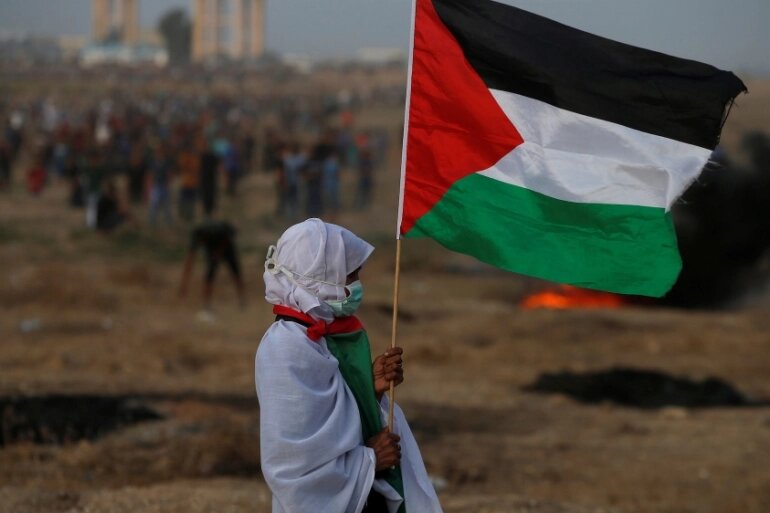
A woman holds a Palestinian flag during a protest demanding the right to return to their homeland, at the Israel-Gaza border fence in Gaza October 19, 2018 [File: Mohammed Salem/Reuters]
Credits: Al Jazeera, available at: https://www.aljazeera.com/opinions/2019/3/30/how-the-great-march-of-return-resurrected-palestinian-resistance
Since the 1948 Nakba, Palestinians have been resisting colonial aggression from Israel at the cost of risking their lives. Over the past decades, the intensity of violence by Israel appears to have been rapidly increasing. The Israeli aerial bombardment of Palestine, especially of Gaza, has claimed many lives of innocent Palestinians. For example, the 2008-09 air attacks and ground invasion by Israel led to at least 1,100 Palestinian deaths. The 2014 air attack and ground invasion resulted in the killing of 2,100 Palestinian civilians in Gaza. And the aerial, sea and land bombardment that happened weeks ago ended in the killing of 254 persons in Gaza, including 39 women and 66 children.

These numbers are important for revealing the extent of violence and brutality on Palestinians by Israeli occupation, but it should not diminish other aspects of the daily struggle of those Palestinians who live under siege and occupation of Israeli forces. Apart from these killings and air attacks, Palestinians resist, struggle against, and experience everyday aggression, restrictions, and sanctions that affect their economy, wellbeing, health, and every other aspect of their life. The most vulnerable among them are children and women. This piece thus focuses on the life and struggles in Gaza and learns from the lens and perspective of a Palestinian woman, Rana Shubair, whom I interviewed about her lived experiences of the conflict and life in Gaza.

Rana Shubair is a survivor of latest aggression of 2021 in the Gaza Strip. She is an activist, mother of three, and author of two books. Her first book ‘In Gaza I Dare to Dream’ recounts details of her own life under the Israeli Occupation and the Gaza Siege. She presents Gaza as “a land where joy and grief are entwined, yet its people dare to dream, dare to love and struggle to gain their basic human rights”. Her second book, ‘My Lover Is A Freedom Fighter’, is a historical fiction that reflects about romance in Palestine while living under occupation.

While her narrative and personal experiences are heartfelt and reflect the hardship of Palestinians in present, in this interview she also reveals how Palestinians express their agency and determine their resilience and their power of resistance. You can listen to the entire interview (in English) at Global Development Review Podcast or watch it here. A shortened version of the interview follows.

Jaffer: How do you experience of being mother in Gaza at present, and what does it mean to be a mother in Gaza?

Rana: A mother in Gaza is a hero. We are stereotyped in the Western world as having domestic roles, but this is not the case. Mothers, wives, daughters, sisters – they all have a critical role in the Palestinian society and Palestinian resistance. So when I first had my children, I had hoped that by the time they grew up, this occupation would have ended. But I found myself confronted with new realities and much harsher ones. I grew up under occupation, but it wasn’t as brutal as the occupation my kids and their generation are witnessing. Because there was no aerial bombardment at that time.

So as my children grew up, they started asking me questions that sometimes I couldn’t find answers to.

One of my most famous entries I wrote in my book is when my two daughters were arguing with each other. One was saying, “we live in Gaza” and other was saying, “no we don’t live in Gaza, we live in Palestine”. I overheard it and my heart was broken because my own kids who live in their own country don’t know where they are located. They think that Palestine is a foreign land. They learn about Palestinian cities in their schools. But they have never seen those cities and were never allowed to go and visit their own country. So there was this dilemma that if we are living in Gaza, if we are living in Palestine, how come we can’t see it? As a mother I have come across situations where I can’t explain to them why we can’t go there.

This was one issue. Another issue that they were faced with the issue of Palestinian prisoners. One day my son came and wanted to make a poster that teachers often ask children to do for extra credit. When he came back, he brought a poster that was about a girl Wafa who was recently released from Israeli prison. And my son asked me innocently why she went prison. So I had to explain why they were in prison.

When we are walking down on the street, we see pictures of martyrs that are pasted on the walls. And they would ask you who these people were. Then you would have to say them that they are martyrs and explain what a martyr is. So one day my son came home and said, ‘mom I wanna go and see the hole where they put the martyrs in’. I was really shocked, because I don’t know where he got the information from.

For me, you can’t prevent your children from going outside. And this is something that is very painful for us as parents and as mothers. They don’t go through the normal phases of childhood that other children go through. They can tell you what kind of warplane is flying over them or what kind of rocket or missile is being launched. So as a Palestinian parent, you have to be strong, you have to be resilient, and you have no choice. It’s a heavy burden that we shoulder.

Jaffer: When people’s houses are destroyed, where do they go?

Rana:  Those whose houses are targeted – the one that were recently targeted – were not as lucky as those who were prewarned. People living in the tall towers were warned. They could flee from their homes, some of them going to nearby relatives and some of them going to UNRWA schools (United Nations Relief and Work Agency Schools). And I believe that many of them took refuge in UNRWA schools because it is presumably safer, as it was assumed that Israel would not target a UN school. But in 2008 and 2014, Israel did target schools and they killed people who took refuge there. There is no safe place. If I want to leave my home and go to another home, it doesn’t mean that I am going to a safer place. Because what happened to two families that I know is that one of the women went to her parents’ house and she was killed there. So it’s like another displacement in the Gaza Strip and these people really have nowhere to go.

I would like to say that ordinary Palestinian life here is not ordinary. Israeli drones don’t leave our skies. And these drones are the surveillance drones, but they can also shoot and kill. So it’s not safe. So you think that it’s a surveillance drone, but a few years ago children were playing at the nearby park and they were killed and targeted by the drone on the spot. So by day and night, you can’t ignore the noise; you can’t pretend that it’s not there. I can’t really pretend that nothing is going to happen. So life here is very unstable and unpredictable.

Jaffer: As an international community, how can we support Palestine or how can we stand in solidarity with the Palestinians?

Rana: What I see is that the media outlets in the Western world is that they block the Palestinian narrative or twist the facts. So number one, I think we need to promote awareness about the Palestinian cause, no matter how small your role is. For me, connecting through this kind of online webinar or meeting between you and I is one way in which to do so.

In the recent attacks on Gaza, I have seen dozen of protests across the world, such as in America, in Britain, and even in Arab countries. They were people who responded to the protests and they are people who still protest to this day. And this is something that is very crucial. I think we have to keep making noise. Tell your government to keep making noise and keep being vocal about what the Palestinians are going through.


This article comes as a collaboration between Jaffer Latief Najar and Rana Shubair with an aim to spread awareness about the life and struggles in Palestine, especially Gaza. The collaboration was in the form of interview with Rana Shubair.

Opinions do not necessarily reflect the views of the ISS or members of the Bliss team.

About the author:

Jaffer latief Najar is a PhD researcher at International Institute of Social Studies, and Rana Shubair is a Palestinian survivor, activist and author of two books.

Are you looking for more content about Global Development and Social Justice? Subscribe to Bliss, the official blog of the International Institute of Social Studies, and stay updated about interesting topics our researchers are working on.


Tearing down the walls that colonise Palestine, a thousand bricks at a time

By Posted on 3105 views

Palestinians are showing enormous bravery during this moment of horror. The walls of intimidation and despair that Israel has erected in the minds of Palestinians to prevent resistance are being torn down. Now that everyone has seen that Palestinians will no longer be silent , we need the rest of the world to respond with corresponding acts of courage and support, tearing down the wall of silence, inaction and complicity so Palestinians can finally enjoy freedom, justice and equality.

A man waves the Palestinian flag for Eid al-Fitr prayers at the Dome of the Rock Mosque in the Al-Aqsa Mosque compound in the Old City of Jerusalem, Thursday, May 13, 2021. (AP Photo/Mahmoud Illean)

Yesterday, without prior warning, a close relative of mine, 84, experienced an eruption of long-suppressed memories of his traumatic childhood during the 1948 Nakba and was overcome by mixed feelings of ominous fear and liberating hope. While unbearable, the images of the latest massacre of Palestinians in the besieged Gaza Strip did not bring him to this emotional tipping point, nor did the images of the brutal repression of worshippers in the Al-Aqsa mosque compound or the relentless forcible displacement of Palestinians in Sheikh Jarrah and around occupied East Jerusalem.

What did was the view, from his little balcony in Akka (Acre), of young Palestinians struggling to fend off a mob of far-right Jewish Israelis roaming the streets, chanting “death to Arabs”, and hunting Palestinians to lynch. The same thing happened to indigenous Palestinian communities in Lydda, Jaffa, Ramleh, Haifa, Bat Yam and in other places, triggering calls for international protection.

As my relative looked on, memories of his beloved Haifa in 1948 gushed through his mind – of Zionist militias aided by British soldiers literally chasing Palestinians at gunpoint to the sea. Of the makeshift raft his family had to board, heading to Lebanon ‘for safety’. Of his father’s wise decision to disembark in Acre instead.

Yet, even as these memories filled his mind – memories of existential fear and the trauma of vulnerability – they shared space with a new and inexplicable hope. “My generation lost Palestine,” he said. He then continued with a defiant inflection and a smile: “But this new generation is courageous, resilient, determined to resist and to overcome 73 years of our ongoing Nakba. All they… I mean, all we need is some, just some, more courage from the world.”

Cracks in the walls that colonise the mind

It is not naïveté or fatalism that gives hope to my elder relative or the Palestine diaspora. It is the fact that the dual walls that Israel has so systematically erected over decades – the walls it is truly trying to ‘guard’ – are showing some serious cracks, if not beginning to topple. The first of these walls is Ze’ev Jabotinsky’s ‘iron wall’ of despair that has colonised Palestinian minds. The second, just as inhibiting and debilitating, is the wall of intimidation that inhibits many people of influence worldwide from speaking out for Palestinian rights.

In 1923, Jabotinsky, a prominent Zionist leader, theorised the necessity of the first wall: “Every native population in the world resists colonists as long as it has the slightest hope of being able to rid itself of the danger of being colonized…. Zionist colonization must either stop, or else proceed regardless of the native population.” He recommended an ‘iron wall’ to overpower the native Arab Palestinian population, partly by colonising our minds through instilling a sense of hopelessness and making us internalise a sense of inferiority, as Frantz Fanon puts it. Decades later, and backed by the United States and the European Union, Israel had built concrete walls and employed its Dahiya Doctrine (a doctrine of extreme, ‘disproportionate’ violence targeting Palestinian – and Lebanese – civilians and civilian infrastructure) precisely to sear into our collective consciousness the futility of resisting its colonial hegemony.

As for the other wall, Israel and its lobby groups have invested massive resources in building it in the minds of opinion-shapers globally, especially in the West, making the price of dissence, of defending Palestinian rights, ruthlessly painful to one’s career, reputation, and even mental health. Analysing this wall, Edward Said explained how ‘avoidance’ and “fear of speaking out about one of the greatest injustices in modern history [Palestine] has hobbled, blinkered, muzzled many who know the truth and are in a position to serve it.”

Cracks in both walls have started to widen under pressure from fearless Palestinian popular resistance across historic Palestine and the corresponding courage that Hollywood celebrities, prominent musicians, star athletes, and millions of activists worldwide are displaying in standing up against the injustice. The bravery of Palestinian families in Sheikh Jarrah defending their homes against forcible displacement is among the factors inspiring tens of thousands of other Palestinians to participate in acts of civil disobedience. The same Palestinian bravery was visible in the thousands who defended the occupied Old City of Jerusalem against a ‘pogrom’ by Israeli ‘Jewish fascists’ – a pogrom, moreover, encouraged by government officials expressing “racist, even genocidal animus towards Palestinians” – as the progressive Jewish American group If Not Now described it.

This bravery has inspired an outpouring of support across new and vital parts of the US landscape. Expressing a growing sentiment in the US Congress, and connecting military funding to Israel with social and justice struggles at home, representative Cori Bush said, “The fight for Black lives and the fight for Palestinian liberation are interconnected. We oppose our money going to fund militarized policing, occupation, and systems of violent oppression and trauma… we are anti-apartheid. Period.” Susan Sarandon tweeted, “What’s happening in Palestine is settler-colonialism, military occupation, land theft and ethnic cleansing.” Halsey wrote, “It is not ‘too complicated to understand’ that brown children are being murdered + people are being displaced under the occupation of one of the most powerful armies in the world.” Viola DavisMark RuffaloNatalie Portman, and many others expressed solidarity with Palestinians.

These cracks, which shatter much of the silence that Palestinians have often witnessed, reflect the cumulative, creative, and strategic efforts exerted over years by Boycott, Divestment, and Sanctions (BDS) and other Palestine solidarity campaigners around the world, including those by progressive Jewish groups. A 2018 US poll for instance shows that 40 percent of Americans (56 percent of Democrats) support imposing sanctions or more serious measures on Israel to stop its occupation.

A particularly important source of Palestinian hope is the growing impact of the Palestinian-led nonviolent BDS movement, which aims to end Israel’s regime of military occupation, settler-colonialism, and apartheid and defends the right of Palestinian refugees to return home. Sovereign funds in NorwayLuxembourg, the NetherlandsNew Zealand, and elsewhere have divested from Israeli or international companies, and banks that are implicated in Israel’s occupation. Mainstream churches in South Africa have endorsed BDS, while major churches in the United States, including the Presbyterian Church and the United Methodist Church, have divested from complicit US companies and/or Israeli banks. The city of Dublin in 2018 became the first European capital to adopt BDS, while tens of other cities and hundreds of cultural institutions and public spaces across Europe have declared themselves Israeli Apartheid Free Zones. BDS has won the endorsement of major international trade union federations in South AfricaLatin America, India, Europe, Canada, and the United States. Thousands of artists, academics, and hundreds of student governments, LGBTQI+ groups, and social justice movements across the world have also endorsed BDS accountability measures.

The main contribution of the BDS movement to Palestinian liberation, however, is its role in decolonising Palestinian minds from deep-seated powerlessness, and in leading a radical praxis of globalised, intersectional resistance, transformation, and emancipation.

Today, more than ever, Palestinians are telling the world that true solidarity with our struggle for freedom, justice, and equality spells out BDS. We are shattering our wall of fear every day, and we need not just “some more courage”, as my relative from Acre said, but an eruption of meaningful solidarity that ends all complicity in Israel’s oppression.


This article was edited by Lize Swartz. The original appeared here.

Opinions do not necessarily reflect the views of the ISS or members of the Bliss team.

About the author:

Omar Barghouti is a Palestinian human rights defender and cofounder of the Boycott, Divestment, and Sanctions (BDS) movement for Palestinian rights, former ISS Visiting Research Fellow. He is corecipient of the 2017 Gandhi Peace Award.

Are you looking for more content about Global Development and Social Justice? Subscribe to Bliss, the official blog of the International Institute of Social Studies, and stay updated about interesting topics our researchers are working on.


What can we do as Palestine burns?

By Posted on 5345 views

It is May 2021. Once again, Palestine is burning. Again, the US- and EU-funded Israeli military machine is in full throttle and again, the US – now led by Joe Biden – persistently blocks a UN Security Council Resolution, even to call for a cessation of violence. I am again writing, the latest of dozens of articles, feeling hopeless as people are killed and most of the world remains silent. I ask myself, again … what can I do?

Picasso’s painting of Guernica 1(937) with Palestine colours

In the weeks leading up to the violence that is now shaking Palestine, there has been “fear and fury” in Jerusalem. The pro-settler group Nahalat Shimon has been using lawfare to try and evict Palestinians from their homes in the neighbourhood of Sheikh Jarrah (at the time of writing, the case was on appeal to the Israeli Supreme Court). And the violence has spread across the country. Jewish-Israeli mobs have roamed the streets of the “multicultural” towns of Acre, Haifa and Lod, searching for those who are Palestinian – or who look “Arab” – dragging them from their cars and homes, and in one case beating an Arab man on live television. A smaller, but totally unacceptable number of Jewish civilians have also been killed in the mob violence.

Other mobs of Jewish-Israelis roamed through streets, chanting “death to Arabs” and smashing up storefront windows of Palestinian-owned shops in scenes that the organisation Jewish Voices for Peace described as reminiscent of the Nazi-led Kristallnacht.

Also in May, a massive crowd of Jewish-Israelis celebrated in the square outside the Western Wall, celebrating Jerusalem Day, gazing above the square as Palestinians fled a violent police raid of the Al Aqsa Mosque compound, one of the holiest places in Islam, during Eid-al-Fitr.

Netanyahu has firmly declared that he would “bring back sovereignty to Israel’s cities with an iron fist, if necessary”. The latest round of violence is no doubt a welcome distraction for the Israeli strongman who has been on trial in Israel for corruption and continually unable to form a government, leading to the country’s fourth election in two years.

And as if that were not horrifying enough, Gaza, too, is in flames – again. The territory is already struggling with a humanitarian crisis in the midst of a 15-year-long Israel siege of the territory. Enraged by the violence in Jerusalem at one of Islam’s holiest places, Hamas militants began launching mostly homemade rockets into sparsely populated Israeli towns. While the majority of the bombs were destroyed by sophisticated missile defence systems provided by the US government, some have managed to make it through. As of 13 May this year, a total of seven people – six Israelis and an Indian national – had reportedly been killed, including an Israeli child. There have been reports of Israelis fleeing with their terrified children to bomb shelters and safe rooms.

The Israeli military – the most technologically advanced on Earth – responded with its usual, brutally terrifying force, which Netanyahu vowed to continue. Once again, Israel’s massively well-armed military has targeted densely-populated civilian areas. By 13 May, the numbers of dead Palestinians was reported to be 113, the large majority of whom were civilians. According to the United Nations relief agency OCHA, these numbers include 14 Palestinian children.

So how did this all start?

To understand how this latest bout of violence started, one needs to face what facilitates these kinds of eruptions of violence, time and again. There are four points we need to understand, two of which squarely point to Israel, and two that point to the rest of the world.

First, Israel is a settler-colonial regime and the majority of Palestinians living in Gaza are refugees and their descendants. Some regard this regime as having started in 1967 when Israel occupied the territories of Gaza, the West Bank and East Jerusalem; others see this as having begun in 1948 when Israel unilaterally declared its independence after ethnically cleansing the territory of hundreds of thousands of Palestinians and refusing them to return to their homes and livelihoods. One could go back even further than that, and certainly to the end of the first World War, when Ottoman Rule ended and Britain was designated to administer Palestine and prepare the territory for independence. This never happened. Regardless of when one considers this regime to have started, the main point is that it continues and expands until this day.

Second, Israel is an apartheid regime, both in the Palestinian territories that it continues to belligerently occupy and administer in a grossly unequal way that Al Haq, B’tselem, Human Rights Watch, and the United Nations in a difficult-to-find report all describe as a situation of apartheid. Apartheid also exists in Israel itself, as affirmed in 2018 with a racist Nation-State Law that affirmed Israel as a homeland for Jews and Hebrew as the only official language (Arabic used to be included); it is described as a system of exclusionary constitutionalism.

Third, Israel is persistently supported, particularly by the European Union and the United States. Despite an International Criminal Court investigation of reported war crimes and crimes against humanity now taking place, US and EU support remains unwavering, including USD 3.8 billion of military aid that the US provides every year, which is more than its entire combined aid budget for every other country in the world.

Finally, there is widespread ignorance, with citizens and politicians confused by media reporting that – in its well-intended, but misguided efforts at “balance” – ends up favouring an Israeli perspective.

So, what can we do?

Hopelessness tends to lead to inaction. It is the human condition to turn a blind eye when the situation is just too awful, confusing, or far away. However, as Angela Davis powerfully reminded us in a statement posted on 17 May, people in the United States did not remain silent when George Floyd was killed from a police officer putting his knee in Floyd’s neck. And people should not remain silent now as Palestinians – and Israelis – have their lives cut short by yet another wave of violence. Davis condemned not only the violence in Israel and Palestine, but condemned the Biden-Harris administration for their complicity in it.

Clearly, the violence should stop immediately, and there should be justice, but what can those of us in The Hague, New York, Johannesburg, Buenos Aires, Karachi or Kuala Lumpur do?

First of all, recognise that this is not an even-sided conflict. It is massively asymmetrical.  Unlike Israelis, Palestinians in Gaza and the West Bank have no bomb shelters or sophisticated missile defence systems. They have no drones or fighter aircraft. In Gaza especially, which has been described as an open-air prison, people not only have nowhere to go; they rarely even have electricity, potable water or food nowadays due to the Israeli siege of Gaza that has been going on, and deepening, since 2016.

Second:  voice your anger and concern to family, friends, neighbours, and elected representatives. Let Palestinians tell their own story. Share the music of Shai Zaqtan of Nai Barghouti and others. Post your outrage on social media and make it visible in street protests. As the corona lockdown eases in many parts of the world, speak to others, including at community centres and in places of worship.

Finally, do what you can in your individual and professional capacity to support the Palestinian call for #BDS = Boycott, Divestment, and Sanctions.

Update: Since the article was initially drafted, the United Nations and Save the Children reported that “58 children[i] in Gaza and two children in southern Israel have been killed in the last week. More than a thousand people in Gaza, including 366 children, have also been injured.” Source, OCHA. At the time of the “ceasefire” on 20 May 2021, this figure was revised to “at least 232 Palestinians, including 65 children, who have been killed in the Israeli bombardment. On the Israeli side, 12 people, including two children have been killed.”

Opinions do not necessarily reflect the views of the ISS or members of the Bliss team.

About the author:

Jeff Handmaker

Jeff Handmaker is a senior researcher at the International Institute of Social Studies (ISS) and focuses on legal mobilisation.

Are you looking for more content about Global Development and Social Justice? Subscribe to Bliss, the official blog of the International Institute of Social Studies, and stay updated about interesting topics our researchers are working on.


Seeds of resistance: Palestinian farmers fight against annexation and pandemic

The violent Israeli encroachment and annexation of Palestinian land is compromising the future of the West Bank and putting its residents in an extremely vulnerable position. Palestinians are resisting both annexation and the Covid-19 pandemic by returning to their land and cultivating it, with the support of social justice movements. A concrete example of their contribution to Palestine’s rich agrarian heritage is a seed bank, whose hardy indigenous seeds are feeding people in the short term and protecting the climate and defending territory for generations to come.

Olives in the hand of an old woman
Image Credit: Salena Tramel

It has not been an easy year for Palestinians, if there ever was such a thing. With the turn of a new decade in January, the U.S. administration unveiled the paradoxically branded calling for Israel to unilaterally annex about a third of the West Bank. Then the coronavirus slipped through the checkpoints into Bethlehem in March, sending millions of Palestinians into lockdown. And in April, Israel formed a unity government with an eye on the immediate annexation of the Jordan Valley in direct violation of international law.

The land grab is set to be pushed through this month, and many Palestinians worry that it could go largely unnoticed as the world’s attention is focused squarely on defeating the Covid-19 pandemic and curbing its economic fallout.

Palestine is often presented as an anomaly in global politics. Apologists of the Israeli occupation of the Palestinian territories have been able to effectively present a narrative of exceptionalism by emphasising the relatively small size of this hotly contested corner of the Mediterranean, insisting that there are irreconcilable religious divisions. The fight against Covid-19 points to similar dynamics as the Israeli government has received lavish praise for its response to the pandemic within its own borders while letting it spill over into the occupied territories essentially unchecked.

In the context of crisis that has recently been compounded by the looming annexation plan and the health threats presented by the pandemic, social justice movements in the agricultural sector have elevated their struggles to new levels. Key among these endeavours are the protection of natural resources such as land, water, and seeds, as well as the ongoing struggle for the recognition of multiple forms of Palestinian sovereignty.

“Our response to the coronavirus pandemic has been to urge our people to go back to their lands and cultivate,” said Amal Abbas* of the Union of Agricultural Works Committees (UAWC), a small-scale food producers’ movement representing some 20,000 peasant farmers and fishers in the West Bank and Gaza. This Palestinian version of sheltering in place mirrors UAWC’s broader strategy of resisting occupation and annexation, work that it has been doing since 1986.

Settler colonialism, the invasive process that seeks to replace an indigenous population with an external one, has its own Kafkaesque set of rules upholding it in the Israeli legal system. An important example of this is a law that stipulates that if land is not worked for three years, it automatically becomes [Israeli] state land. The Israeli military has gone to great lengths to fold as much “idle” Palestinian land as possible into the architecture of the state. This law is used in part to justify the establishment and expansion of illegal Israeli settlements by means of violent evictions, home demolitions, the confiscation of cultivated agricultural land, and the separation wall.

Palestinian human rights defenders are working to flip this narrative and the overarching political project it sustains on its head. Farmers and rural workers in the West Bank and in the Gaza Strip—just like anywhere else—have been longstanding agents of social change, and for this reason are among the most targeted sectors of Palestinian society.

This slow form of violent encroachment, together with the fast-tracked one of annexation that is on the Israeli parliamentary table with strong U.S. support, puts the future of the West Bank and its residents in an extremely vulnerable position. “The Israeli military has been taking advantage of our current emergency situation and accelerating its actions,” offered Amal.

Some of the most egregious actions taken by Israeli authorities in the current context of pandemic have occurred in the Jordan Valley, which is precisely the area they seek to annex. This area already falls under the classification of Area C, meaning that it is part of the more than 60% of the West Bank that is under full Israeli civilian and military control. Perhaps unsurprisingly, Area C is rich in natural resources such as underground water and fertile growing land. Not only is the Jordan Valley the unequivocal agricultural jewel of Area C, but it is also a strategic border with Jordan and a gateway to the Arab countries of the greater Levant.

Public services are in short supply for the Jordan Valley’s majority Bedouin population. That is why movements of farmers and workers like UAWC are filling that gap, providing basic services like water, sanitation, education, seeds, food, and nutrition. Even these services face relentless and aggressive opposition. For instance in late March, the Israeli military destroyed an emergency coronavirus field clinic that Palestinians were in the process of erecting in the northern Jordan Valley.

Despite these threats, UAWC and other Palestinian grassroots organisations visit elderly people and pregnant women in mobile clinics, distribute educational and protective supplies, and construct rooftop and urban gardens across diverse communities. This coronavirus crisis response work has largely been successful because it is a reflection of the kind of work Palestinian social movements continually engage in throughout the ongoing crises that occur under military occupation.

“Some of the best work that we are doing to fight off the virus and resist the annexation is through our seed bank,” said Amal. UAWC has maintained a seed bank since 2003; in it they safeguard rare heirloom Palestinian seeds that have been carefully passed down from one generation to the next. These seeds and the food sources they produce have a multiplicity of purposes. “Not only do our indigenous seeds make it easier to return to our land and protect it through cultivation,” Amal explained, “they hardly use any water and shield us from climate change.” She added: “And with so many still locked down because of Covid-19, continuous access to seeds allows people to feed their families and neighbours when it is unsafe to access food via the marketplace.”

UAWC insists on the importance of internationalism and solidarity in normalising the plight of the Palestinian small-scale food producers it represents. It is a member of the international peasant movement La Vía Campesina, which has taken a strong stand against colonialism and corporate control of agriculture and is active in 81 countries. Maintaining that important political relationship has allowed Palestinian activists the opportunity to host learning exchanges in their territories and also participate in those that take place abroad.

“Together with La Vía Campesina, we are using this opportunity to prove to the whole world that the global health care and food systems are not working and put forth our solution of agroecology as an alternative to the neoliberal model,” Amal explained.

Our contributions to the food sovereignty movement as Palestinians can help people understand that the occupation is about control over natural resources just like most other land grabs – Amal

Certainly, the militarised Israeli conquest of Palestinian territory has its own history, but it is also indicative of settler colonial processes that have taken place elsewhere, such as in the Americas, Australia, and South Africa. As this next phase of annexation plays out in the West Bank, against the distracting backdrop of the pandemic, these connections are critical. Far from an anomaly of the global politics of natural resources, Palestine has encapsulated them in a microcosm.

* Name has been changed to maintain confidentiality

This article was originally published on Open Democracy and has been reposted with permission of the author.

About the author:

Salena TramelSalena Fay Tramel is a journalist and PhD researcher at the International Institute of Social Studies (ISS) in The Hague, where her work is centered on the intersections of resource grabs, climate change mitigation, and the intertwining of (trans)national agrarian/social justice movements.

Misleading narratives distort antisemitism discourses

By Posted on 4530 views

Bigotry, in all its forms, is steadily rising. Clearly, being non-racist is not enough; we need to be anti-racist to be able to combat race-related bigotry once and for all. This principle should indeed apply to all forms of bigotry, including antisemitism. However, as this article explains, misleading narratives in the documentary film Viral: Antisemitism in Four Mutations distort our understanding, and even serve as a cover, for other forms of intolerance, which can move us closer to bigotry instead of further away from it.

Anti-black racism, antisemitism, Islamophobia and other forms of bigotry are on the rise in Europe and elsewhere in the world, according to annual reports of the European Commission Against Racism and Intolerance. As a result, people are rising up in protest through #BlackLivesMatter and other movements. The global outcry and calls for change following the police killing of George Floyd vividly reveals just how prevalent racism still is. Yet, it is also clear how some organizations purporting to challenge such hate crimes can use an anti-racist message as “cover” for other forms of bigotry and intolerance, as a recent documentary has also done.

Antisemitism in films and documentaries

In cinematography, antisemitism, like other forms of bigotry, often has been afforded special attention. As a Jewish youth growing up in my congregation, I watched many of these movies dealing with antisemitism—from classics such as Ben-Hur (1959) to the more recent Schindler’s List (1993). One of the most recent and acclaimed documentaries I saw was the bold 2009 film Defamation by Israeli film-maker Yoav Shamir. I was therefore curious about how antisemitism was dealt with in the recently released documentary Viral: Antisemitism in Four Mutations by the American film-maker Andrew Goldberg. However, I felt very dispirited after watching it. Rather than meaningfully addressing the very real problem of antisemitism in the world, this documentary reproduces misleading narratives that distort discourses on antisemitism.

In this article, I will explain how the film-maker argues that there is a moral equivalence between four different forms or “mutations” of antisemitism and what’s wrong with this conceptualization of it.

Four “mutations” of antisemitism

Viral: Antisemitism in Four Mutations attempts to show how four different examples of antisemitism manifest in present-day society and the “logics” that purportedly drive antisemitism. The documentary is intended to provide what the film-maker regards as an honest view of antisemitism, but is so unbalanced that it ends up having the opposite effect.

In Part I of the movie, the focus is on the Far Right in the USA. After very moving, personal testimonies by victims of various violent antisemitic attacks, the documentary turns to an interview with a Mr. Walker, who is running for the state legislature in North Carolina. Walker insists that “God likes whites more than blacks”, argues that black persons and Muslims are the same, and finally reproduces a typical antisemitic conspiracy trope that “the Jew was created to destroy white Christian nations”. George Will, a prize-winning Washington Post columnist, then sums up the perverse “logic” behind antisemitism: “In a healthy society that has problems, people ask ‘what did we do to cause this’? In an unhealthy society that has problems, they say ‘who did this to us’? And the Jews are always a candidate.”

In Part II, the focus is on a smear campaign by the right-wing, nationalist president of Hungary, Victor Orban, aimed at the liberal Hungarian-American businessman and philanthropist George Soros. Classic antisemitic tropes are invoked, presenting clear examples of antisemitism through the use of grotesque cartoons and photoshopped images of Soros with exaggerated Judaic features. Moreover, the Hungarian media juxtaposes images of Muslims entering the country against accusations that they are “inundating your culture” and, moreover, are part of a “Soros plan”. Posters, billboards and television ads all reinforce these patently antisemitic and Islamophobic messages.

I am disgusted. However, something crucial is missing. While examples of antisemitism by Orban and others in his government are well established, paradoxically, as one interviewed professor notes, Orban does not want to be accused of antisemitism. Indeed, “he wants to pose with ‘them’—he even wears the hat”. Why is it, then, that Orban, his political party and the Hungarian government crudely reproduce antisemitic tropes while simultaneously object to being called antisemitic? The film-maker doesn’t address this crucial issue at all, also avoiding Orban’s very public cultivation of diplomatic ties with the State of Israel.

Further omissions are apparent in Part III of the film, which purports to focus on antisemitism among the “Far Left” in the United Kingdom. There is no mention of antisemitism within the Conservative Party. The focus is squarely on the Labour Party. The accusation is that Labour’s alleged antisemitism problem is due to “left-wing extremists” who condemn capitalism, criticize Israel and therefore by definition are antisemitic. This is both highly unconvincing and inflammatory, reinforced by interviews with embittered former Labour members who are also vocal supporters of Israel (and neo-liberal economic policies), such as former Labour leader Tony Blair.

Totally unaddressed are what these so-called “left-wing extremists” criticize, namely Israel’s discriminatory and brutal policies against Palestinians that have been labelled as an “apartheid regime”. While maintaining its thin claims against “leftists”, the film-maker fails entirely to engage with the many critics of these claims, such as Jamie Stern Weiner or Mehdi Hasan. Or with a comprehensive report on distorted media coverage of the Labour Party by Dr. Justin Scholsberg of Birkbeck College and journalist Laura Laker. Or with the book Bad News for Labour: Antisemitism, The Party and Public Belief by award-winning journalists and academics Greg Philo, Mike Berry, Justin Scholsberg, Antony Lerman and David Miller. To name but a few.

Part IV focuses exclusively on what the filmmaker describes as “Islamic radicalism” in France. The primary perpetrators of antisemitism, it is claimed, are “Islamic extremists”. Brief reference is made to what is described as “France’s colonial experiment”, which led to hundreds of thousands of Muslims to move to France. The implication is that those suffering from “post-colonialism” have a problem. Rather than acknowledge the country’s expansive Islamophobia, the film-maker plays directly into it, asserting that, based on “surveys”, one-third of Muslims in France are antisemitic, as compared with ten percent of non-Muslims. The suggestion that Muslims are far-more inclined than anyone else to hate Jews is both unsubstantiated, based on anecdotal examples and utterly fails to address the historical context of both antisemitism and Islamophobia.

 Time for a serious discussion about antisemitism

As the film does reveal, there is clearly a problem of antisemitism (as well as Islamophobia, racism and other forms of bigotry and intolerance), deserving of a serious discussion. However, the film is so filled with distortions that it doesn’t help to really understand, let alone combat this problem.

The film’s fatal flaw, noted elsewhere by Michelle Goldberg, is its conflation of criticisms of Israel and antisemitism. Indeed, this becomes a conspiracy theory of its own that “people hate Israel because they simultaneously hate the Jews, capitalism, and Western democracy”. Moreover, by interspersing credible examples of antisemitism with highly questionable examples, the selective treatment of these four “mutations” and the drawing of a moral equivalence between them critically undermine the very important goal of addressing antisemitism.

The need for critical reflection

The global fight against bigotry must be taken seriously. Hence, a serious and balanced documentary about antisemitism would be something different entirely. It would acknowledge the context of antisemitism as being part of a broader pattern of hatred, intolerance and discrimination affecting many persecuted groups. It would include constructive criticism of the film-maker’s assumptions. And finally, it would not make simplistic and distorted assumptions that critics of Israel’s expansionist, colonial and discriminatory regime are de facto antisemitic.Jeff Handmaker

About the author:

Jeff Handmaker is a senior researcher at the International Institute of Social Studies (ISS) and focuses on legal mobilisation.

He is a regular author for Bliss. Read all his posts here. 

Legal mobilization to end impunity for international crimes by Jeff Handmaker

In 2014, on the 20th of July, the Israeli military targeted and bombed a home in a refugee camp in Gaza, killing several family members of Saad Ziada, including his mother and three brothers. Since this day, Mr. Ziada, a Dutch citizen and resident of the Netherlands, has persistently been seeking justice through legal mobilization. Ziada’s search for justice reveals the immense challenges faced by individuals and organizations seeking to hold individuals accountable for international crimes through different forms of legal mobilization.


It hasn’t been an easy journey. Ziada’s family were some of the 2000 killed, overwhelmingly civilians, during this large-scale Israeli military operation, which was extensively documented by United Nations investigators as well as representatives of Palestinian, Israeli and international human rights organizations. Numerous reports, including extensive dossiers that have been submitted to the International Criminal Court in The Hague as part of a preliminary examination, allege that international crimes were committed during Israel’s 2014 military operation.

Holding individuals accountable who were allegedly responsible in either Gaza or Israel has been a non-starter. The Israeli government has not even acknowledged that crimes took place, let alone pursued investigations against the alleged individuals responsible for those crimes. Ziada has therefore been compelled to seek justice elsewhere.

The most common response to any crime committed by an individual is prosecution in the country where the crimes took place. Obviously, this is an unrealistic prospect in a country that is led by a government unwilling to even acknowledge that such crimes took place. But international crimes have a special character.

International crimes are described in the preamble of the Rome Statute that established the International Criminal Court as “unimaginable atrocities that deeply shock the conscience of humanity”. Accordingly, multiple alternatives to prosecute international crimes have gradually emerged on the basis of what is described as “universal jurisdiction”. These alternatives include prosecution by the International Criminal Court or other specialized tribunal and prosecution in a “third country” that may have little to no association with the crime committed or the nationality of the alleged perpetrator.

The person who is prosecuted for international crimes doesn’t even need to have committed the alleged crimes themselves. For example, the Netherlands prosecuted the Dutch businessman Guus Kouwenhoven in relation to his complicity in war crimes committed in Liberia. In 2017, the Dutch Court of Appeal found Kouwenhoven to be criminally liable for his complicity in these crimes.

Alongside criminal jurisdiction, there is the possibility to sue an individual who is alleged to have committed an international crime for damages in a civil court. This is currently the basis of the case that has been brought to the Dutch District Court in The Hague by Ziada. The case is being brought against two Israeli military commanders who were believed to have ordered the bombing, including the former General Chief of Staff of the Israeli military, Benny Gantz, who has been campaigning to become president of Israel.

Universal jurisdiction received significant attention in our 2019 book Mobilising International Law for ‘Global Justice’, particularly in a chapter by Aisling O’ Sullivan. O’Sullivan argued how the struggle for ending impunity for international crimes is locked in a struggle between two competing approaches: on the one hand, there is a desire to hold individuals accountable for the most heinous of crimes; on the other, there is a desire to maintain order between nations which can be disrupted by these kinds of criminal trials. What further complicates matters are the different power positions between states and the tendency to give “deference to the interests of powerful states” (p. 180).

Universal jurisdiction was also the topic of a seminar that I co-organized in 2010 with Professor Liesbeth Zegveld, the outcome of which was contained in an ISS Working Paper. One of the key observations at this seminar was that “while some governments show a willingness to prosecute these crimes, others see this as a ‘problem’ and even advising their nationals / soldiers not to travel abroad” (p. 14).

What we observed then as a “relatively new area of the law” (p. 15) is now gaining currency, particularly in the courts of the Netherlands. Zegveld, who is also a prominent human rights lawyer, has represented several individuals and groups who have been seeking justice for international crimes committed against them and their loved ones. This includes the family of three men, including Rizo Mustafic, an electrician, who were killed during a massacre in the town of Srebrenica in Bosnia-Herzegovnia by Serbian military forces in 1995. A Dutch military contingent was part of a United Nations military force stationed in Srebrenica at the time and was said to have mostly stood by while the massacre took place. In September 2013, the Dutch Supreme Court confirmed that the Dutch military commanders were partly responsible for not taking sufficient action to try and prevent the massacre.

Apart from the obvious political sensitivities involved in holding individuals accountable for international crimes, these kinds of cases are incredibly complex, not least the challenges of gathering evidence to prove what happened. There are also various cultural and other challenges associated with international criminal justice, particularly through international criminal tribunals, which I have discussed in other academic work.

Zegveld represents Ziada in the case that will be heard on 17th September, 2019. Will the outcome of this particular case of legal mobilization further advance the struggle against impunity for international crimes? There can be little doubt that international lawyers, human rights groups and concerned individuals around the world will be awaiting the outcome of this hearing with great anticipation.


Image Credit: Palestine Justice Campaign


JeffHandmakerISS
About the author:

Jeff Handmaker is a senior researcher at the International Institute of Social Studies (ISS) and focuses on legal mobilisation.

He is a regular author for Bliss. Read all his posts here. 


Confronting Apartheid Through Critical Discussion by Ana María Arbeláez Trujillo and Jeff Handmaker

By Posted on 4227 views

The history of apartheid in South Africa is generally well-known. Yet, apartheid is not exclusive to that country. According to international law, and on various social grounds, Israel too may be viewed as maintaining an apartheid regime. What does apartheid mean and how has the international community confronted both South African and contemporary regimes of apartheid? This article takes up this discussion, reflecting on a recent event organised at the ISS.


On 11th April 2019, ISS hosted an event  to critically discuss the concept of apartheid and its application. Inspired by the work of known South African legal scholar Professor John Dugard, who addressed this event, he and other panellists went beyond the legal-historical origins of apartheid in South Africa and explored its relevance to the longstanding impasse between Israel and the Palestinians.[i]

Beyond the legal foundations of apartheid in South Africa and it becoming a crime in international law, the panelists explored the social impact of apartheid as separate development and how civic organizations and governments have resisted or maintained this situation.

Apartheid under international law

According to international law, the crime of apartheid, as defined by article 7 of the Rome Statute of the International Criminal Court, is a crime against humanity. It consists of:

inhumane acts (…) committed in the context of an institutionalized regime of systematic oppression and domination by one racial group over any other racial group or groups and committed with the intention of maintaining that regime.

The origins of this crime can be traced to the racialized legal regime established in South Africa from 1948 to 1990, although its definition is not restricted to that particular case. To the contrary, it is now an established position within academia, among civil society organizations, and UN agencies that the policies of Israel towards the Palestinian population also may be legally classified as an apartheid regime.

According to Dugard, Israel is more disrespectful of international law than South Africa was. He underscored that South Africa had accepted the importance of complying with norms of international law, yet argued that these norms were not applicable to the facts. By contrast, despite being party to several Human Rights Conventions that South Africa never was,[ii] Israel disregards the applicability of international law norms. This includes the Israeli government’s refusal to recognise the jurisdiction of the International Court of Justice, which in 2004 confirmed that the construction of the wall in the Occupied Palestinian Territory, the settlements and associated regime were contrary to international law.[iii]

So, how does one explain such a dismissive attitude towards international law? Both Dugard and Shawan Jabarin, who also spoke at the event, agreed that a combination of State complicity and lack of political will on the part of the United States and the European Union to ensure that Israel respected human rights and other sources of international law played a crucial role in perpetuating Israel’s domination of the Palestinian people.

As Jabarin further highlighted, although legally it is possible to argue that Israel’s occupation has many features of apartheid and colonialism, when assessing how the concept of apartheid applies in the Israel-Palestine territory, a purely legal analysis is insufficient. It is critical to consider political factors and the daily conditions that people face under the regime.

How nationality works in Israel-Palestine

Israel does not legally-recognise Israeli nationality. Instead, Israelis and Palestinians experience profoundly different conditions and enjoy different privileges, depending on their legally-mandated, privileged nationality as Jewish, or in accordance with more than 130 other officially-recognised nationalities. By disassociating the concepts of nationality and citizenship, Israel enforces a particularly strict regime of separate development. Ronnie Barkan, who also addressed the event, argued strongly that apartheid went beyond its application to Israel’s occupation of Palestinian territories, noting that not every Israeli citizen enjoys the same rights. In other words, the dual-layered legal framework of Israel privileges Jewish nationality, while excluding and/or neglecting the rights of everyone else.

Moreover, Barkan argued that Israel was built upon this sophisticated dual-layered framework that on the surface seemed like a democracy, but only protected the rights of a privileged national group. For example, although Palestinians are allowed to vote, only candidates who recognize Israel as a Jewish state are permitted to participate in elections. In this sense, the participation of Palestinians in the political system is only apparent in so far as it does not have the potential to modify power structures, or their living conditions.

Nationality also determines who gets access to land and who is allowed to live in certain areas. The blockade of the Gaza Strip and the West Bank, the establishment of settlements and the forced displacement of Palestinians from their villages are further examples of inhuman practices, through which Israel exercises its control.

All panelists agreed that the issue went beyond domination. The long term goal of Israel’s apartheid regime is not merely to exercise control over Palestinians, but to expel them from the land.

Responses to challenge apartheid

In July 2018, Israel issued the “Nation-State Law”.[iv] Among other measures, the law declares that Israel is a Jewish state, and that the only official language is Hebrew, whereas previously the second official language was Arabic. The law is by no means the first, but possibly the most blatant effort to entrench apartheid. Protests from civil society have been considerable, including a stepping-up of the Palestinian-led Movement for Boycott, Divestment and Sanctions (the BDS Movement) until Israel respects Palestinian rights.

As observed by the third panelist, Nieuwhof, the BDS Movement offers an action perspective, a tool to mobilize citizens to pressure governments and companies to support the Palestinian people. One of the early achievements of the movement, she noted, was a decision by the Dutch Bank ASN to divest from Veolia, one of many companies that has generated profits from the illegal occupation of the territory of Palestine.

All in all, the event was both timely and highly-relevant to the ISS research agenda on social justice. Regardless of one’s views, it is important to preserve spaces for discussions like this, which allow us to explore a critical perspective regarding one of the most relevant social justice issues of our time.

[i] In addition to Dugard, Ronnie Barkan, an Israeli human rights activist and founder of the movement Boycott From Within shared his perspectives, together with Adri Nieuwhof, a long-standing human rights advocate who worked from the late 1970s with the Holland Committee for Southern Africa and Shawan Jabarin, a Palestinian human rights advocate, Commissioner of the International Commission of Jurists (ICJ) and General Director of the Al-Haq.
[ii] Israel is signatory of the International Convention on the Suppression and Punishment of the Crime of Apartheid (ratified on 1973), the International Convention on the Elimination of All Forms of Racial Discrimination (ratified on 1979), the Convention against Torture and Other Cruel Inhuman or Degrading Treatment or Punishment (ratified on 1991), and the International Covenant on Civil and Political Rights (ratified on 1991).
[iii] Israel’s Supreme Court only partially recognised the ICJ’s ruling. See Susan Akram and Michael Lynk (2006) ‘The Wall and The Law: A Tale of Two Judgements’, Netherlands Quarterly of Human Rights 24(1): 61-106.
[iv] This was the subject of an earlier event, also organized at ISS.

Image Credit: © 2007 George Latuff. Wikicommons. Nelson Mandela, who spent 27 years in prison for fighting apartheid in South Africa, said that “our freedom is incomplete without the freedom of the Palestinians”.


About the authors:

Ana Maria ArbelaezAna María Arbeláez Trujillo is a recent graduate from the Erasmus Mundus Program in Public Policy. She is a lawyer and a specialist in Environmental Law. Her research interests are the political economy of extractivist industries, environmental conflicts, and rural development.

JeffHandmakerISSJeff Handmaker is a senior researcher at the International Institute of Social Studies (ISS) and focuses on legal mobilisation.

He is a regular author for Bliss. Read all his posts here. 


Distorted anti-Semitism allegations in UK’s Labour Party are a cover for Israeli apartheid by Jeff Handmaker

By Posted on 2916 views

On 18 February 2019, Luciana Berger and six other British Members of Parliament (MPs) left the UK Labour Party. The most prominent reason provided by the departing MPs, led by Berger, is that the Party had become ‘institutionally anti-Semitic’, due mostly – or so it would appear – to Labour Party leader Jeremy Corbyn’s outspoken criticisms of the Israeli government and military. As discussed in this blogpost, which draws on a longer article published on Mondoweiss, these allegations are both dangerous distortions of anti-Semitism and serve as a shameful cover for Israel’s regime of apartheid.


In the extensive reporting that followed the departure of the Labour MPs, a Spectator columnist alleged that this was the beginning of the end for Labour, while the Guardian claimed that the party faced an anti-Semitism crisis. It was hardly mentioned in any of this reporting that the seven Labour Party members who decided to leave were all closely tied with Labour Friends of Israel, an avowedly pro-Israel organisation. Berger is its former director.

A report by the Media Reform Coalition identified ‘myriad inaccuracies and distortions’ in the reporting of anti-Semitism claims against the Labour Party, which prompted a public statement by prominent journalists and scholars. Fomenting a strategy of disinformation is consistent with claims made by Jonathan Cook, a highly respected author and long-time journalist, who has established that the Israeli Ministry of Strategic Affairs has long been actively seeking to marginalise its critics through a range of measures.

But where did the anti-Semitism claim come from?

The IHRA Definition

The contemporary ‘debate’ over anti-Semitism within the Labour Party relates to August 2018, when pro-Israel members of the party proposed the incorporation of a highly controversial definition of anti-Semitism. Called the “Working Definition of Antisemitism” and drafted in 2016 by a group called the International Holocaust Remembrance Alliance (IHRA), the IHRA definition contains vague and dangerously far-reaching conflations of criticisms of Israel and references to the holocaust.

The lobby to incorporate the IHRA definition was fierce and unrelenting, largely led by Berger and others affiliated with Labour Friends of Israel. At the time of the August 2018 debate, there were even efforts to smear Hajo Meyer, a Jewish survivor of Auschwitz who had once spoken at a Labour Party rally where he made comparisons between the Nazi regime and his observations of Israeli policies. Meyer, an outspoken retired theoretical physicist, recorded his experiences in a moving memoir The End of Judaism: An Ethical Tradition Betrayed, published in 2012.

Steven Garside, a member of the UK Labour Party and Palestine Solidarity Campaign who strongly opposed the IHRA definition, maintained that erroneous allegations of anti-Semitism were in fact related to Corbyn’s harsh criticisms of the Israeli government and military. Ash Sarkar of the Sandberg Instituut condemned the move as a threat to free expression. Prominent human rights lawyer Geoffrey Robertson warned that the definition would suppress legitimate criticism of Israel while failing to cover genuine cases of anti-Semitism.

But despite these criticisms and warnings, Labour ultimately decided to incorporate the definition in full.

Since then, emboldened by the wide-ranging IHRA definition, groups such as Labour Friends of Israel and the Jewish Chronicle, with very little substantiation, have sought to equate criticism of Israel as “Jew hate”.

For liberal supporters of Israel, adopting the IHRA definition has been a crucial strategy. However, the true aim of such vacuous, yet highly damaging allegations is to avoid a critical dialogue on Israel’s policies of apartheid against Palestinians. Unlike South Africa apartheid, which from the 1960s became increasingly reported, understood and eventually condemned, Israeli apartheid has been shamefully underreported and is far less understood.

So what does Israeli apartheid look like?

The many forms of apartheid in Israel

Israeli apartheid takes many forms, whether this be the overt racism enshrined in Israel’s 2018 “Nation-State law” that discontinued Arabic as an official language, which is now being challenged in Court, or Israel’s continued blockade and bombing of Gaza (since 2005) that is currently the subject of a preliminary examination by the International Criminal Court.

Apartheid also takes the form of literally hundreds of insidious Israeli military orders, including Order 101 that makes it impossible for Palestinians to legally protest. Israeli regulations make it virtually impossible for Palestinians to build a home. This is due to the fact that Israel’s land and zoning regulations are, according to Israel’s Basic Law, oriented around “preserving” the land for Israel’s Jewish inhabitants.

But the most insidious manifestations of Israeli apartheid are the decades-long, everyday experiences of Palestinians. Farmers have to stand in long lines to reach their sheep in the agricultural village of Qalandia (that is surrounded by a high, concrete wall). School children in Hebron cannot walk to school without being stopped daily by soldiers at a military checkpoint to check the contents of their schoolbags. The UN Committee on the Elimination of Discrimination Against Women has heard numerous cases of official abuse against Palestinian women, including a seven-month pregnant woman assaulted at a checkpoint.

Given these examples, and much more, of Israel’s apartheid policies, it is exasperating that there is such a resistance to criticise Israel. And yet, this is exactly what happens. Liberal groups such as Labour Friends of Israel in the UK, Centre for Information and Documentation on Israel (CIDI) in the Netherlands and others repeatedly fuel the public’s outrage on anti-Semitism through disingenuous use of the IHRA definition, yet simultaneously maintain a silence that Israel’s policies amount to apartheid, not unlike the approach of like-minded liberal groups in Israel.

Apartheid cannot compete with a global social justice movement

Just as was ultimately the case in South Africa, neither Israel’s government, nor its most adamant, liberal supporters, can compete with a global social justice movement committed to ending Israel’s regime of apartheid. Rooted in equal rights claims, this movement is bolstered by growing judicial attention to Israel’s commission of war crimes and a highly successful, Palestinian-led global campaign of boycott divestment and sanctions (BDS).

The success of the BDS movement is acknowledge to have transformed the debate on Israel-Palestine. Indeed, as prominent Israeli journalist Gideon Levy has put it, BDS has been a true success story for the movement, succeeding to undermine Israel’s strongly cultivated image as a liberal democracy.

The conclusion that can be drawn from all this is that just like those who turned a blind eye for decades to apartheid in South Africa, the failure of Luciana Berger, Labour Friends of Israel, CIDI, and others to confront Israeli apartheid will place them all on the wrong side of history.


Image Credit: https://www.stopthewall.org/apartheid-wrong


JeffHandmakerISS
About the author:

Jeff Handmaker is a senior researcher at the International Institute of Social Studies (ISS) and focuses on legal mobilisation.

He is a regular author for Bliss. Read all his posts here. 


Resistance and persecution: fighting the politics of control by Salena Tramel

By Posted on 1534 views

Social justice movements from around the world are pushing back against a shift toward nationalism, extraction and environmental destruction. Those who resist increasingly do so at risk of great personal harm, arrest and indefinite jailing as political prisoners, or the criminalisation of their movements as a whole. Even so, the resistance not only remains steadfast, but is also steadily gaining strength.


Introduction

The rise of destructive and reactionary political power impacts people and ecosystems across many global settings. These shifts in control, characterised by a resurgence of racist and nationalistic rhetoric and policies, a redoubling of environmental exploitation and even climate change denial, and a renewed expansion into and pillaging of indigenous territory, represent urgent challenges for social movements and activists. Although these contemporary pressing issues have some distinctive new features, they are rooted in past forms of injustice, whether that be borrowing from the colonial playbook or amplifying the privatisation schemes of the more recent neoliberalism, such as free trade and deregulation.

At the same time, these are precisely the dynamics that cultivate resistance. Social justice movements from around the world are pushing back against this shift toward nationalism, extraction and environmental destruction. Those who resist increasingly do so at risk of great personal harm, arrest and indefinite jailing as political prisoners, or the criminalisation of their movements as a whole. Even so, the resistance not only remains steadfast, but is also gaining strength, in places as diverse as Brazil, Honduras, and Palestine—countries featuring violent, conservative, reactionary and acquisitive governments.

Power grabs in Brazil

Gaining political control starts with power grabbing—a concept to which the sprawling country of Brazil is no stranger. Power grabbing in the form of smashing intricate peasant leagues occurred during the military dictatorship, and it continues to this day. Most recently, the parliamentary coup that ousted a democratically elected president and relegated authority to an unelected and corrupt right wing was the ultimate seizure of power.

Under such corruption and disregard for democratic processes, social movements suffer even more intense criminalisation. This has often included the pre-emptive imprisonment and even assassination of peasant and indigenous leaders, most notably those connected to the Landless Workers Movement (MST) that is arguably the largest and most important state-level peoples’ movement in the Americas.

Nearly twenty-two years ago in April 1996, 19 activists from the MST were killed by the Brazilian military police in what would come to be known as the Eldorado dos Carajás massacre. Now, more than two decades after the massacre, the Brazilian government tends to treat activism—especially that which takes place in the countryside—as a criminal activity. Mining in Brazil, much like logging, is strongly opposed by peasant and indigenous movements as one of the greatest threats to the world’s largest rainforest while championed by the powerful nexus of state, business, and lobbies.

These massive power grabs contextualised within a definitive push for right-wing exclusionary populism have spelled trouble for seekers of social justice. The MST as a whole is increasingly criminalised and its members imprisoned. This is due in large part to the peasant movement’s relentless efforts towards agrarian reform, for which its activists can be arrested without evidence.

Resource grabs in Honduras

Power grabbing is indeed oftentimes connected to resource grabbing, yet another piece of the overall political dynamics of control. Although resource grabbing, in the form of taking away peoples’ rights to water and land, have been fixtures of injustice for centuries, this phenomenon has recently taken new shapes under globalisation. More specifically, powerful states and their militaries tend to prey on the weak points of former colonies for their own financial and political gains. As the case of Honduras warns us, when intertwined with power grabs, resource grabs become even more deadly—especially for those who resist.

Honduras, however, has vast alliances—peasant, environmental, feminist, LGBTQ, indigenous, Garífuna (Afro-indigenous), and labour struggles that engage in multiple forms of resistance, from land occupations to human rights documentation to interfacing with the state. The criminalisation of these movements and imprisonment of activists is routine.

In Garífuna communities along Central America’s Caribbean coast, the Black Fraternal Organization of Honduras (OFRANEH) has been at the forefront of resistance to what has become an attack on their ancestral resources and cultural identity from all sides: sea, water, land, and forest. OFRANEH uses organizing tactics from community radio broadcasts to land occupations, all of which the government has noted and responded to with violence. The group’s leaders face threats or instances of imprisonment on falsified charges on a daily basis. OFRANEH’s vice president Alfredo López spent six years in prison before finally being released for ‘lack of evidence’ and intense international pressure in 2015.

Control grabs in Palestine

In Palestine, power grabs and resource grabs have resulted in the ultimate manifestation of enclosure—control grabbing. First by British Empire, and then by Israeli occupation, Palestinians have been continually squeezed out of their homeland, and those who remain are subject to various forms of violence and discrimination.

The current hard-line political climate in Israel has increased the Israeli government’s stronghold on Palestinian lands. This amounts to territorial restructuring in the forms of illegal settlement expansion and transfer of Israeli citizens into occupied Palestinian territory, in the case of the West Bank, and increasing restricted access zones and militarised attacks, in the case of the Gaza Strip. These and other forms of control perpetrated by the Israeli occupation are likewise made possible and maintained through outside military and financial support.

Palestinian human rights defenders and social movements pose one of the biggest threats to maintaining and proliferating the occupation, a fact that has not been lost on the Israeli government. The result has been a trend of mass incarceration, including administrative detention, where people are held in prison for months or even years without charge or trial, supposedly because of ‘secret evidence.’ The Prisoner Support and Human Rights Association in Palestine, Addameer found that as of July 2017, 449 Palestinians were being held without trial or even charge.

One such political prisoner held without charge is Abdul-Razeq Farraj, a leader in the Union of Agricultural Works Committees (UAWC). Farraj has spent more than 16 combined years in Israeli prisons, most of them under administrative detention. Most recently, he was wrested from his home and family at midnight on May 24, 2017, and has been held without cause ever since. Abdul-Razeq’s work with UAWC has been focused on improving the lives of Palestinian farmers, whose suffering is in large part due to confiscation of land and water resources and repression under Israeli occupation.

Grabbing back

The struggles in Brazil, Honduras, and Palestine are indicative of politics of control—and resistance—that are happening all over the world. In Brazil, the coup government has chosen corporate-driven economic growth, privatisation, and corrupt politics through power grabbing rather than respect for democratic processes and the well-being of its low-income populations, particularly peasants and indigenous peoples. Honduras, a fragile state in the wake of a coup, bears the scars of external influence, and these wounds are most pronounced in the form of unchecked natural resource grabbing.

And in occupied Palestine, one of the world’s few remaining colonial projects continues with no end in sight; in the absence of statehood or any meaningful form of political sovereignty, the Israeli occupation has become the extreme expression of control grabbing. In each of these cases, oppressive states and business interests use a variety of tools of repression, from criminalisation and the creation of political prisoners, to physical threats and assassinations.

Winning back sovereignty and achieving justice are the political tasks at hand in these and other cases around the world, and ones that movements and activists take seriously—no matter how high the stakes. From Brazilian mass movement building to pinpoint alternatives and retain the countryside, to Honduran reclamation of natural resources through food sovereignty, agroecology, and climate justice, to relentless Palestinian efforts of upholding international law and defending human rights, people are challenging destructive political orders. Doing so is a collective act of resilience and resistance, ‘grabbing back’ in order to move forward in uncertain times.

What you can do

Grassroots International, a U.S.-based non-profit, supports small farmers and producers, Indigenous Peoples and women working around the world to win resource rights: the human rights to land, water and food. Grassroots works through grant-making, education, and advocacy. The Landless Workers Movement (MST), Black Fraternal Organization of Honduras (OFRANEH), and Union of Agricultural Work Committees (UAWC) are among its global network of partners.


The unabridged article originally appeared in Huffington Post and can be read here


picture_2Salena Tramel is a PhD researcher at the ISS, where her work is centered on the intersections of resource grabs and climate change mitigation, and the intertwining of (trans)national agrarian/social justice movements. In addition to her research at ISS, Salena draws on her global experience with social movements and grassroots organisations to inform her work as a policy and communications consultant and freelance journalist. Prior to joining the academic community at ISS, Salena served as the program coordinator for the Middle East and Haiti at Grassroots International, where she oversaw two key geographical areas while developing pro-poor advocacy strategies at the US/UN levels.