
 By
By On 17 October 2024, together with colleagues from various EUR faculties, another Teach-In was organized at the EUR Woudestein campus to address Israel’s aggression in Palestine and Lebanon. In this blog post, Isabel Awad and Jeff Handmaker reflect on the urgency of the current moment and the responsibilities of academics and educational institutions to respond.

Frustration at a lack of accountability and inaction
There is a palpable frustration across the EUR about the genocidal violence perpetrated by Israel and the absence of accountability for its actions, either from its international partners or via international mechanisms. The violence has directly affected our own academic colleagues/students, and their families. Their steadfastness has inspired us to keep this issue on the EUR agenda.
Since our event on 17 October, Israel’s aggression in Gaza was the subject of a UN report which experts concluded has the “characteristics of genocide”. Moreover, a football match between the Tel Aviv Maccabi and Ajax football clubs in Amsterdam have led to a week of heated violence as well as polarising political debates around a perceived wave of “antisemitism and even an “integration problem” in The Netherlands.
These latest developments have shaken our universities directly. On November 14, a nationwide protest in Utrecht against the Dutch government’s budget cuts in education was cancelled by the trade unions, following unsubstantiated allegations that a pro-Palestinian organization would threaten the safety of protestors. Student unions held a protest after all, facilitated by the Utrecht municipality, and drawing at least 1000 participants. The protest not only took place without any incidents, but was extended to also cover the right to protest. This, and other recent events have exacerbated the frustrations we observed during the Teach-In of October 17. They also underscore the need to process on-going horrors critically, avoiding moral equivalence and relativism. As humans, it is important to see the humanity in others, certainly without normalisation, and without “both siding” the conflict.
Amplifying a Palestinian and Lebanese narrative
The main speaker at the 17 October event was Rima Rassi, a lecturer of Sociology at American University in Beirut and also a doctoral student at the ISS-EUR. She joined us online.
Rima shared insights into her current reality, living under lockdown in Beirut with her family. She highlighted Israel’s massive escalation of violence in Gaza and Lebanon, including bombings, missile attacks and ground invasions.
As numerous scholars had warned already back in October 2023, Rima underscored how “we are witnessing ethnic cleansing and genocide in real time, streamed through the small bright screens of our smartphones, recorded through tweets and Instagram reels and TikTok videos”.
She quoted Lina Mounzer, a Lebanese writer: “we have discovered the extent of our dehumanization to such a degree that it’s impossible to function in the world in the same way”.
Rima’s powerful presentation made clear that understanding and amplifying the grossly under-represented Palestinian and Lebanese narrative is crucial.
This violence has a context
The attacks of 7 October and Israel’s genocidal violence that followed have a context, including a decades-long process of ethnic cleansing and forced displacement that started in the lead-up to 1948 (The Nakba), intensified in 1967 (with the occupation of Gaza, West Bank, Jerusalem and the Golan Heights), and through many wars since.
As the ICJ reiterated in a 2024 Opinion, which built on its earlier, 2004 Opinion, in this context there are clear responsibilities, not just for Israel, but for all states in responding to these atrocities. Moreover, as the ICJ has authoritatively underscored, there is a responsibility for all states, particularly those who have been lending diplomatic, financial and military support, to end their complicity and to hold Israel accountable.
Universities in the West cannot ignore the widespread destruction in Gaza including the killing of dozens of professors as well as hundreds of students and the destruction of university buildings and infrastructure. As we highlighted in an earlier Teach In with Dr. Maya Wind, we are witnessing a “scholasticide”, aimed at the total destruction of higher educational capacity in Gaza.
So how have we (as EUR) responded?
EUR staff and students have organised Teach-Ins, spoken to the media and written Op-Eds. We have nurtured parternships, within our faculties and student communities at the EUR, between colleagues and students at different EUR faculties, with colleagues at other universities in The Netherlands, and with colleagues at universities elsewhere, including in Palestine.
With empathy for the unimaginable suffering being experienced, those within the EUR community have checked-in on each other, and in particular those we know from Israel, Palestine and Lebanon. And we have centered the voices of Palestinians, which are so frequently silenced by the media, by the academy and by governments.
Students organised an encampment, renaming the space in front of the food court as Shireen Abu Akleh square, to honour the Al Jazeera journalist who was killed by the Israeli military in 2022. This renamed square on the Woudestein campus has been a frequent spot for protests and commemorations of all kinds. Events have been held on all four of our campuses: the Erasmus Medical Centre, EUC, ISS and on Campus Woudestein.
We also note how EUR has established an Advisory Committee on Sensitive Collaborations, which has yet to take a definitive decision in relation to the University’s partnerships with Israeli institutions and complicit companies. The Committee’s chair attended the 17 October event.
Who spoke, and who did not
Rassi’s talk received a standing ovation. In-depth responses to her talk came from an expert panel of EUR academics from Sociology (Dr. Irene van Oorschot), Law (Dr. Federica Violi), Epidemiology (Dr. Layal Chaker) and Media and Communication (Dr. Isabel Awad). These four EUR scholars underscored the importance of learning from Palestinian and Lebanese voices and of finding ways to turn knowledge into collective action against the ongoing genocide. ISS’ Dr. Jeff Handmaker moderated.
Two speakers from Birzeit University, a longstanding partner university of the EUR, were also scheduled to speak to us through Zoom. These were Ghaied Hijaz, a student and activist with the Right2Education Campaign and Dr Amal Nazzal, an Assistant Professor in the Business Administration and Marketing Department.
As organizers, we considered Hijaz and Nazzal closely connected to EUR, given their affiliation with an EUR partner institution. However, EUR administrators informed us that they were “external guests” who needed security clearance to speak at EUR, a process that required additional time. By the day of the event, only one of the Birzeit speakers was “cleared”. Out of protest and solidarity, the other speaker decided not to participate. The absence of their voices added to the frustration in the room about the frequent silencing of Palestinian perspectives in Dutch society.
Vigil
To close the event, as we did in a previous gathering remembering academics in Gaza who had been killed, a vigil was held to remember and pay tribute to the now more than 40.000 Palestinians killed, including more than 14.000 children. Together, at the Shireen Abu Akleh square, we lay flowers, and collectively recited a poem by Professor Refaat Alareer, formerly of Islamic University of Gaza who was killed in an Israeli airstrike on 6 December 2023, “If I Must Die”:
If I must die,
you must live
to tell my story
to sell my things
to buy a piece of cloth
and some strings,
(make it white with a long tail)
so that a child, somewhere in Gaza
while looking heaven in the eye
awaiting his dad who left in a blaze—
and bid no one farewell
not even to his flesh
not even to himself—
sees the kite, my kite you made, flying up above
and thinks for a moment an angel is there
bringing back love
If I must die
let it bring hope
let it be a tale.
Opinions expressed in Bliss posts reflect solely the views of the author of the post in question.
About the authors:
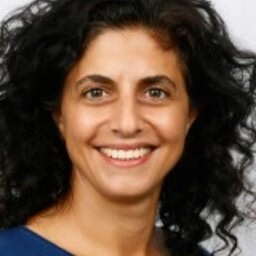
Dr. Isabel Awad is Associate Professor in the Erasmus School of History, Culture and Communication.

Dr. Jeff Handmaker is Associate Professor in the International Institute of Social Studies, both at Erasmus University Rotterdam.
Are you looking for more content about Global Development and Social Justice? Subscribe to Bliss, the official blog of the International Institute of Social Studies, and stay updated about interesting topics our researchers are working on.
Discover more from Bliss
Subscribe to get the latest posts sent to your email.
What do you think?